

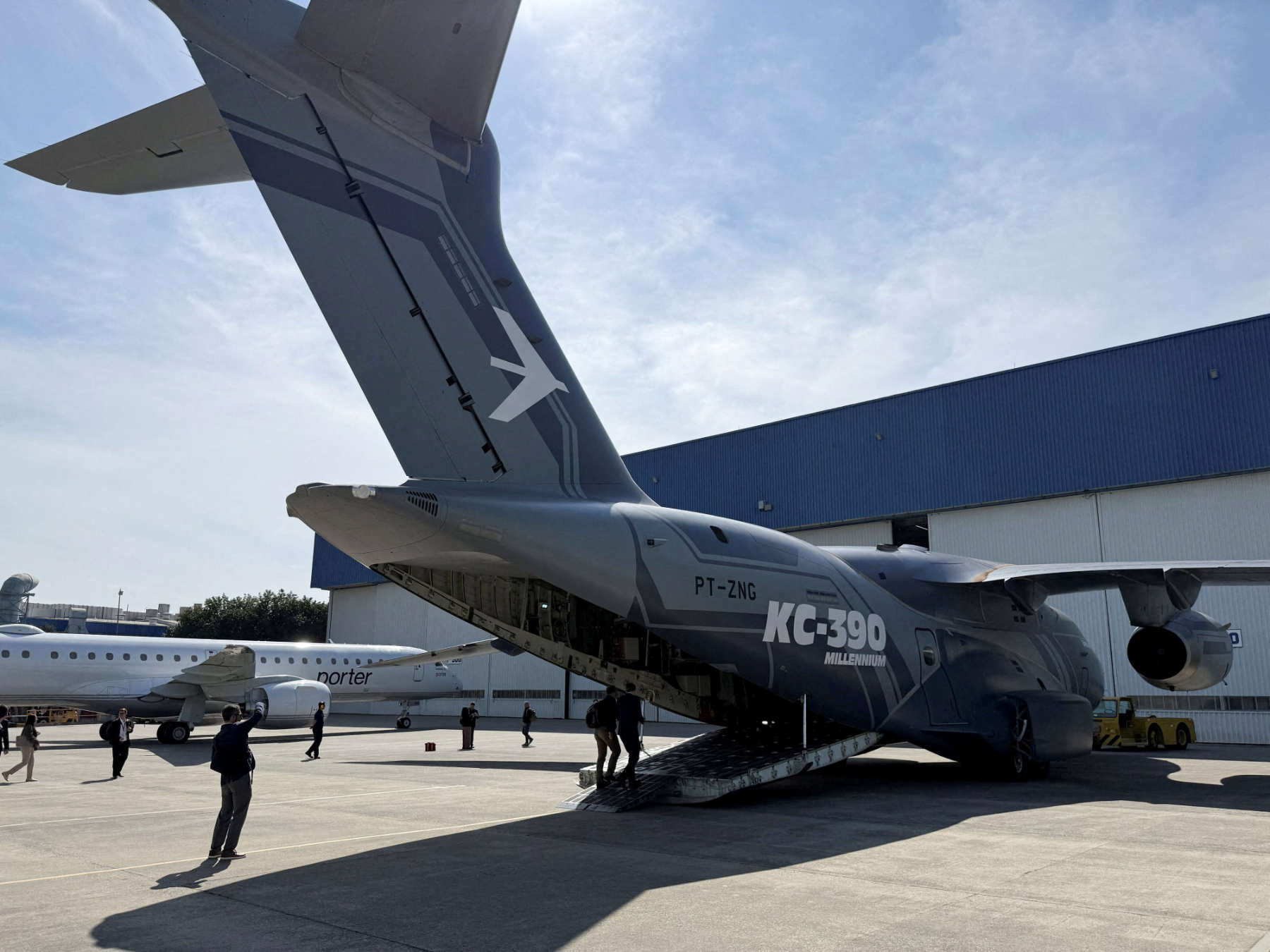
One of the world's most advanced military transport aircraft
Morocco, Brazil deepen defence ties as KC-390 talks advance
The broad scope of the Brazilian offer highlights growing interest in Morocco as a regional defence and industrial hub.
Monday 15/06/2026
One of the world's most advanced military transport aircraft
RABAT – Morocco and Brazil are expanding defence and industrial cooperation as negotiations advance over a potential deal for five KC-390 Millennium military transport aircraft, while Brazilian defence companies seek a broader role in the kingdom's ambitious military modernisation programme.
The discussions mark the latest stage in a rapidly developing defence relationship between Rabat and Brasilia, which has grown significantly since the two countries signed an agreement during the Marrakech Air Show in October 2024 to explore industrial and technological cooperation projects.
At the centre of the talks is Embraer's KC-390 Millennium, one of the world's most advanced military transport aircraft. Designed for troop and cargo transport, aerial refuelling, medical evacuation and humanitarian relief operations, the aircraft has attracted increasing interest from armed forces worldwide.
The Royal Moroccan Armed Forces have not yet placed an official order, but negotiations have intensified in recent months. The aircraft has already undergone practical evaluations in Moroccan airspace, according to defence industry reports, and discussions are now focused on finalising the terms of a potential contract estimated at more than $600 million.
Seeking to strengthen its position against competitors, notably the Lockheed Martin C-130 Hercules, Embraer has proposed providing Morocco with a sophisticated C4I command centre capable of integrating military operations across all branches of the armed forces.
The proposal reflects Morocco's broader objective of creating a unified command architecture that would allow real-time coordination between land, air and naval forces while improving operational efficiency and intelligence-sharing.
The negotiations were a key feature of the Morocco Defence Days 2026 event, during which a delegation from Brazil's Ministry of Defence met senior Moroccan military officials, including General Fouad Moumen, head of the Fourth Bureau of the General Staff, and Saif-Eddine Senouci, financial director of the National Defence Administration.
Brazil's ambassador to Morocco Alexandre Guido Lopes Parola and several senior military officers also participated in the discussions.
Beyond the KC-390 programme, a number of major Brazilian defence firms used the event to present their technologies and explore partnership opportunities with Morocco.
Companies including Taurus, Mac Jee, Segura Defense, Siatt, Atik and Saipher showcased products ranging from defence systems and guided munitions to critical infrastructure protection and advanced surveillance technologies.
Particular attention was drawn to Saipher's presentation of airport infrastructure solutions and its Horus platform, a sophisticated space-surveillance and decision-support system designed to provide monitoring, analysis and operational support capabilities.
The broad scope of the Brazilian offer highlights growing interest in Morocco as a regional defence and industrial hub and reflects Rabat's strategy of developing local defence production capabilities while diversifying its international partnerships.
Moroccan officials increasingly view defence industrialisation as a key pillar of national security policy, seeking not only to strengthen military readiness but also to build domestic expertise in manufacturing, maintenance and advanced technologies.
Brazil's designation of Morocco as a strategic regional partner in April 2025 further underscored the importance of the kingdom in Embraer's long-term plans to develop supply chains covering aerostructures, machining, sheet metal work and composite materials.
For Morocco, the emerging partnership offers more than the prospect of acquiring new military platforms. It forms part of a wider effort to establish a sustainable defence-industrial ecosystem capable of supporting local production, reducing dependence on external suppliers and positioning the kingdom as an increasingly influential defence actor in Africa and the wider region.
As negotiations continue, the KC-390 deal has become a symbol of the growing strategic convergence between Rabat and Brasilia, combining military modernisation, industrial cooperation and technology transfer in a partnership that both sides hope will extend well beyond the purchase of aircraft.