

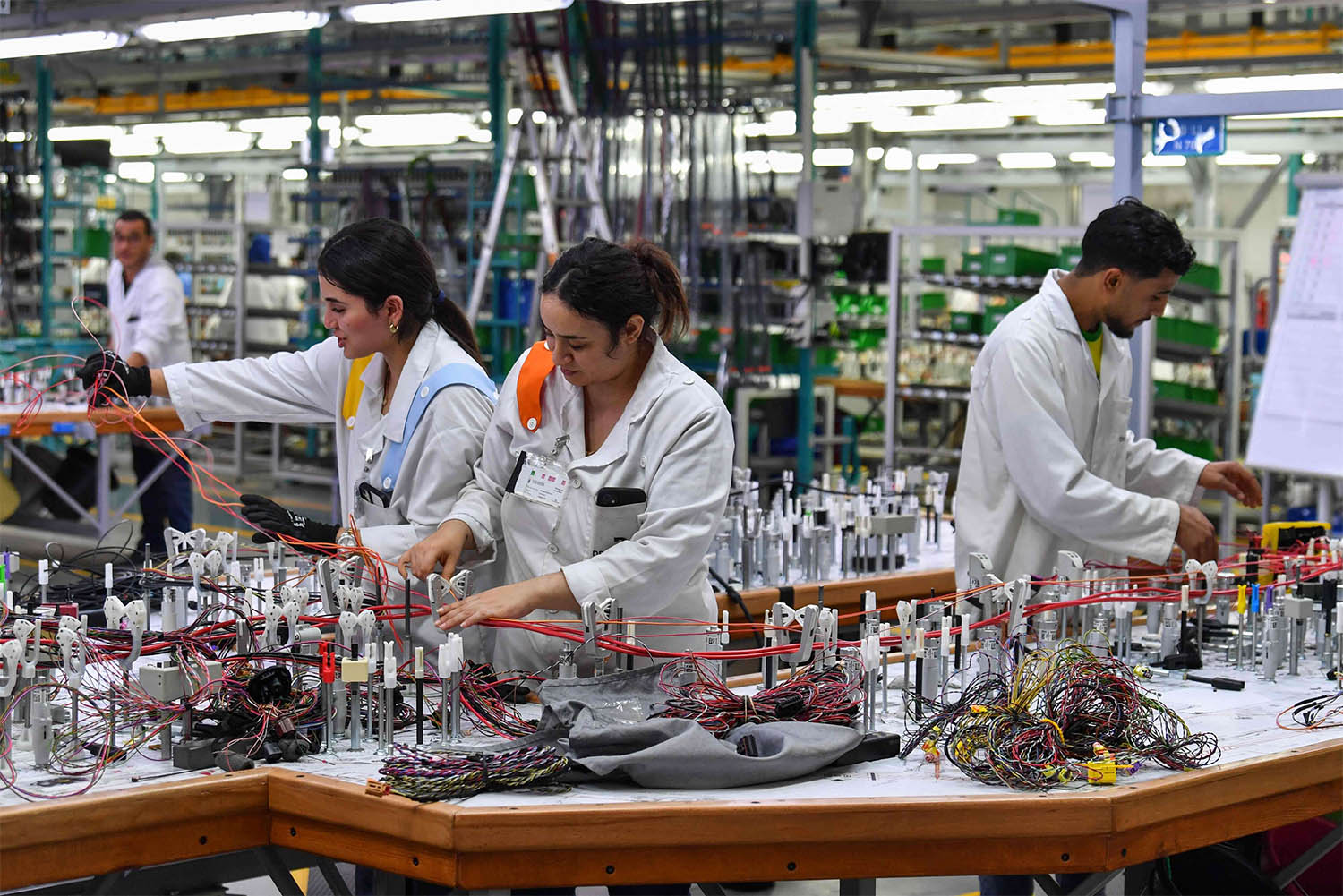
Employees work in a cable factory of the German company Draxlmaier, specialized in the manufacture of automotive components, in Jemmal city in Monastir, Tunisia
Tunisia becomes a black hole for international investors
Tunisia, once hailed as a model of economic management, has plummeted into a severe economic crisis, marked by declining foreign investment and a disappearing presence in international benchmarking reports.
Tuesday 29/07/2025
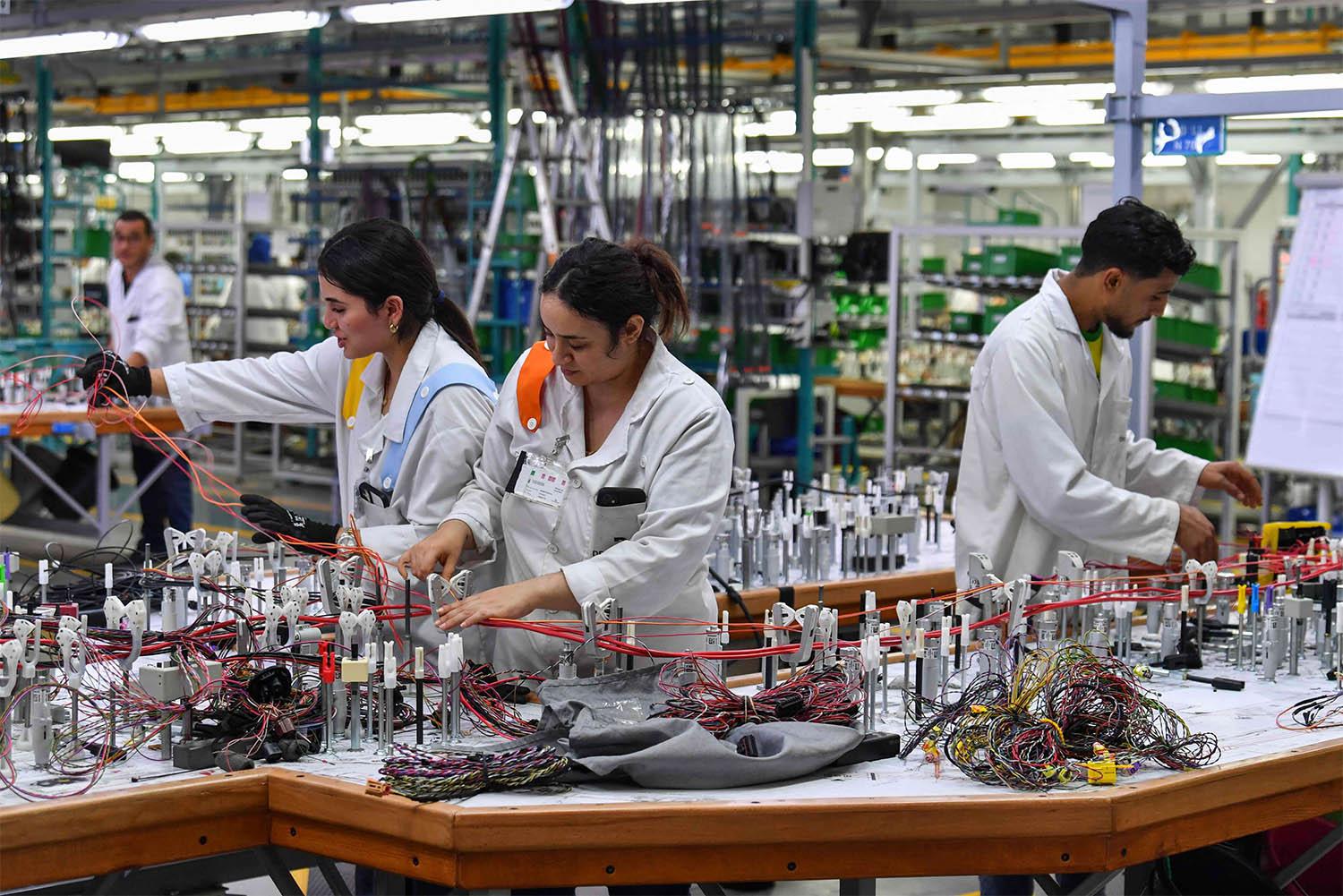
Employees work in a cable factory of the German company Draxlmaier, specialized in the manufacture of automotive components, in Jemmal city in Monastir, Tunisia
TUNIS - The regular downgrading of Tunisian credit by the international rating agencies had been a recurring feature of the country’s political calendar in the 2010s but more recently the country has simply disappeared from leading benchmarking reports such as Business Ready (World Bank) and the Africa Attractiveness Report (Ernst and Young).
A country which at the turn of the century was promoted by the World Bank as “the” example of good management to be followed in Africa and the Middle East has, “disappeared down a blackhole for foreign investors” according to the economist Hachemi Alaya who publishes the respected economic report, EcoWeek.
The country attracts 1.8% of international FDI flows into North Africa (Egypt, Libya, Tunisia, Algeria, Morocco) and less than 0.06% of global FDI flows. Tunisia has fallen off the map and any number of statistics illustrate the fact that the country is in economic freefall.
Beyond the arguments about who is to blame for this sorry spectacle, the history of this small country (12m people) teaches us that the cardinal strategic economic mistake was made by the founder of modern Tunisia and its first president after independence.
Habib Bourguiba ruled from 1957 to 1987 when he was overthrown by Zine el Abidine Ben Ali who fled the country in January 2011, thus sparking the Arab Spring. The mistake, in Alaya’s eyes, was the failure to understand that Tunisia was condemned, by its position on the map and small population to build good relations with its two oil and gas rich larger neighbours, Algeria and Libya. Such a policy would have boosted growth, particularly as the domestic reforms initiated by Bourguiba after independence - education for all and equal rights for women - gave the country a better educated and more enterprising middle class than its neighbours.
Bourguiba resented the power and size of his eastern neighbour, Algeria. Members of the Tunisian elite convinced themselves that they were more sophisticated than their peers in Algiers and what they saw as a “feudal” monarchy in Morocco. They saw themselves as surrogate members of the Paris elite who viewed Bourguiba as an Arab they could frequent because of his emancipation of women and moderate views on the issue of Palestine.
Bourguiba’s agreement to build a union between his country and Muammar Gaddafi’s Libya was stopped in its tracks in 1974 by his prime minister Hédi Nouira with the discreet help of the US and France.
The former colonial power never liked the idea of North African countries working closely together if only because many in the French political elite never forgave Algeria for becoming independent in 1962, after a bitter war which had toppled the Fourth Republic and brought General de Gaulle back to power in 1958.
The fiasco of 1974 also had its roots in the very different political philosophies of the two leaders but did not stop many private Tunisian companies from building subsidiaries in Libya and tens of thousands of people from the poorer south of Tunisia from working in Libya and remitting precious cash to the mother country.
The building of the Enrico Mattei gas pipeline from Algeria to Italy, which was inaugurated in 1983, helped to build trust between Algeria, Tunisia and Italy and offered Tunisia valuable income in throughput fees and easy access to plentiful Algerian gas for its domestic energy needs. But Tunisia failed to develop a refining industry which could have exported refined products to the region although hundreds of Tunisia private companies gained lucrative contracts over the years in Algeria.
Lip service to the Washington Consensus politics of state economic liberalisation was paid by successive Tunisia governments after 1985 but never yielded convincing results in terms of FDI flows, essentially because of the increasingly predatory nature of Ben Ali’s rule. In 2013, two years after Ben Ali had fled the country the World Bank ate humble pie and admitted it had misread Tunisia.
The 2011 revolt decapitated the state but did not produce a new generation of political leaders. It brought back the marginalised elites of the Ben Ali era. Such people were not interested in reforming the economy, let alone the judiciary and the security forces despite the country being hailed in many European policy circles and think tanks as a democratic “success story.”
Since Kais Saied was elected president in 2019 Tunisia has slipped back into a harsher form of autocracy, a form of government it had in truth never really discarded. The country’s economic situation is in much worse in 2025 than at any time since 1957.
According to recent IMF Article IV reports Tunisia’s GDP growth is the weakest in North Africa (Algeria, Egypt, Libya, Morocco and Tunisia). Foreign direct investment has collapsed, public investment also.
The country’s foreign debt has decreased because Tunisia no longer has access to international credit markets. Today it represents 75% of GDP against 90% a few years ago but its structure has changed for the worse as 36% of it has a less than 12-month maturity and is very expensive.
Domestic debt is mushrooming and the consequence is to starve private entrepreneurs out of the market and thus deprive the economy of desperately needed investment. Inflation is running at higher rates than among its neighbours; talent is fleeing the country in droves.
IMF projections forecast that GDP growth in 2025 will be 1.4% in Tunisia, 3.5% in Algeria, 4.5% in Egypt, between 6.9 and 8.4% in Libya and 4.4% in Morocco. Tunisian average GDP growth between 2026 and 2030 will be 1.2% against an average of 3% in neighbouring countries.
Public investment as a percentage of GDP will average 10% over the same period as compared with 37% in Algeria and 35.10% in Morocco. 80% of tax receipts are earmarked to pay civil servants and workers in state companies and for subsidies.
Inflation is forecast to be 9.3% in 2030 as against 3% in Algeria and Morocco. Fewer and fewer up to date and reliable official statistics are being published. The Central Bank has abdicated any independent role it might have claimed to advise the government on debt management and inflation.
It is the handmaiden of the president’s economic policy which consists of redistributing wealth which does not exist. Populist policies have done nothing to reduce income disparities between the coast and the poorer hinterland – the spark which lit the revolt of December 2010. Printing money is official policy. Raising debt abroad is becoming ever more expensive. The emperor has no economic clothes but the Tunisian people are forbidden from saying so.
(Arab Digest)