

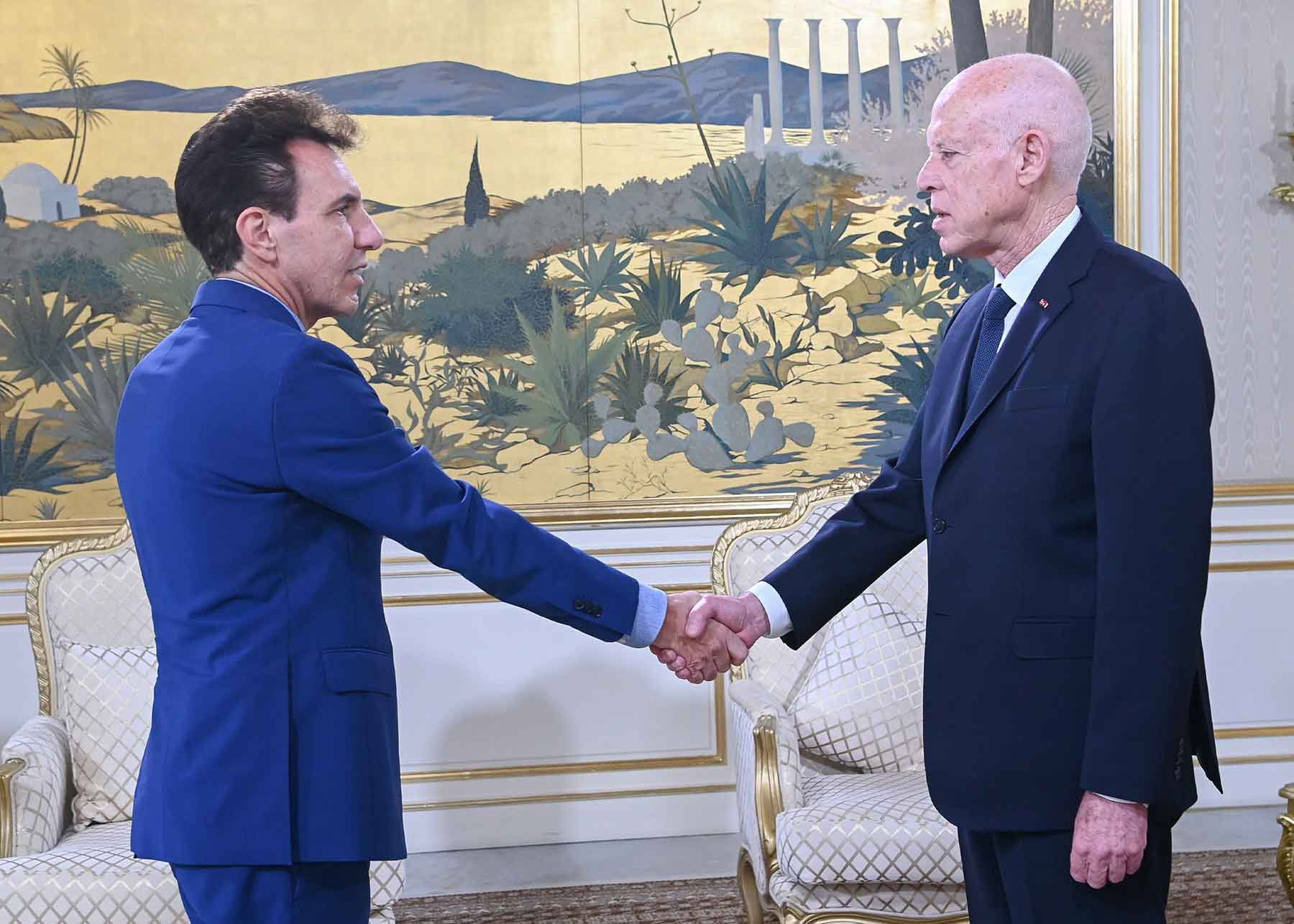
Tunisian President Kais Saied shakes hands with EU Ambassador Giuseppe Perrone at the Carthage Palace in Tunis, November 25, 2025.
EU upholds cooperation with Tunisia despite Saied’s sovereignty rhetoric
European Parliament reflects competing agendas and lobbying forces, producing sometimes contradictory positions.
Tuesday 16/12/2025
Tunisian President Kais Saied shakes hands with EU Ambassador Giuseppe Perrone at the Carthage Palace in Tunis, November 25, 2025.
TUNIS -
In a striking contradiction, Tunisia’s relationship with the European Union continues to oscillate between political pressure and pragmatic cooperation rooted in shared economic and security interests. While the European Parliament has persisted in criticising Tunisia’s human rights record, analysts say these repeated condemnations lack the weight needed to derail the broader trajectory of bilateral cooperation.
Tunisian President Kais Saied has repeatedly rejected European pressure, framing his stance as a firm defence of national sovereignty and a categorical refusal of foreign interference in Tunisia’s internal affairs. On several occasions, he insisted that Tunisia would not accept being placed in the role of a “pupil receiving lessons,” a pointed rebuke to what he views as external tutelage or moral assessment of the country’s political and human rights record.
European institutions have accused the Tunisian authorities of restricting freedom of expression, interfering with the judiciary and carrying out politically-motivated arrests, citing reports by organisations such as Human Rights Watch, Amnesty International and the UN Office of the High Commissioner for Human Rights. Saied has consistently denied these allegations, insisting that the judiciary remains independent.
At the same time, Europe has maintained cooperation with Tunisia in areas such as economy and efforts to curb irregular migration, despite accusations of abuses against migrants and refugees, including collective expulsions, ill-treatment and racially motivated violence, particularly targeting people from sub-Saharan Africa. Tunisian authorities have denied these allegations.
Saied’s consolidation of power began on July 25, 2021, when he imposed exceptional measures that included dissolving the judiciary and parliament, ruling by presidential decrees, adopting a new constitution through a referendum and organising early parliamentary elections.
While some Tunisian political forces have described these steps as entrenching “absolute one-man rule,” Saied’s supporters have defended them as a “correction” of the path of the 2011 revolution that ousted former president Zine El Abidine Ben Ali.
Sovereignty first
Political analyst Abdelrazak Khalouli argues that, in principle, Saied’s position is justified.
“We believe the president’s stance is sound, because we should not allow foreigners, whether diplomats or others, to exploit their presence in Tunisia to interfere in our internal affairs or insert themselves into issues that concern Tunisians alone,” he said.
Khalouli added that he supports positions centred on sovereignty and the protection of national decision-making, arguing that the EU has historically exploited the 1995 Association Agreement in ways that disproportionately favour European interests, particularly in trade liberalisation and tariff dismantling.
He noted that the agreement includes provisions allowing the bloc to intervene in areas beyond economy, such as national choices related to freedoms and democracy, “which is not part of its mandate.” According to Khalouli, the EU repeatedly deploys the language of rights and authoritarianism as a pressure tool whenever it feels its interests are under threat.
Tunisia and the EU signed their Association Agreement on July 17, 1995, which entered into force in March 1998 and laid the groundwork for a free trade area between the two sides.
A non-binding strategic partnership
After several rounds of talks, the two sides signed a memorandum of understanding on July 16, 2023 establishing a “comprehensive strategic partnership” covering trade, irregular migration, agriculture, energy and digital transition.
Khalouli described the memorandum as “a set of promises and future visions rather than a binding agreement”, noting that it remains unclear whether it will lead to a formal treaty similar to the 1995 accord. “So far, it appears to have stalled,” he said.
Parliament versus commission
Khalouli stressed the importance of distinguishing between the European Parliament and the European Commission. Parliamentary activity, he said, amounts largely to recommendations and proposals, while Tunisia remains a strategic partner for Europe, accounting for roughly 80 percent of Tunisia’s external trade.
He added that the European Parliament reflects competing agendas and lobbying forces, producing sometimes contradictory positions.
“At times Tunisia is described as a partner that must be supported in its democratic transition, and at other times as a country sliding into repression and authoritarianism,” he said.
By contrast, the European Commission, he argued, prioritises maintaining relations with Saied in line with EU interests, particularly as Europe faces energy challenges.
“When Europe is cut off from Russian gas, it turns to Tunisia in search of alternatives,” he said.
Although Tunisia does not currently provide a direct substitute for Russian gas, as it is a gas importer rather than a producer and serves mainly as a transit country for Algerian gas to Europe, experts still regard it as a key strategic partner. Future alternatives include renewable electricity exports and green hydrogen projects, developed through EU-backed partnerships.
A misplaced conflation
Tarek Kahlawi, former director of the Tunisian Institute for Strategic Studies, echoed the need to separate the roles of the EU’s institutions. He said the European Parliament contains political parties that are not necessarily influential within the Commission.
“The EU’s executive policy is based on cooperation and coordination,” he said, noting that parties aligned with the European left, such as the Greens, tend to adopt more critical positions focused on democracy and human rights. “These positions should not be conflated with the EU’s executive policy,” he added.
Kahlawi pointed out that negotiations over the Deep and Comprehensive Free Trade Agreement (DCFTA), known by its French acronym ALECA, have remained suspended since 2019. Prior talks involved the EU, the Tunisian government, the employers’ federation and the powerful UGTT labour union.
He suggested that recent EU meetings with the UGTT and employers’ organisations were aimed at reviving stalled trade discussions, rather than addressing democratic concerns. “The issue has nothing to do with democracy or human rights,” he said, adding that the European Parliament’s statement coincided with these meetings, creating confusion.
As evidence, he noted that European governments, individually or collectively, have largely stopped issuing official statements on democracy and human rights in Tunisia.
The ALECA agreement, proposed by the EU, aims to significantly expand trade liberalisation beyond the scope of the 1995 Association Agreement, imposing far broader obligations on Tunisia, a factor that has contributed to its political sensitivity and prolonged suspension.