

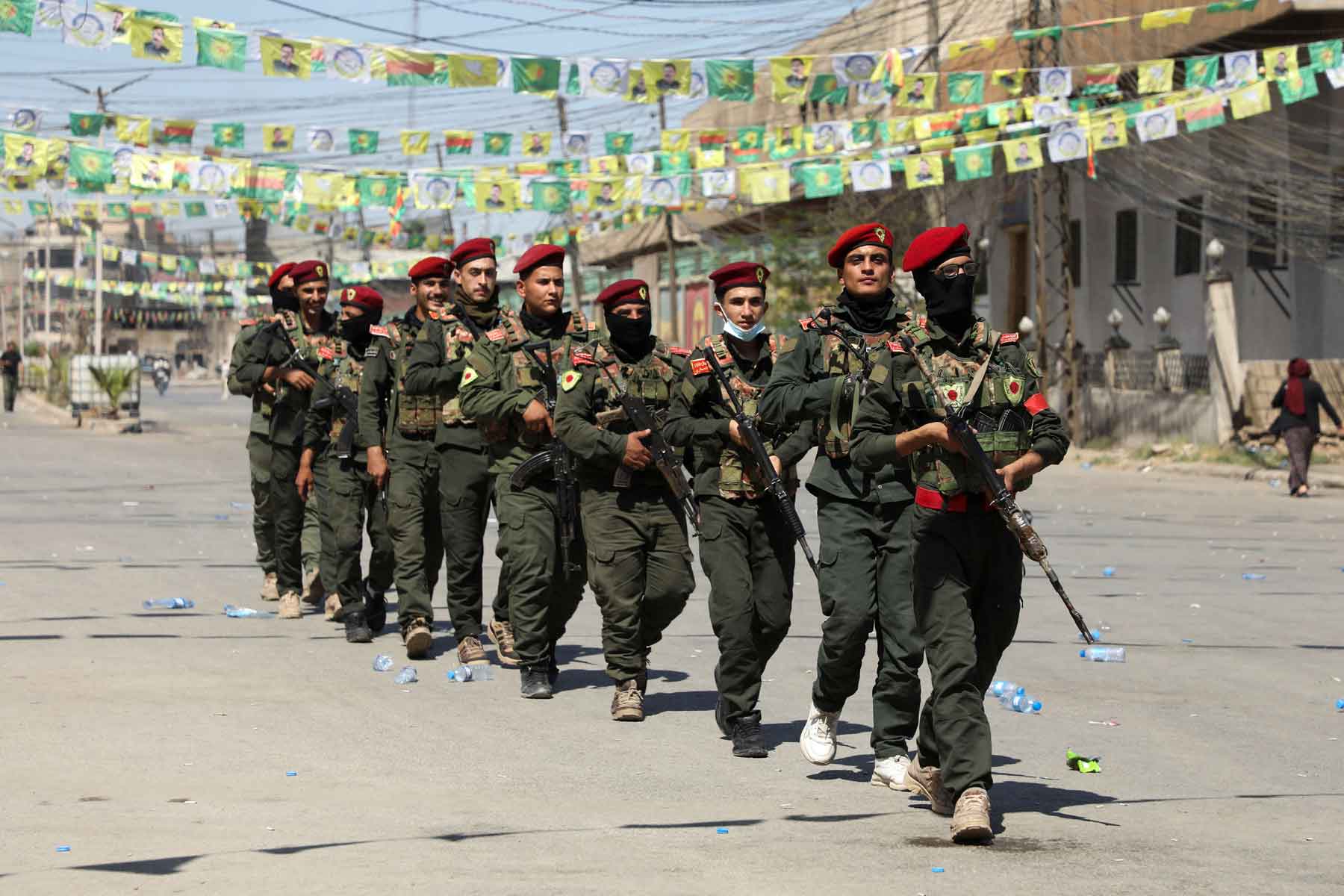
Armed members of the Syrian Democratic Forces (SDF) military police take part in a demonstration under the banner “With our will, we will protect our revolution,” in Qamishli, Syria, September 17, 2025.
Turkey steps up pressure as Syria–SDF integration accord stalls
The standoff is unfolding amid broader instability, including increased Islamic State activity and shifting military postures.
Thursday 18/12/2025
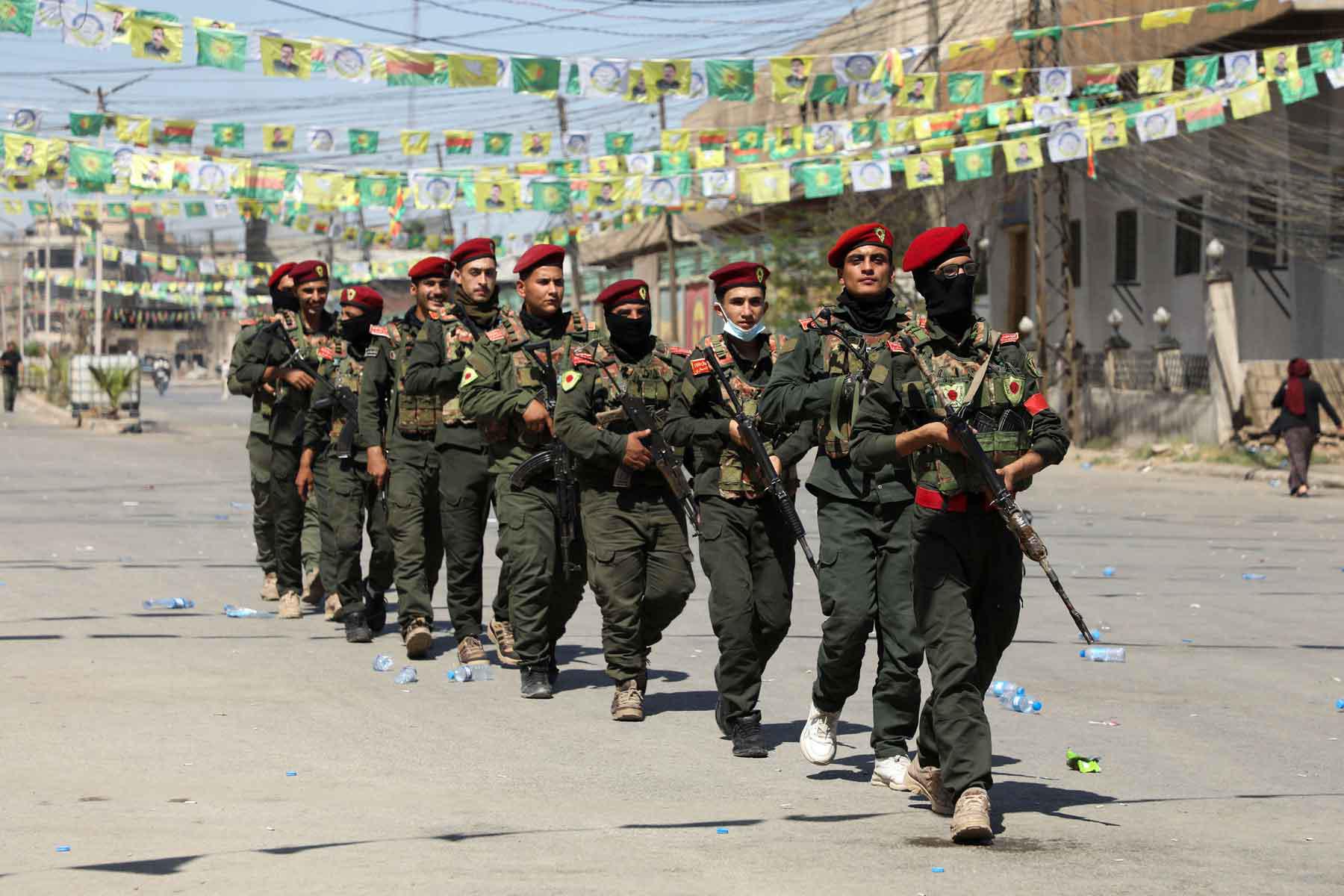
Armed members of the Syrian Democratic Forces (SDF) military police take part in a demonstration under the banner “With our will, we will protect our revolution,” in Qamishli, Syria, September 17, 2025.
ANKARA –
Turkey is sharpening its warnings to Syria’s Kurdish-led Syrian Democratic Forces (SDF), signalling that diplomatic patience is thinning as a landmark integration deal with Damascus remains stalled, raising fears the fragile calm in northeastern Syria could give way to renewed confrontation.
Foreign Minister Hakan Fidan said on Thursday that Ankara did not want to return to military action against the SDF but made clear that delays in implementing the March 10 agreement were pushing the limits of restraint.
“We just hope that things go through dialogue, negotiations and peacefully. We don’t want to see any need to resorting to military means again. But SDF should understand the patience of the relevant actors are running out,” Fidan told TRT World.
“They should come to a place where their commitment to the agreement of 10th of March should be honoured. Everybody is expecting from them to honour that agreement without any delay and without any twisting because we don’t want to see a deviation from this agreement,” he added.
Fidan’s remarks underscore Ankara’s growing frustration with what it sees as SDF foot-dragging, at a moment when the understandings reached with Damascus are entering a decisive phase. Earlier this month, he said the SDF was signalling “no intention” of honouring the agreement to integrate into Syrian state structures and was instead seeking to circumvent it.
Turkey, which views the SDF as an extension of the Kurdistan Workers’ Party (PKK), has also warned that unnamed external actors are encouraging the group to resist integration, insisting such efforts would ultimately prove futile. At the same time, Fidan stressed Ankara was not giving Damascus a “blank cheque” to oppress minorities, saying everyone in Syria “must feel safe and free.”
The March 10 agreement, which remains the sole recognised framework governing relations between Damascus and the SDF, was meant to pave the way for integrating Kurdish-led forces into state institutions and reasserting Syrian sovereignty over the northeast. While the pact does not specify a binding deadline, observers say the working assumption among stakeholders is that meaningful progress must be achieved by the end of 2025.
So far, that progress has proved elusive. Disputes over implementation mechanisms and sharply differing interpretations of the text have produced what both sides acknowledge is a growing crisis of confidence. Joint committees continue to meet, particularly on military integration and the future shape of the Syrian state, but have yet to deliver tangible outcomes.
Officials from the Syrian Democratic Council, the SDF’s political wing, have sought to downplay any sense of urgency, arguing that decades of accumulated crises cannot be resolved on a rigid timetable. But with the end of the year approaching and little to show on the ground, the agreement is increasingly seen as facing its first major test.
The political deadlock has coincided with rising security tensions, amplifying concerns that mistrust could spill into open conflict. Recent incidents near the Tishreen Dam and Deir Hafer, east of Aleppo, have weighed heavily on negotiations. The SDF said two of its fighters were wounded when a suicide drone exploded as they were assisting civilians, accusing factions linked to Damascus of carrying out the attack and calling it a serious escalation and a violation of international law.
Syrian officials, in turn, accuse the SDF of procrastination and deliberately buying time, warning that delays are increasing risks on the ground. Turkish officials share that assessment, arguing that prolonged ambiguity benefits only instability.
Behind the scenes, negotiations have failed to ease tensions. Sources say Damascus has agreed in principle to incorporate SDF forces into the Syrian army as organised divisions reporting directly to the defence minister, a formula intended to absorb the forces into state structures without immediately dismantling them.
In return, Damascus insists on what it calls a non-negotiable condition: the deployment of the Syrian army and internal security forces across northeastern Syria under Syrian law. Officials say SDF commander Mazloum Abdi’s rejection of such deployment is the main obstacle to progress.
The SDF says it has submitted a comprehensive proposal detailing mechanisms for integration into the army and state institutions, but has yet to receive a formal response. It continues to push for decentralised governance and an integration process that preserves its organisational cohesion, arguing that the March agreement has political significance beyond security arrangements and could shape Syria’s future constitutional order.
Damascus has firmly rejected federalism or any form of territorial division, reiterating its commitment to “one Syria, one army, and one government.” It has also voiced concerns over what it sees as separatist tendencies, SDF control of oil resources, and attempts to maintain a cohesive military force within the national army, an arrangement officials have described as a “ticking time bomb.”
The standoff is unfolding amid broader instability, including increased Islamic State activity and shifting military postures. US forces have redeployed and reinforced some positions in eastern Syria without announcing new withdrawals, while a recent Islamic State attack in Palmyra that killed two US soldiers and a civilian highlighted the group’s persistent threat.
Against this backdrop, Turkey’s increasingly blunt language reflects a calculation that time is no longer neutral. As the deadline approaches and security tensions mount, the March agreement hangs between signed commitments and a complex reality, with Ankara signalling that dialogue still has a chance, but not indefinitely.