

A flexible policy of engagement with all Libyan power centres
Italy bets on Libya stability as Dbeibah meets Meloni on Rome visit
For Italy, officials increasingly view Libya as a matter of national security directly tied to domestic political stability, economic resilience and social pressures.
Friday 08/05/2026
A flexible policy of engagement with all Libyan power centres
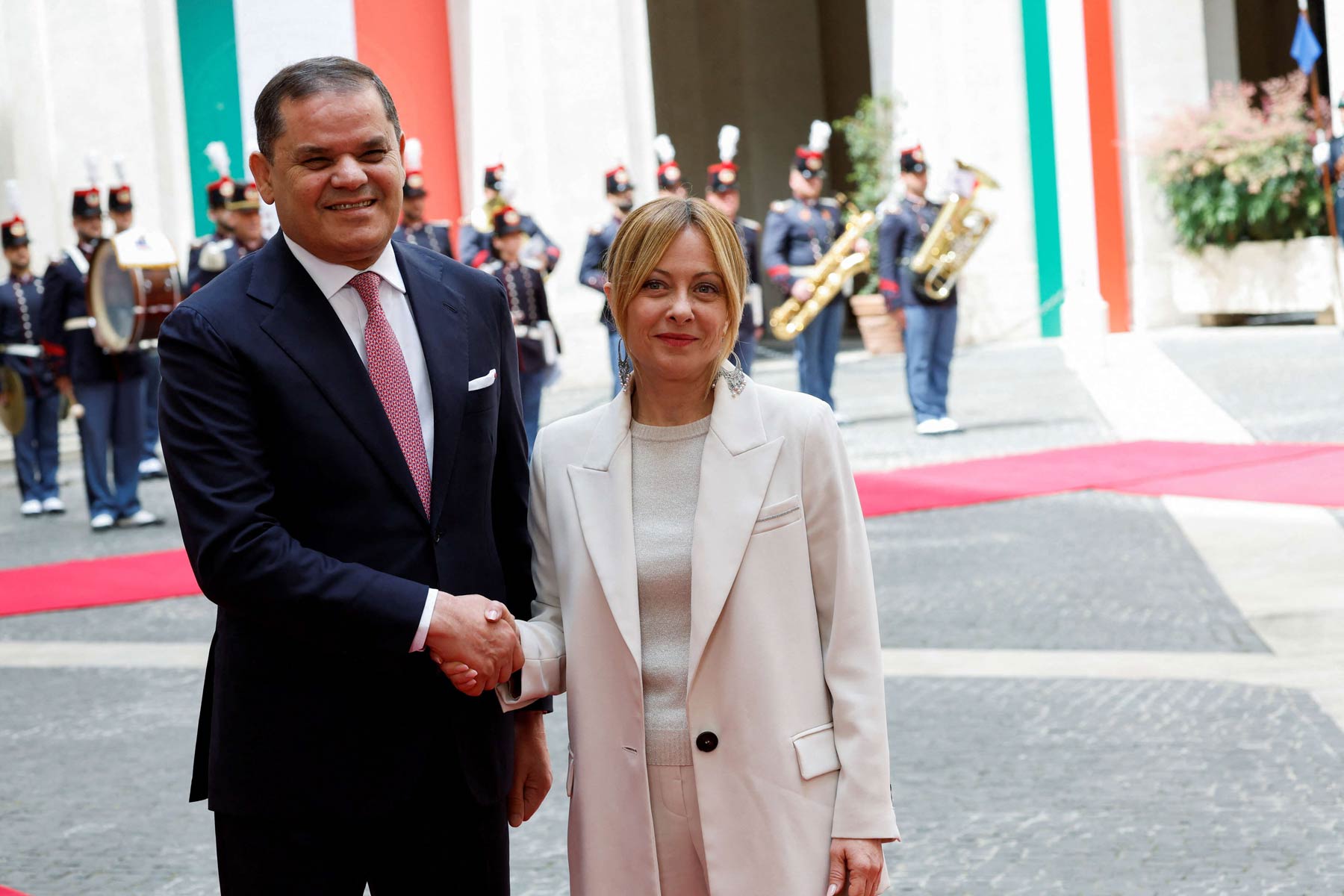
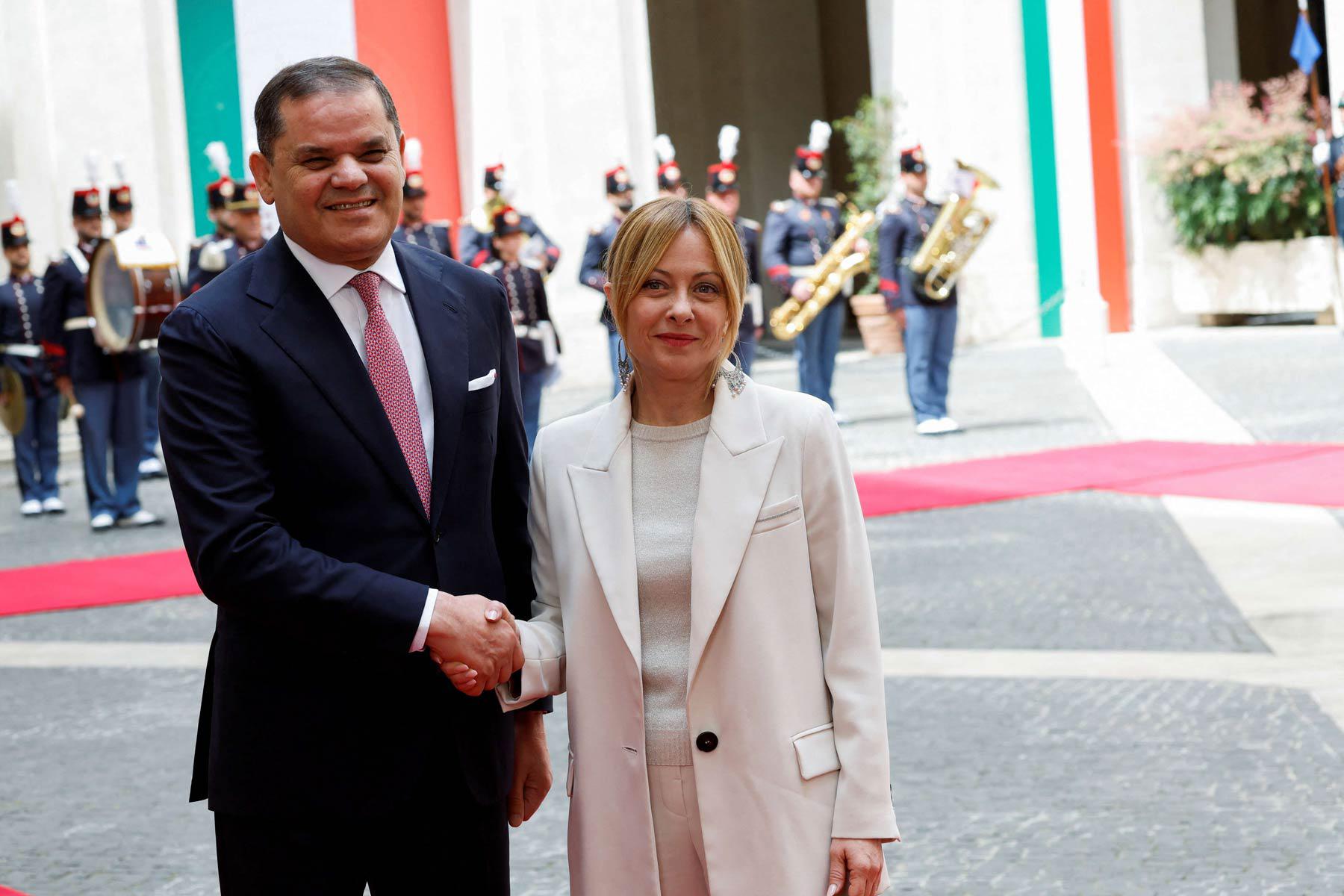
ROME – Libyan Prime Minister of the Government of National Unity Abdulhamid Dbeibah’s visit to Rome was far more than a routine diplomatic stop. It reflected the depth of Libya–Italy interdependence across migration, energy security and wider Mediterranean geopolitical balancing at a time of acute regional instability.
Dbeibah met Italian Prime Minister Giorgia Meloni at Palazzo Chigi, where discussions focused heavily on irregular migration, energy cooperation and security coordination. For Italy, officials increasingly view Libya not as an external policy issue but as a matter of national security directly tied to domestic political stability, economic resilience and social pressures.
The Libyan delegation included senior officials such as Deputy Defence Minister Lt. Gen. Abdul Salam Al-Zoubi, Minister of State for Communication and Political Affairs Walid Al-Lafi, Minister of State for Cabinet Affairs Mohammed Bin Ghalboun, Justice Ministry Undersecretary Ali Ashtaiwi, and Libya’s ambassador to Italy Mohannad Younes, underlining the strategic weight of the visit.
The talks come at a sensitive moment ahead of upcoming Libya’s 4+4 military dialogue meetings in Rome and amid renewed US and UN efforts to revive institutional unification in Libya’s divided political landscape.
Italian outlet “Decode39” noted that the presence of multiple senior ministers highlighted Tripoli’s effort to reinforce its international legitimacy through engagement with Rome, while Italy simultaneously maintains contacts with all Libyan factions in the east and west under a more pragmatic diplomatic approach.
Since the fall of Muammar Gaddafi in 2011, Italy has struggled to define a consistent Libya strategy, initially losing influence as France, Turkey and Russia expanded their roles. Over time, however, Rome shifted toward a flexible policy of engagement with all Libyan power centres, recognising that stability in Libya is inseparable from Italy’s own security interests.
Migration remains the most politically sensitive pillar of the relationship. Italy has increasingly treated Libyan stability as central to its domestic agenda, particularly as Libya remains the primary departure point for migrants crossing the central Mediterranean route.
Under Prime Minister Meloni, migration control has become a defining element of Italian foreign policy. Reducing arrivals is seen in Rome as a direct measure of government effectiveness.
According to Italian agency reports, arrivals to Italy have fallen by more than 50 percent in early 2026 compared to the previous year, although Libya continues to account for around 85 percent of departures.
Energy cooperation is equally central. Libya remains a key supplier of crude oil to Italy, while Italian energy giant Eni has operated in the country for decades, maintaining strategic production assets despite ongoing instability.
However, gas exports via the Greenstream pipeline have declined sharply, falling to around 1 billion cubic metres in 2025, compared with 1.4 bcm in 2024 and 2.5 bcm in 2023. The decline reflects Libya’s internal political fragmentation, infrastructure disruptions and fluctuating domestic energy demand.
At the same time, Libya remains Italy’s largest crude oil supplier, accounting for roughly 22.5 percent of imports, underscoring the structural importance of the bilateral energy relationship even amid volatility.
Italian officials also see Libya as increasingly critical in the post-Ukraine war energy landscape, as Europe seeks alternatives to Russian gas supplies. Libya’s offshore and onshore reserves are viewed in Rome as a potential stabilising source for Mediterranean energy security, provided production constraints can be addressed.
A recent visit by members of Italy’s parliamentary security committee highlighted continued Italian pressure for increased investment in Libyan gas production, aimed at boosting output and restoring export capacity to Italy.
Migration and energy are closely tied to security cooperation. Discussions in Rome also covered coordination mechanisms involving Libya, Italy, Turkey and Qatar, aimed at managing migration flows and strengthening border control capacity.
Dbeibah emphasised Libya’s “heavy burden” in managing migration flows on behalf of the wider region, calling for more balanced international responsibility-sharing and stronger support for Libyan institutions tasked with border and coastal surveillance.
Italy, for its part, continues to rely on Libya as a key partner in reducing irregular migration flows across the central Mediterranean, while also seeking to stabilise supply chains and protect its strategic investments.
The broader geopolitical context is also shaping the relationship. Italy is keenly aware that any further deterioration in Libya could reopen migration routes, destabilise energy supplies and expand space for rival external actors.
Turkey has entrenched influence in western Libya, Russia maintains a foothold in the east and south, and France continues to pursue limited engagement, creating a fragmented external environment that Italy seeks to navigate through pragmatic diplomacy.
In this context, Rome positions itself as the most capable European interlocutor with all Libyan factions, leveraging historical ties, geographic proximity and economic interdependence.
Despite ongoing instability, Italy remains Libya’s leading European trading partner, accounting for a significant share of Libyan exports, further reinforcing the depth of economic interconnection.
Ultimately, the Rome visit underscores a shift toward what analysts describe as a “necessity partnership” between Libya and Italy, one driven less by political alignment than by geography, energy dependence and shared security pressures across the Mediterranean.
As regional instability continues to ripple across energy markets and migration routes, both countries appear increasingly bound by mutual constraints, with Libya’s fragmentation and Italy’s domestic pressures making sustained cooperation not a choice, but a strategic requirement.