

Support for allies without abandoning regional diplomacy
Egypt balances support for UAE with diplomacy drive in Iran crisis
In Oman, Sultan Haitham and Sisi exchanged views on ways to reach a final agreement resolving the US-Iran crisis through dialogue, understanding and diplomatic channels.
Friday 08/05/2026
Support for allies without abandoning regional diplomacy
ABU DHABI/MUSCAT – Egyptian President Abdel Fattah al-Sisi used a rapid Gulf tour on Thursday to deliver a dual message of solidarity and de-escalation, backing the United Arab Emirates against Iranian attacks while simultaneously pushing for diplomacy to prevent the region from sliding back into open conflict.
Sisi’s visits to Abu Dhabi and Muscat came at a particularly volatile moment for the Gulf, as a fragile ceasefire between Washington and Tehran remains under strain despite mounting talk of a possible US-Iran understanding that could formally end months of confrontation and reset regional security arrangements.
The Egyptian leader’s trip underscored Cairo’s attempt to position itself as a balancing Arab power capable of supporting Gulf allies while preserving communication channels with Iran and encouraging a negotiated regional settlement.
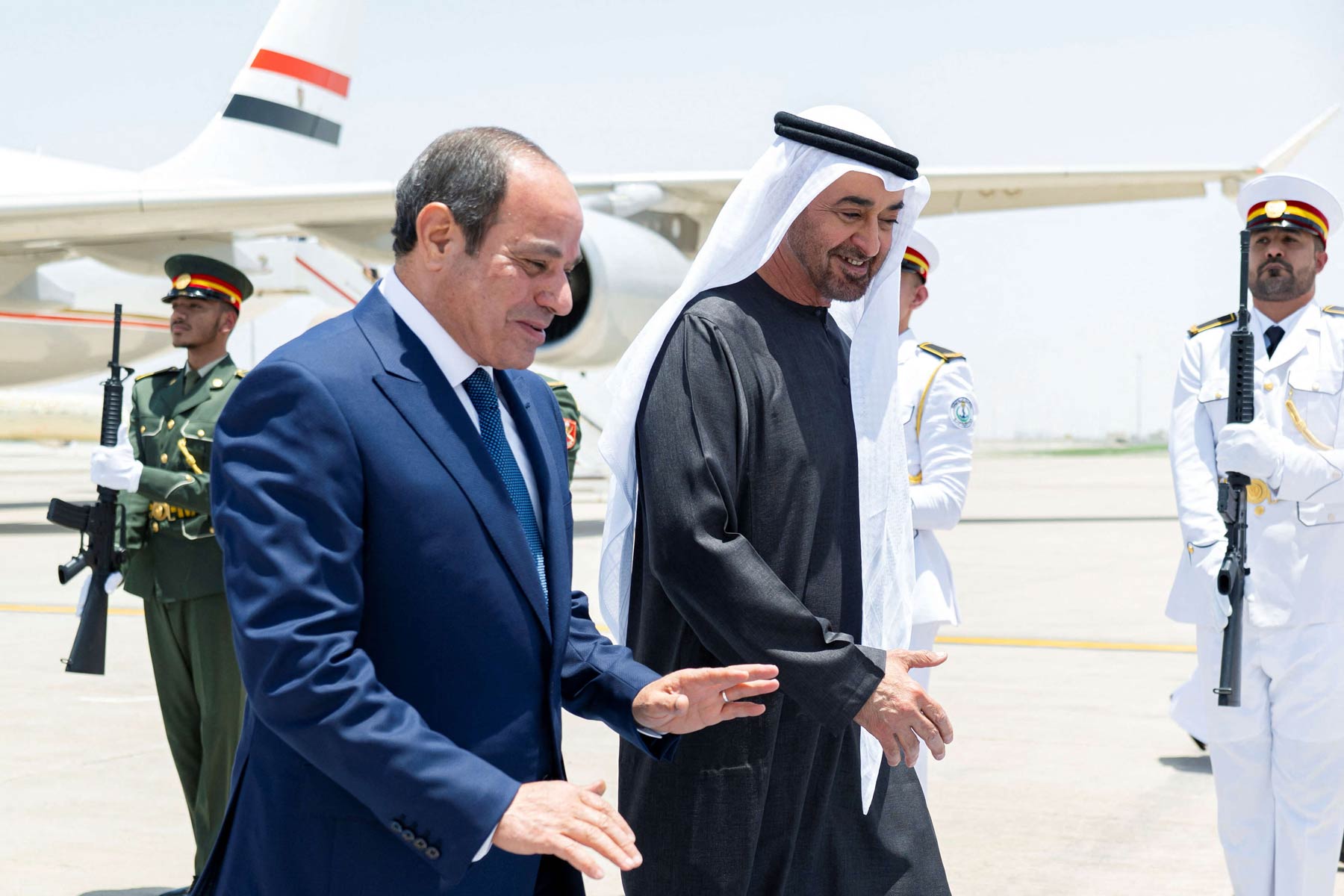
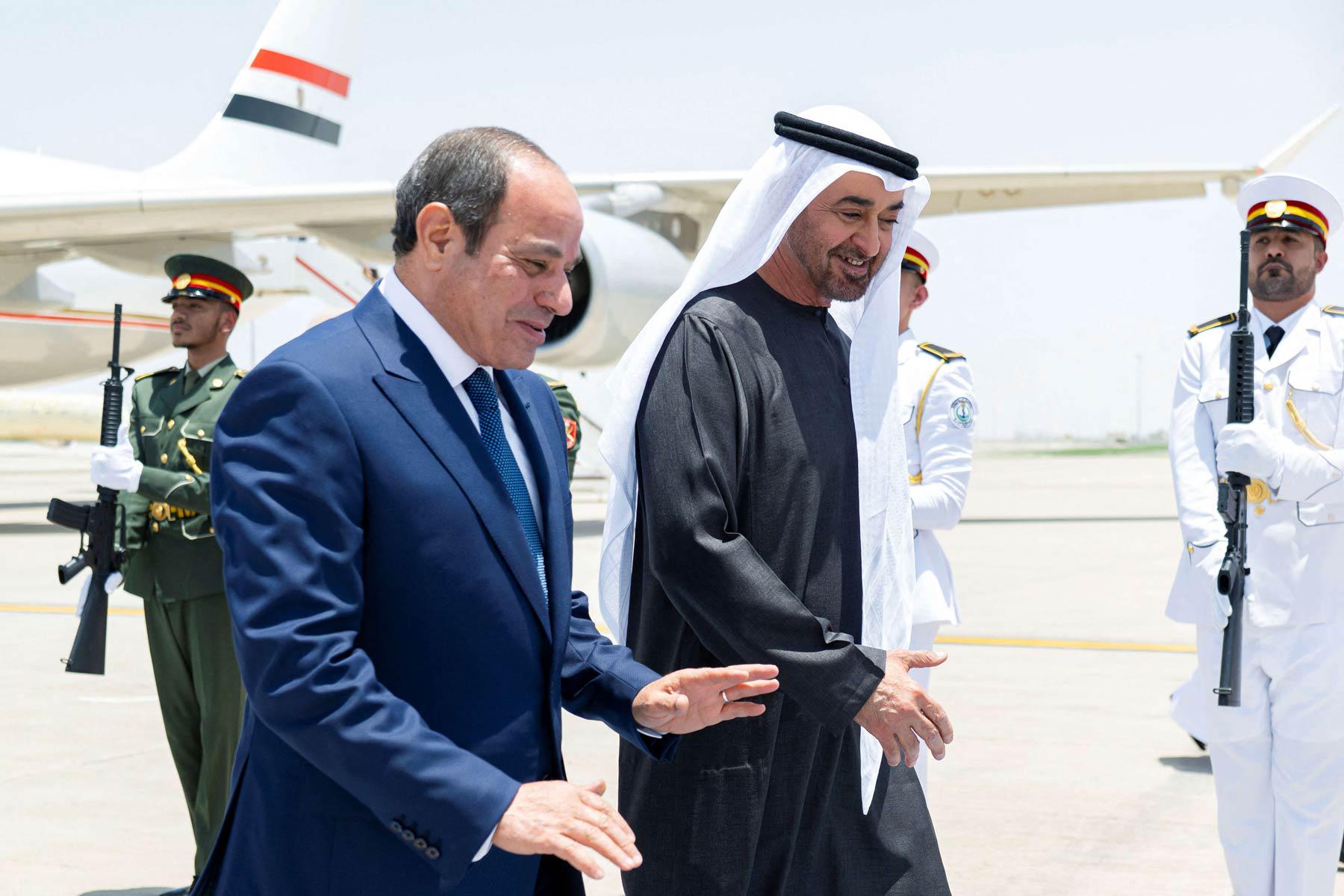
In Abu Dhabi, Sisi held talks with UAE President Sheikh Mohammed bin Zayed Al Nahyan after being received at Abu Dhabi International Airport. The two leaders reviewed regional developments and the implications of the ongoing crisis for Gulf and international security.
The Egyptian president also visited an Egyptian fighter jet detachment stationed in the UAE alongside Sheikh Mohammed bin Zayed, in a highly symbolic display of military coordination and support as Gulf states remain on alert following repeated Iranian missile and drone attacks.
According to Emirati state news agency WAM, the leaders inspected the readiness of the Egyptian contingent and reviewed efforts aimed at strengthening operational preparedness in the face of regional threats.
During the talks, Sisi strongly condemned Iranian strikes targeting the UAE and reiterated Cairo’s support for Emirati sovereignty and security.
“These attacks constitute a blatant violation of the principles of international law and the UN Charter, and a grave escalation that threatens the security and stability of the region and the world at large,” Sisi said.
He stressed Egypt’s “complete rejection” of attacks on Emirati territory and said that “what affects the UAE affects Egypt,” describing Gulf security as inseparable from Egyptian national security.
The UAE has emerged as one of the Gulf states most exposed to the fallout from the Iran conflict since the war erupted in late February after US and Israeli strikes on Iranian targets triggered retaliatory attacks by Tehran.
According to official Emirati figures, the UAE has faced more than 2,000 drones, hundreds of ballistic missiles and dozens of cruise missile attacks since the conflict began. Although most were intercepted, the strikes caused casualties and damage to civilian infrastructure, including energy facilities.
Earlier this week, the UAE said its air defences intercepted fresh Iranian missile and drone attacks despite the month-old ceasefire between Washington and Tehran. Tehran has alternated between denying responsibility and accusing the United States and regional partners of escalating the conflict.
The latest escalation has revived Gulf fears that any collapse in negotiations between Washington and Tehran could once again place the region’s economies, energy infrastructure and vital maritime routes at direct risk.
Against that backdrop, Egyptian officials and regional observers say Cairo is trying to promote a formula that separates political disputes from the economic security of the Gulf, particularly the safety of energy exports and shipping through the Strait of Hormuz.
While firmly backing Gulf allies, Egypt is also advocating dialogue as the only viable path to preventing another regional war.
The Egyptian presidency said Sisi and Sheikh Mohammed discussed intensifying consultations on regional crises “in a way that preserves the unity and integrity of states and protects their peoples’ resources.”
The UAE recently announced the creation of a national committee tasked with documenting Iranian attacks and assessing the human, economic and material damage caused by the strikes, in preparation for potential legal action against Tehran.
The committee, chaired by the UAE attorney general, will gather evidence of what Abu Dhabi described as “Iranian acts of aggression” according to internationally recognised legal standards.
After his brief stop in Abu Dhabi, Sisi travelled to Oman, where he met Sultan Haitham bin Tariq at Al Baraka Palace in Muscat for talks that carried broader diplomatic significance given Oman’s longstanding role as a discreet mediator between Iran and the United States.
The two leaders held expanded bilateral discussions attended by senior delegations, followed by a private meeting and a working dinner hosted by the Omani ruler.
According to the Oman News Agency, Sultan Haitham and Sisi exchanged views on ways to reach a final agreement resolving the US-Iran crisis through dialogue, understanding and diplomatic channels.
The discussions reflected a clear convergence between Cairo and Muscat on the need to contain tensions and avoid another spiral of military escalation in the Gulf.
Sisi reiterated Egypt’s support for Oman and for the sovereignty and stability of Arab states, stressing that the security of Gulf countries forms an integral part of Egypt’s own national security framework.
For his part, Sultan Haitham praised Egypt’s role in supporting Arab stability and mediation efforts across the Middle East, while reaffirming the deep historical ties between Cairo and Muscat.
Analysts say Sisi’s decision to combine visits to both the UAE and Oman was carefully calibrated.
The UAE has become one of the Gulf states most directly exposed to Iranian military pressure, while Oman remains the region’s most trusted diplomatic channel with Tehran.
By moving between the two capitals, Cairo appeared to be signalling support for Gulf allies without abandoning efforts to preserve regional diplomacy and avert a wider confrontation.
Egyptian observers say Cairo is acutely aware that any renewed Gulf conflict would carry serious economic consequences for Egypt itself, including higher energy prices, disruptions to global trade and the Suez Canal, and potential damage to Gulf investments, tourism revenues and remittances from Egyptians working in the region.
For Egypt, reducing tensions in the Gulf has increasingly become not only a diplomatic priority but a matter of national security.
Despite signs of progress in US-Iran contacts, major disputes remain unresolved, particularly over Iran’s nuclear programme and uranium enrichment activities, raising concerns that the current truce could unravel if negotiations stall or military incidents resume.
In that context, Egypt is attempting to present itself as a regional actor capable of encouraging de-escalation while maintaining solidarity with Gulf partners, a delicate balancing act that reflects Cairo’s growing concern that another major regional war could destabilise the wider Middle East for years to come.