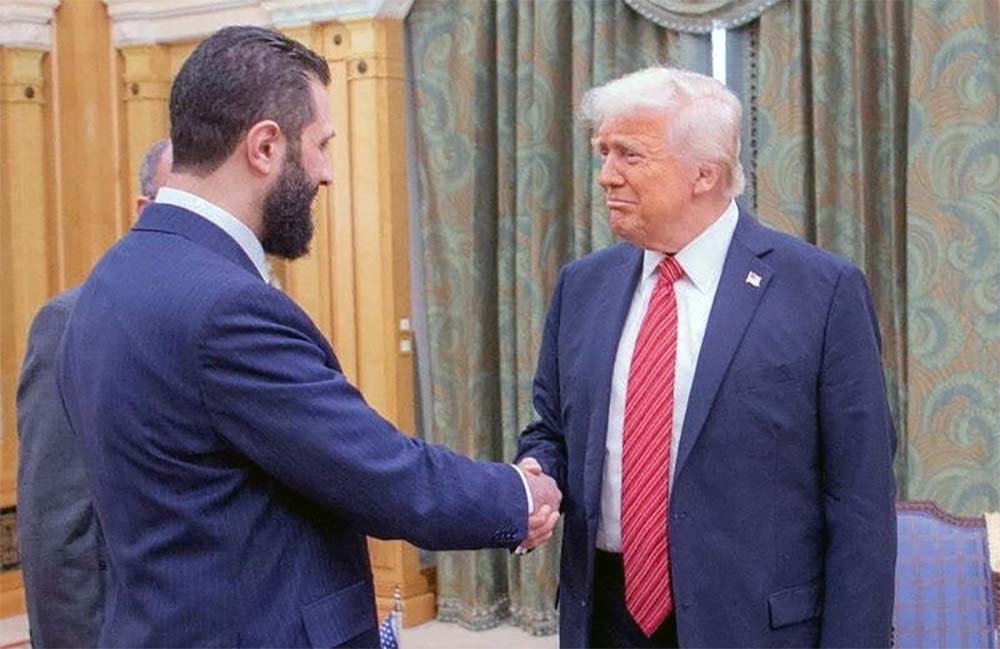
There is no logical explanation for Donald Trump's behaviour with Ahmed al-Sharaa other than ignorance of the Middle East and the Syrian situation
Trump and ignorance in Syria... and Sharaa’s agenda
It seems that it will take days, perhaps weeks, before judging the effectiveness of the Iranian policy of the Donald Trump administration, which is betting on the possibility of co-opting and absorbing the Iranian regime. It will not take, neither days nor weeks, to judge the failure of Donald Trump's bet on Syria's military intervention in Lebanon in order to control the “party.”
Thursday 25/06/2026
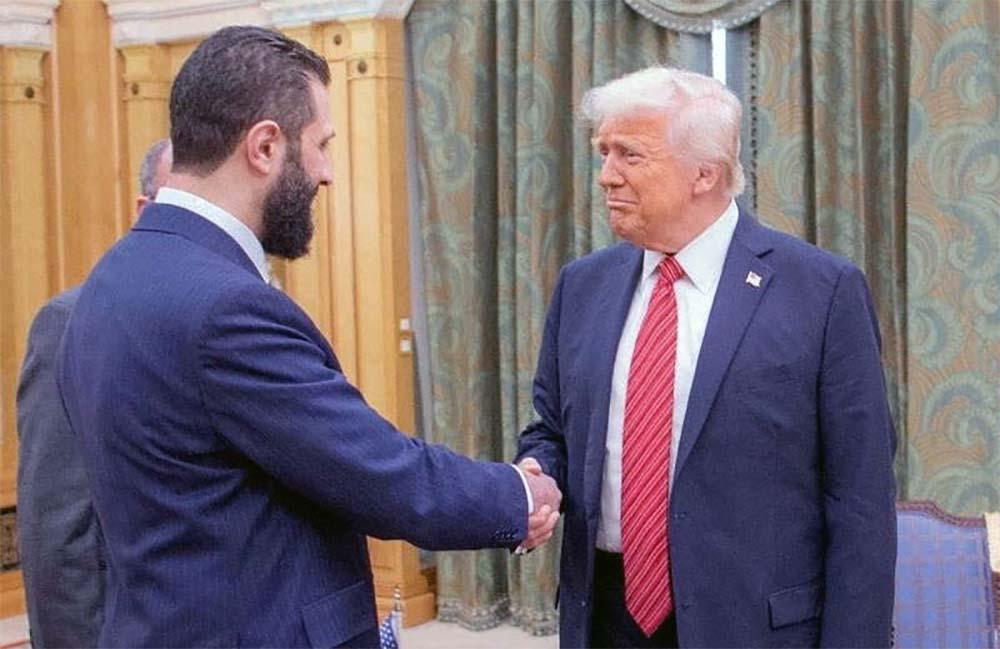
There is no logical explanation for Donald Trump's behaviour with Ahmed al-Sharaa other than ignorance of the Middle East and the Syrian situation
It is incomprehensible, in any form or logic, the US president's insistence on pushing President Ahmed al-Sharaa to enter Lebanon militarily and clash with Hezbollah, based on what Iran has committed against the Syrian people, directly or through its Lebanese proxy.
There is no logical explanation for Donald Trump's behaviour with Ahmed al-Sharaa other than ignorance of the Middle East and the Syrian situation. This does not bode well. The US President does not know that the agenda of the new Syrian regime is very different from his simplistic thinking, which is based on the experience of the Syrian army's entry into Lebanon in 1976, under Arab and Israeli cover, in order to seize control of the bases of Palestinian organisations in Lebanon.
Fabricating a quantity of smoke
In late 1975, Henry Kissinger, then the US Secretary of State, sent professional diplomat Dean Brown to Lebanon. According to the only diplomat who accompanied Dean Brown, whose task was to record the US envoy's meetings, Dean Brown's task was limited to passing time. This diplomat, who was in 1975, at the beginning of his career, told me that Kissinger asked Dean Brown to "make up as much smoke" as possible in order to make the administration appear to be trying to find a solution to the Lebanese crisis that began on April 13 of that year.
A few months after the outbreak of the Lebanese crisis and Dean Brown's return to Washington, Kissinger discovered that the only solution to prevent this crisis from becoming a regional conflict was for the Syrian army to enter Lebanon and take control of Palestinian bases.
Hafez al-Assad had been preparing himself for this task since before he monopolized power in November 1970. He then assumed the presidency at the beginning of 1971. He tightened his grip on the Syrian army and turned it into an army controlled by Alawite officers. At the same time, Assad Sr. presented his credentials to Israel when in 1974 he reached "points of understanding" with Kissinger himself regarding guaranteeing the security of the Jewish state in the occupied Golan. Above all, Hafez al-Assad had found, prior to that, in the "October War" of 1973, a legitimate cover for his regime, which took upon itself to raise the slogans of resistance to Israel and stand against it.
Assad entered under the cover of the United States
Hafez al-Assad entered Lebanon under American cover and known Israeli conditions. Donald Trump cannot relive that more than half-century-old experience at a time when Ahmed al-Shara is still working to stabilize his regime, and he is still trying to build an ideological army to replace the Alawite army built by Hafez al-Assad, which enabled him to pass power to his son Bashar. The need for many years to build a Syrian army is still not just a collection of factions and militias that fought and defeated the former Syrian regime thanks first to Turkish support and the decision of the government of Benjamin Netanyahu to withdraw its cover on Bashar al-Assad's regime secondly and finally.
Above all, there is no suggestion that Trump is aware of the regional implications of any Syrian military intervention in Lebanon at a time when it would not be unlikely that it would lead to an intervention in Syria by the Popular Mobilization Forces (PMF) militias in Iraq. These are militias that are mobilized sectarianly and will not find any reason to avoid pressure on Syria in the event of any confrontation between them and Hezbollah and a section of Lebanon's Shiites. There is no doubt that Israel dreams of the day when a Sunni-Shiite war, with an Iraqi extension, will break out, staged by Syria and Lebanon.
At the end of 1975, the Lebanese theater was preparing for a Syrian military entry into Lebanon, especially if we take into account Hafez al-Assad's desire to get his hands on an independent Palestinian decision on the one hand, and his personal hostility to Yasser Arafat on the other. Henry Kissinger, with his political genius and strategic mind, was known for exploiting regional contradictions in the interest of avoiding the transformation of the crisis in Lebanon and the small and large wars raging on his soil into a regional conflict in a world that was living in the shadow of the Cold War.
The US administration is confused
In mid-2026, a US administration is at a loss as to how to deal with Iran. This confusion is expressed only by the text of the memorandum of understanding that Washington reached with Tehran, which Iranian officials interpret in their own way. This memorandum only reflects complete ignorance of Iran and the absence of anyone in Washington, from within the administration, who is able to understand in depth the nature of the Iranian regime, its bet on time, and that there is no room to abandon the slogan of "exporting the revolution."
It is possible to respond with regard to the memorandum of understanding that opened the Strait of Hormuz in exchange for significant concessions obtained by the Islamic Republic, including the release of frozen funds whose use is unknown. On the other hand, there is no room to take a word regarding the Syrian intervention, which is required by the United States in Lebanon, only because Trump is asking Ahmed al-Shara to do what he does not seem willing or able to do.
Trump's stance raises all the concerns in a region where there is doubt about whether the American president is up to the level of events taking place in our world and has the ability to understand their dimensions and complexities.