

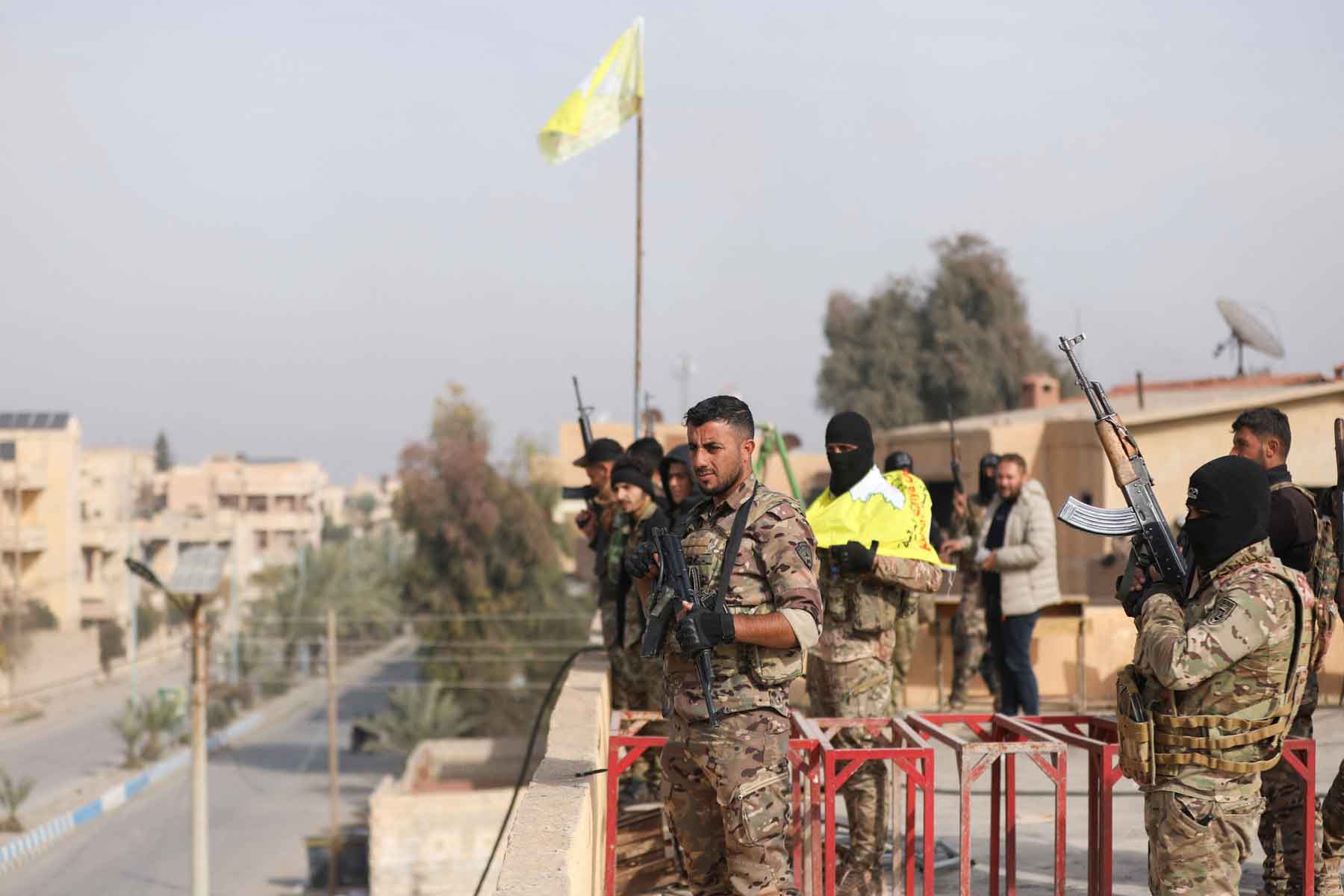
Members of the Kurdish-led Syrian Democratic Forces (SDF) hold weapons in Deir ez-Zor, December 7, 2024.
US presses on with plan to integrate SDF into Syrian state structures
On the anniversary of the fall of the former regime, the SDF called for a comprehensive national dialogue to rebuild Syria on the principles of democracy and equality.
Thursday 11/12/2025
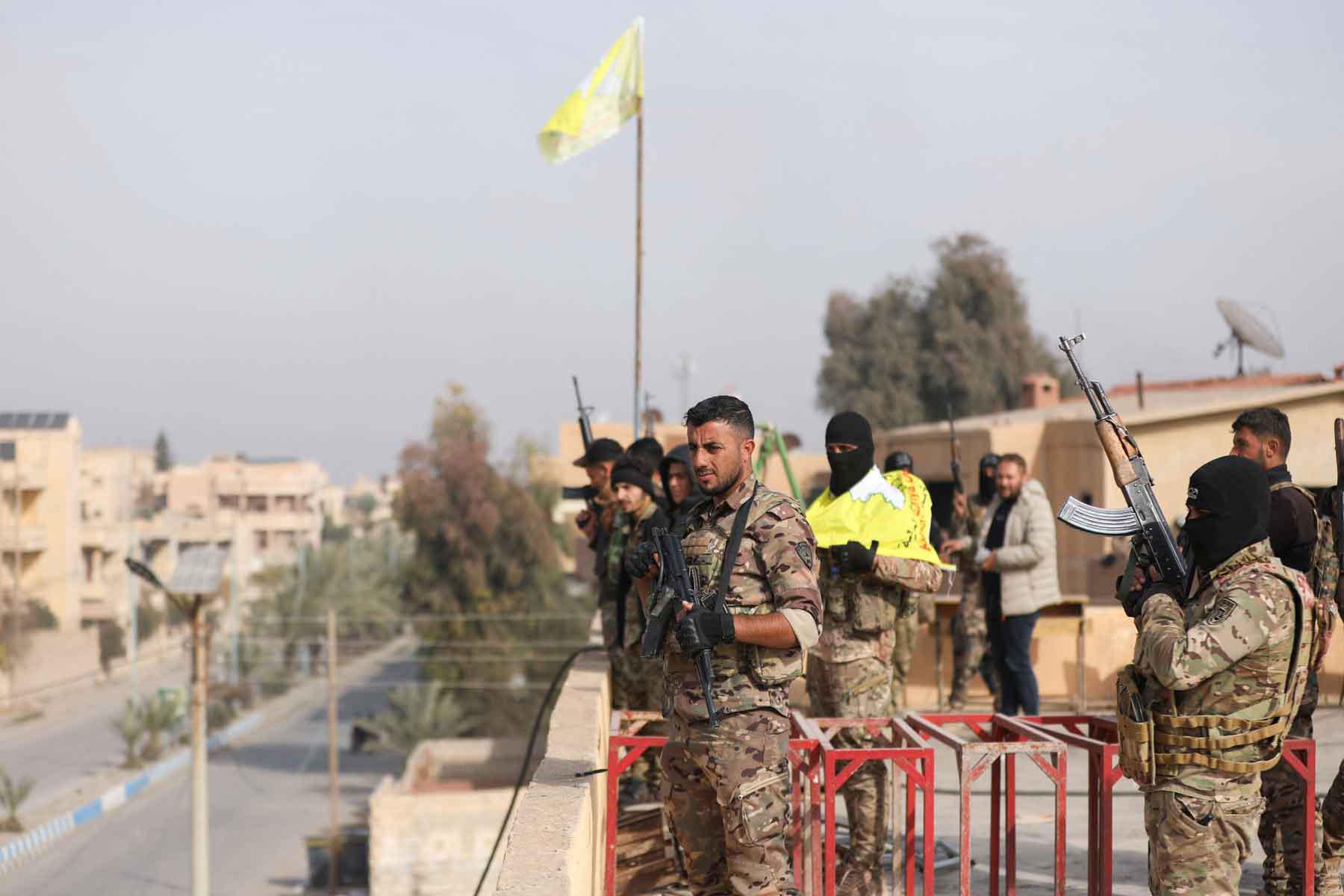
Members of the Kurdish-led Syrian Democratic Forces (SDF) hold weapons in Deir ez-Zor, December 7, 2024.
WASHINGTON
The head of US Central Command (CENTCOM) Brad Cooper said that integrating members of the Syrian Democratic Forces (SDF) into Syrian government forces is a prerequisite for creating a more predictable and stable security environment, as the United States steps up efforts to ease tensions between the two sides and advance the integration process.
Speaking virtually on Wednesday at the Syria Conference hosted by the Washington-based Middle East Institute, Cooper highlighted the integration agreement reached on March 10 between Damascus and the SDF, emphasising that Washington “stands ready to support” ongoing talks, including the latest round of negotiations held in Damascus.
He underlined that the United States and Syria share a common interest in maintaining peace and stability across the Middle East.
Cooper identified three core priorities for CENTCOM: “pursuing ISIS inside Syria, supporting the integration of SDF forces with the Syrian government and coordinating with Damascus to enhance counterterrorism operations.”
Washington views the integration of the SDF into Syria’s regular armed forces as a potential gateway to a comprehensive settlement, ending years of conflict and preventing extremist groups from re-establishing themselves in the north and east of the country.
On March 10, Syrian President Ahmed al-Sharaa and SDF leader Ferhad Abdi Shahin, also known as Mazloum Abdi, signed an agreement to integrate civil and military institutions in the northeast under state administration.
Diplomatic circles have described the accord as the most significant Syrian peace document in years. Its aim is to end the administrative and military separation that has persisted in the north and east, paving the way for these regions to return fully to Damascus’ authority.
However, the agreement has not prevented sporadic clashes at points of contact, particularly in Aleppo, Deir ez-Zor and Raqqa, which have so far been contained through US mediation.
Abdi has called for the Druze and Alawite communities to participate in negotiations on self-administration with the transitional Damascus authority, stressing that their demands regarding the northeast mirror those of Druze and Alawite areas, widely interpreted as a strategy to exert pressure on Sharaa.
During a visit to Washington last month, Sharaa urged the United States to play a direct role in overseeing the integration process, stressing that it represents a pivotal step towards rebuilding state institutions on inclusive, national foundations while preserving Syria’s territorial unity.
On the anniversary of the fall of the former regime, the SDF called for a comprehensive national dialogue to rebuild Syria on the principles of democracy and equality, advocating a new social contract, widely seen as a signal aimed at bridging divisions.
The SDF also noted that the peoples of north and east Syria have suffered for years under policies of exclusion, starvation and displacement, and that the next phase must close that chapter while fostering a new discourse focused on unity and solidarity, away from the incitement and division still exploited by some parties.