

Washington: Autonomy initiative is the most realistic framework for ending the conflict
US pressures Polisario, urges progress on Western Sahara settlement
American concerns have expanded beyond the Sahara conflict itself to include allegations regarding Polisario’s links to armed groups and trafficking networks.
Thursday 21/05/2026
Washington: Autonomy initiative is the most realistic framework for ending the conflict
RABAT – The United States has expressed growing frustration over obstacles delaying the resumption of negotiations on the Western Sahara dispute, as Washington intensifies diplomatic efforts to revive a stalled political process centred on Morocco’s autonomy proposal.
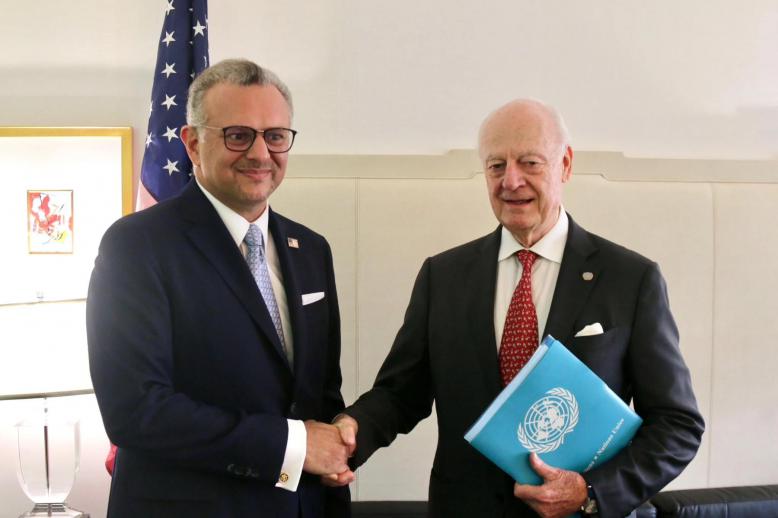
The position was conveyed by US Ambassador to Morocco Richard Duke Buchan following talks in Rabat with the UN Secretary-General’s Special Representative and head of the United Nations Mission for the Referendum in Western Sahara (MINURSO) Alexander Ivanko.
According to a statement released by the US Embassy in Rabat, Buchan said he had discussed “the Sahara peace process” with Ivanko and stressed that recent violence carried out by the Polisario Front had drawn “resounding international condemnation.”
He added that the separatist movement’s “continued refusal to engage seriously on the future of the Sahrawi people threatens progress,” underscoring Washington’s increasingly direct criticism of the Polisario Front amid renewed diplomatic activity around the decades-old dispute.
The ambassador reiterated that the United States “remains committed to peace through Morocco’s Autonomy Proposal,” while stressing that “peace requires partners willing to negotiate towards a brighter future.”
The remarks come as pressure mounts on the Polisario Front following revelations that informal contacts between Morocco and the separatist movement have quietly resumed in recent months under US and UN sponsorship.
Mohamed Yeslem Beissat, presented as the Polisario Front’s so-called foreign minister, acknowledged in an interview with Spanish newspaper El Español that Morocco and Polisario had already held three rounds of unofficial discussions since February. Two meetings reportedly took place in the United States while a third was held in Spain.
Beissat admitted that discussions focused on Morocco’s autonomy proposal during meetings in Madrid and Washington conducted under direct UN and US supervision as part of efforts linked to UN Security Council Resolution 2797.
The renewed contacts signal a significant shift in diplomatic momentum around the conflict, which has remained unresolved for nearly half a century despite repeated UN mediation attempts.
Moroccan analysts say the latest US statements reflect a broad bipartisan consensus in Washington supporting Morocco’s position and viewing Rabat’s autonomy initiative as the most realistic framework for ending the conflict.
The proposal envisages granting the Sahara region wide-ranging self-rule under Moroccan sovereignty while allowing local populations to manage their affairs within a unified Moroccan state.
Observers also say Washington increasingly views Algeria as a central actor in the dispute because of its political, financial and military backing for the Polisario Front and its hosting of the movement on Algerian territory.
The latest tensions intensified after Polisario forces launched projectile attacks on the southern Moroccan city of Smara on May 5, prompting swift international condemnation.
The US mission to the United Nations condemned the assault, warning that “such violence threatens regional stability and the progress made towards peace.”
“These actions are inconsistent with the spirit of the recent talks,” the US diplomatic mission said, adding: “The time to end this 50-year-old dispute is now.”
Washington further stressed that UN Security Council Resolution 2797 confirmed that “the Moroccan Autonomy Proposal lays out the path to peace in Western Sahara,” while calling on “all those resisting peace to genuinely commit to a brighter future.”
“The status quo cannot continue,” the statement added.
The attack on Smara has reinforced concerns in Washington and among Western allies regarding Polisario’s increasingly militant posture at a time when diplomatic efforts are being revived.
The issue has also resurfaced in the US Congress, where initiatives launched since June 2025 seek to classify the Polisario Front as a terrorist organisation.
American concerns have expanded beyond the Sahara conflict itself to include allegations regarding Polisario’s links to armed groups and trafficking networks operating across the Sahel region.
During an open congressional hearing in April, Monica Ager Jacobsen, Senior Bureau Official for the Bureau of Counterterrorism, publicly acknowledged US concerns regarding the Polisario Front for the first time.
“We share concerns about the Polisario Front and its impact in the counterterrorism space,” Jacobsen said.
She noted that areas where the Polisario operates are located near trafficking and militant activity zones in the Sahel, creating vulnerabilities “that external actors, including Iran, could seek to exploit.”
The latest US statements come amid an intensified diplomatic push led by Washington to relaunch negotiations and move towards a final political settlement.
In recent days, senior US diplomat Christopher Landau conducted a regional tour that included Rabat and Algiers in an effort to revive the stalled political process.
The diplomatic activity also coincides with a broader UN review of MINURSO’s future role and performance ahead of upcoming Security Council discussions on the mission’s mandate.
Meanwhile, influential US think tank the Stimson Center described the Sahara issue as the cornerstone of Moroccan foreign policy, noting that Rabat has made sovereignty over its southern provinces a strategic priority in its international relations.
The centre also observed that the UN-led process has gradually shifted away from earlier proposals centred on a referendum, which it said had proved “unworkable”, towards a negotiated political solution based on compromise.
For Morocco, the latest American position represents another major diplomatic gain after Washington’s recognition in recent years of Moroccan sovereignty over the territory and its consistent backing for the autonomy initiative.
For the Polisario Front and Algeria, however, the increasingly explicit US support for Rabat’s proposal and mounting international criticism of armed attacks mark a growing diplomatic challenge as efforts intensify to break one of North Africa’s longest-running conflicts.