

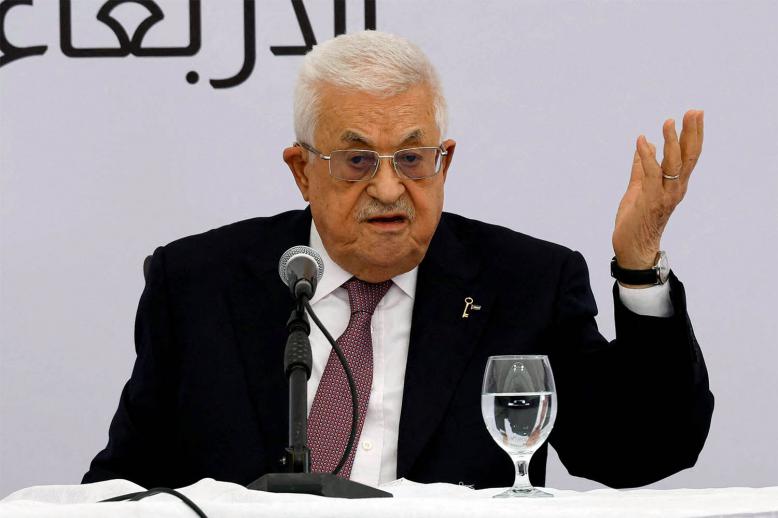
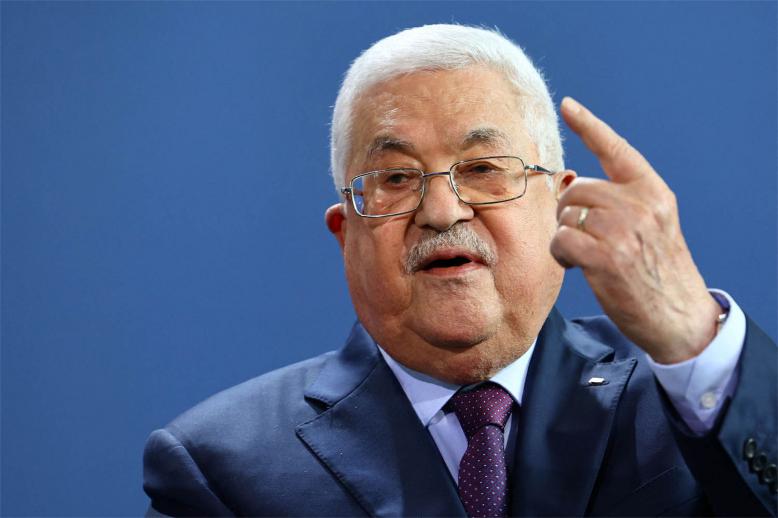
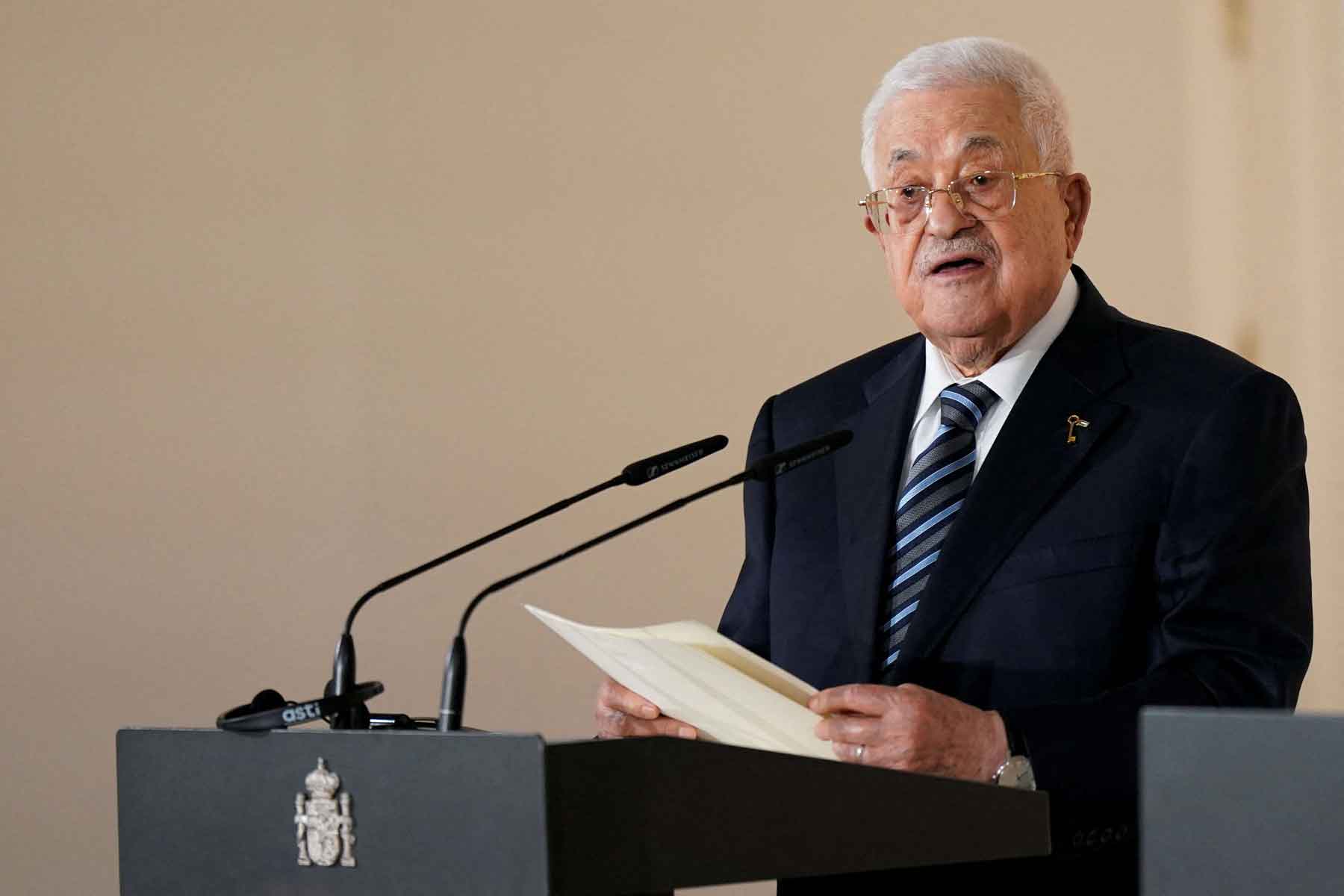
Palestinian Authority President Mahmoud Abbas holds a news conference at Moncloa Palace in Madrid, December 10, 2025.
Abbas defends reform drive amid donor pressure, street anger
International donors have long urged the PA to tackle corruption and overhaul public finances. Among the most sensitive demands are calls to reform Palestinian school curricula.
Thursday 25/12/2025

Palestinian Authority President Mahmoud Abbas holds a news conference at Moncloa Palace in Madrid, December 10, 2025.
RAMALLAH, West Bank –
Palestinian President Mahmoud Abbas on Wednesday renewed his commitment to sweeping constitutional, political and economic reforms, as his administration faces growing pressure from Western donors and mounting domestic anger over changes to payments for prisoners and families of those killed in the conflict with Israel.
In a statement carried by the official Palestinian news agency, Abbas, 90, said the Palestinian Authority (PA) was pressing ahead with a “comprehensive national reform programme” in line with its national and international obligations.
“We are proceeding with the implementation of a comprehensive national reform programme aimed at developing and modernising the legal and institutional system of the State of Palestine, consolidating the rule of law, strengthening the principles of good governance, transparency and accountability, and ensuring the separation of powers,” Abbas said. The reforms, he added, were intended to serve the public interest and restore citizens’ confidence in state institutions.
The Palestinian Authority was created in 1994 amid hopes it would pave the way for an independent Palestinian state in the occupied West Bank and Gaza Strip, with east Jerusalem as its capital. That prospect appears more distant than ever, despite recent steps by some Western countries towards recognising a Palestinian state.
Israeli settlement expansion has accelerated, while Prime Minister Benjamin Netanyahu has repeatedly rejected Palestinian statehood, describing it as a threat to Israel.
Donor demands and school curriculum
International donors have long urged the PA to tackle corruption and overhaul public finances. Among the most sensitive demands are calls to reform Palestinian school curricula.
Netanyahu told the United Nations General Assembly on September 26 that Palestinian textbooks taught children “hatred of Jews and the destruction of the Jewish state.”
Abbas said his reform programme would also cover education, including a review and update of school curricula “in accordance with international standards.”
This, he said, would be done in a way that “reinforces the values of tolerance, respect for the law, and rejection of violence and incitement, without compromising our inalienable national rights or our historical narrative.”
Defence of ‘Tamkeen’ amid backlash
Abbas also moved to defend the Palestinian National Institution for Economic Empowerment, known as Tamkeen, which he tasked with managing payments to Palestinian prisoners held in Israeli jails or recently released, as well as to families of those killed or wounded in the conflict.
His comments followed calls from senior figures within his Fatah movement to dissolve the body and find an alternative mechanism that would “preserve people’s dignity” in accessing financial assistance.
Abbas said Tamkeen was “an official national institution with an executive character,” operating solely to implement policies and decisions in accordance with the law, and holding no legislative or political authority.
“Placing responsibilities on it beyond its legal role constitutes a distortion of facts and unjustified harm to a national institution carrying out its duty within the unified reform and social protection framework,” he said.
Tamkeen is headed by Ahmad Majdalani, secretary-general of the Palestinian Popular Struggle Front and a member of the Palestine Liberation Organisation’s executive committee.
The party said on Monday it was following “with deep concern” what it described as public incitement campaigns against Majdalani at a particularly difficult moment for the Palestinian cause.
Protests and payment changes
In recent months, the PA has halted payments to hundreds of prisoners and to families of those killed or wounded, responding to Israeli and international pressure. It has replaced the previous system with a new mechanism that bases assistance on families’ economic circumstances rather than the length of imprisonment.
Under the new system, applicants must complete a 16-page questionnaire detailing their family’s economic and social situation before receiving aid.
The changes have sparked protests, particularly in the northern West Bank city of Nablus, where demonstrators have blocked major roads in recent days. Protesters object to transferring prisoners’ cases to Tamkeen and accuse the authority of bowing to foreign pressure.
Rayed Abu al-Hummus, head of the Commission of Prisoners’ and Ex-Prisoners’ Affairs, called for Tamkeen to be removed from the issue of prisoner payments.
“There is an urgent need to unify efforts to overcome the serious failures that Tamkeen and those running it have brought upon us,” he wrote on Facebook, arguing that the issue should be led by senior Fatah figures to ensure a “Palestinian national approach, not one that seeks to appease Israel, the United States and the West.”
Abbas, however, urged Palestinians to show national responsibility.
“We must not allow inciting or defamatory rhetoric to distract our national compass or weaken our internal front,” he said.
Israel tax revenues
Israel has for years deducted funds from tax revenues it collects on behalf of the PA, citing Palestinian payments to prisoners. Over the past seven months, Israel has withheld the revenues entirely, deepening the PA’s financial crisis.
Israel has accused the PA of failing to fully halt payments to prisoners, an allegation Palestinian officials deny, saying the new system is needs-based social assistance.
Until recently, families of prisoners and those killed or wounded received their allowances directly from the Palestinian finance ministry via post offices.