From climate stability to bodily integrity: How a systems approach redefines health
Analyst Heinz J. Sturm argues that modern healthcare must shift from a reactionary, symptom-based model to a systemic approach that integrates climate stability, water quality, and food security with human physiology.
Thursday 05/02/2026
BONN - For more than a century, modern healthcare systems have been built on a straightforward logic: diagnose disease, treat symptoms, and restore bodily function. This model has proven highly effective in acute medicine, surgery, and emergency care, and has contributed to major gains in life expectancy and quality of care.
Yet contemporary health transformations clearly reveal that this approach, while necessary, has reached its structural limits. Rising costs, ageing populations, and the widespread prevalence of chronic non-communicable diseases are placing growing pressure on health systems worldwide.
A Health System under Structural Strain
Experience across many industrialised countries points to a striking paradox: increasing health expenditure accompanied by stagnation or even decline in public health indicators. Insurance costs rise and access to services becomes more complex, without these efforts necessarily translating into healthier societies.
This paradox shows that the challenge does not lie in a lack of physicians or technologies, but in an organisational model that isolates health from its broader vital context. Health has been treated as a standalone sector, detached from water, food, energy, environment, and climate—despite the fact that these factors collectively constitute the physical and physiological foundations of human life.
Health as the Outcome of System Integration
Health does not begin in the clinic or the hospital, but in the conditions that structure everyday life. Water quality, food composition, environmental stability, and patterns of energy use all directly influence bodily functions and internal regulation. When these conditions are disrupted, disease emerges not as an incidental event, but as a logical consequence.
Focusing on symptom management while neglecting the drivers of disease results in health systems that are costly and limited in effectiveness. From this perspective, today’s health, environmental, and climate crises are deeply interconnected, representing different manifestations of a single dysfunction within the life-support system.
From Climate to Human Physiology
The Bonn Climate Project emerged from applied research in environmental and climate sciences, with particular attention to the role of water and hydrogen cycles in regulating energy and matter within natural systems. This research demonstrated that resilience is not achieved through isolated technical solutions, but through an understanding of how living systems function and self-regulate.
As this systemic perspective deepened, it became clear that the principles governing the stability of ecological and climatic systems are the same principles that govern human biological health. From this insight arose the Ars Medica Nova framework, conceived as a preventive health approach grounded in physiology and the laws of nature, rather than in symptom management alone.
Within this framework, health is understood as functional integrity: the ability of a living organism to regulate energy, water, and metabolism, and to adapt to change over time. This concept extends beyond humans to include soil, plants, and animals—encompassing the entire life-support system upon which human existence depends.
A Historical Perspective: Systemic Preventive Medicine
This understanding of health is not new. For centuries, the Levant, Anatolia, and Mesopotamia were leading centres of medical knowledge. Classical medical thought—from Hippocrates to Ibn Sina (Avicenna), Al-Razi, and Al-Kindi—conceived health as a dynamic balance between the human being and the environment.
Water quality, dietary patterns, movement, climate, and ways of living were central medical concerns, no less important than medicines themselves. These systems were distinguished by their emphasis on prevention and their long-term economic sustainability. This orientation was not an expression of nostalgic traditionalism, but of practical systemic thinking well ahead of its time.
Prevention as a Structural Necessity
Despite this legacy, modern health systems—particularly in the West—have prioritised treatment after the onset of disease, with limited investment in prevention as a structural principle. In the face of rising costs and the growing burden of chronic disease, prevention is no longer a reform option, but a strategic necessity for ensuring the sustainability of healthcare.
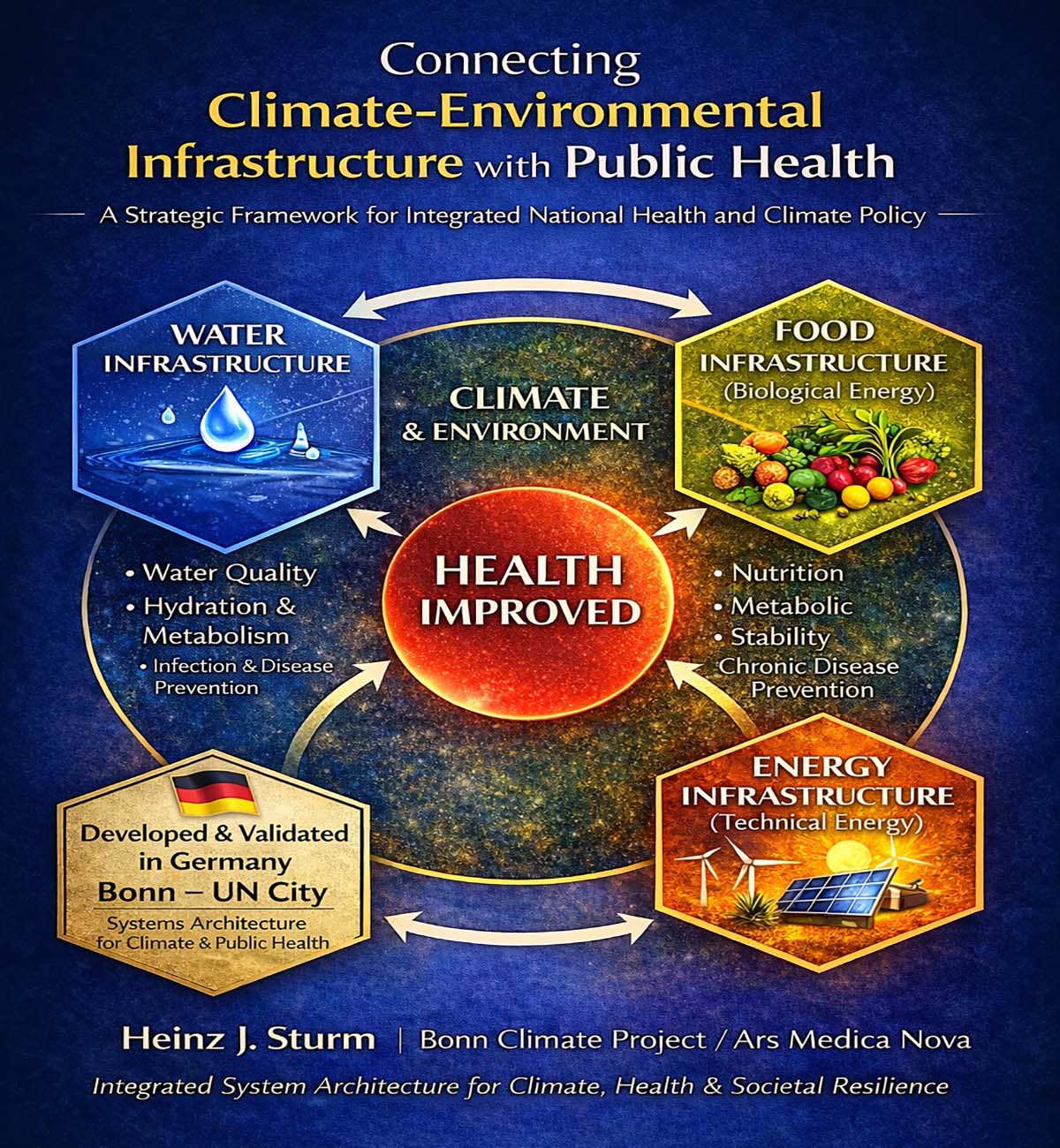
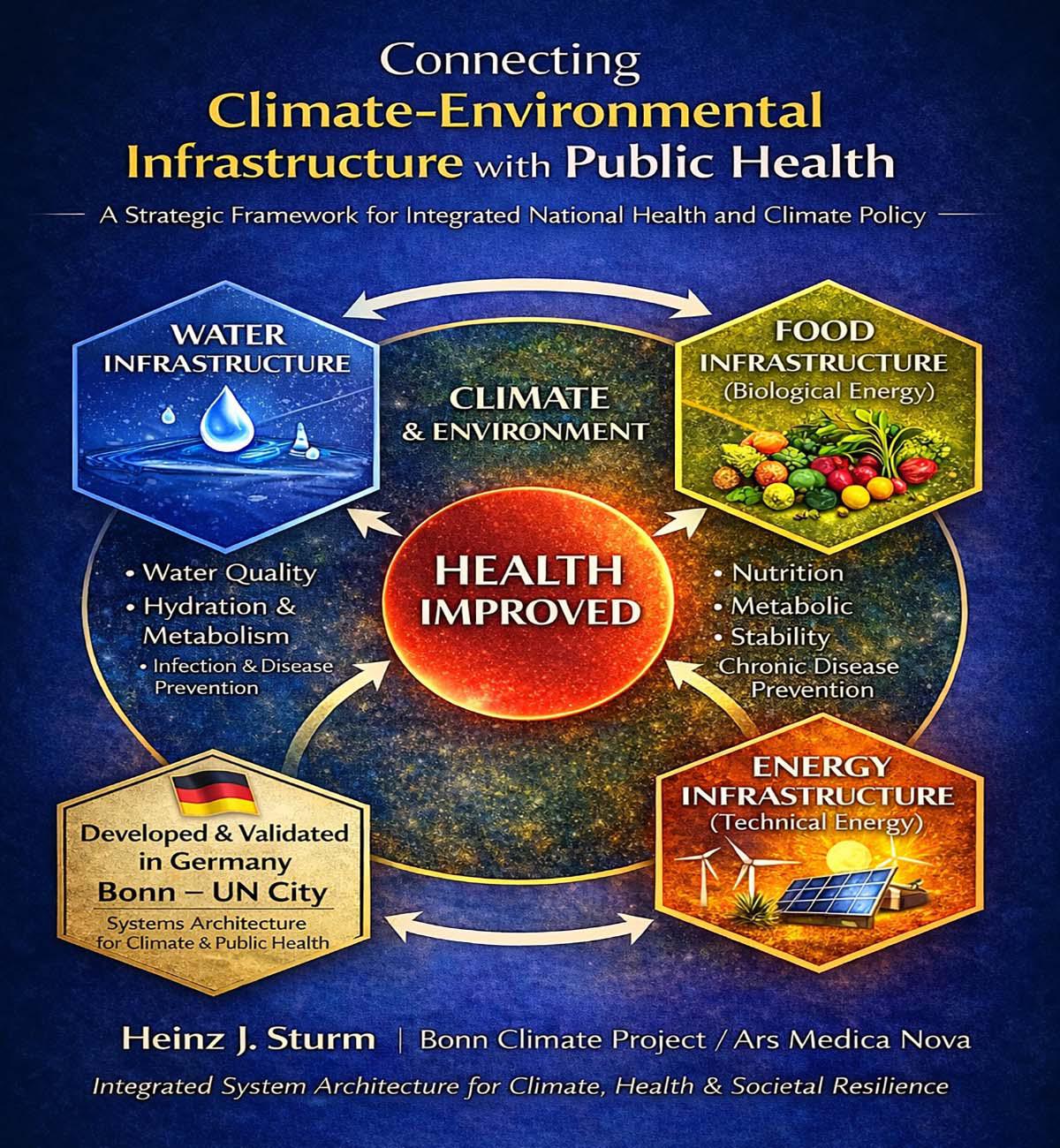
The Water–Energy–Food–Health Nexus
The water–energy–food–health nexus offers a practical framework for redesigning health systems. Sustainable health depends on:
- Clean and accessible water
- Fertile, nutrient-rich food systems
- Energy systems that support vital processes
- Living environments that preserve physiological balance
Accordingly, the central question is no longer how to treat disease more efficiently, but how to create conditions in which health is the natural state of society.
The Gulf States and a Strategic Opportunity
The Gulf states—particularly the Kingdom of Saudi Arabia and the United Arab Emirates—are undergoing profound transformations in their health systems as part of long-term development visions. These include strengthening prevention, improving spending efficiency, upgrading health infrastructure, and addressing demographic challenges and chronic diseases.
These trajectories reflect a growing recognition that health is no longer a purely medical matter, but a systemic issue linked to urban planning, food security, resource management, and environmental sustainability. This opens the door to integrated preventive models before financial and social pressures intensify further.
Health as a Long-Term Investment
When health systems are built on prevention, integration, and balance, health shifts from a recurring financial burden to a long-term investment. Healthier societies are more productive and better able to adapt to economic and environmental change.
“This systemic logic is further developed within the Ars Medica Nova framework, which translates preventive health principles into a coherent physiological and policy-oriented architecture.”
Conclusion
The future of healthcare will not be determined by more interventions or greater complexity, but by our ability to design better systems. Preventive, physiology-based approaches redefine health as the outcome of integrated life-support systems. By reconnecting climate, water, energy, and food with human physiology, the Ars Medica Nova framework opens a new horizon for more resilient and sustainable health systems in the Middle East and globally.
Heinz J. Sturm is a system architect and analyst and initiator of the Bonn Climate Project and the Ars Medica Nova framework. His work focuses on linking climate, environment, and energy with health through systemic models grounded in the laws of nature and life-support systems. He is based in Bonn, Germany.