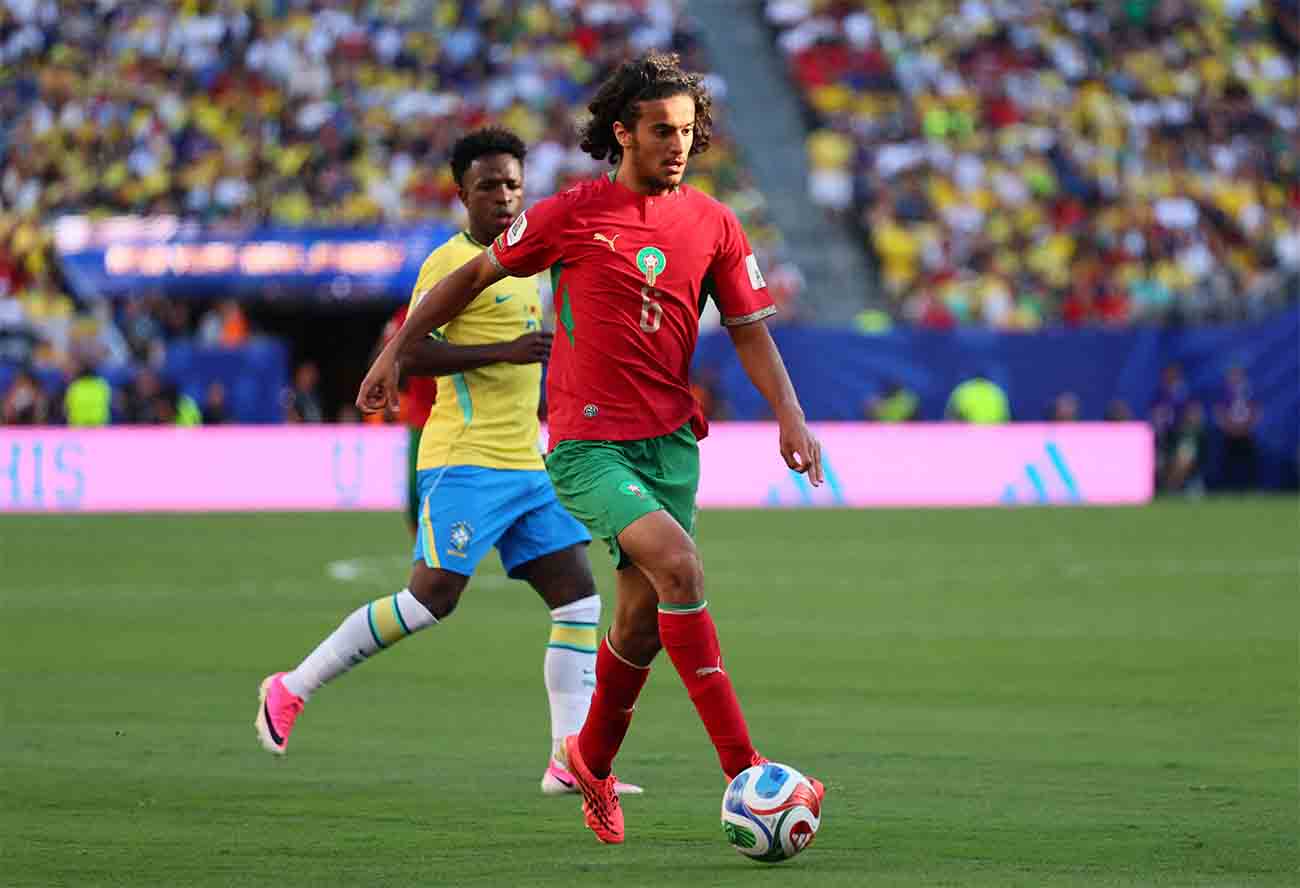
Bouaddi, a raw talent and intelligence
Morocco’s Ayoub Bouaddi thinks faster than the ball
Players who study mathematics do not just understand spaces; they understand the relationships between them. Ayoub does not run to reach the ball, but rather to reach the idea that will precede the ball.
Monday 22/06/2026
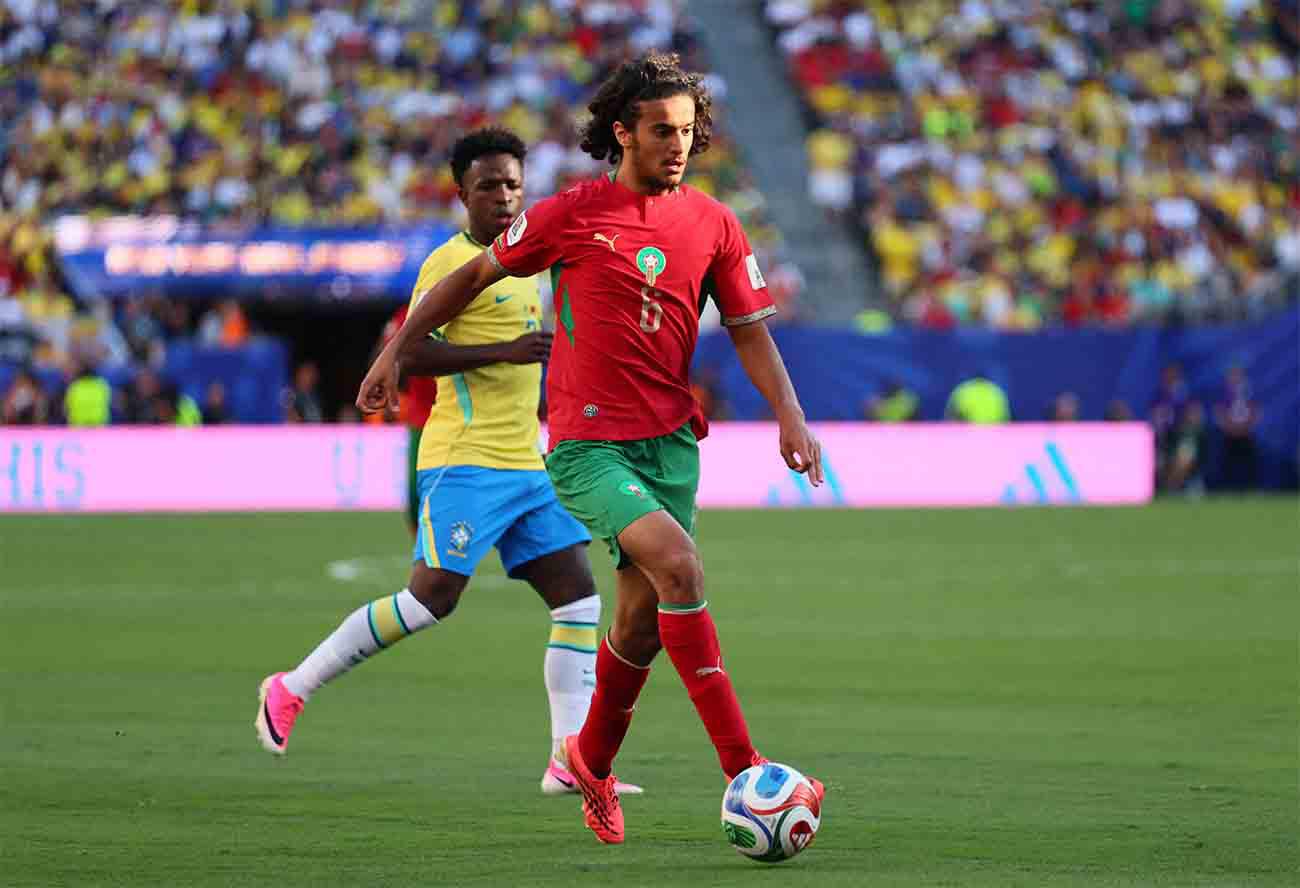
Bouaddi, a raw talent and intelligence
We must go back to those years when football philosopher Pep Guardiola used to sit for hours with Garry Kasparov, studying the chessboard as if it were a science of controlling time. There, in that territory where tactics meet intuition, we can find the key that explains the astonishing confidence displayed by the Moroccan national team players as they passed the ball to the young Ayoub Bouaddi. He was not just a midfielder; he was the one moving them, as if the pitch were a mathematics canvas and he was the only one who knew its equation.
The prevailing belief was that Ayoub is a math genius applying equations to the green rectangle as if he were solving a problem. This is not a metaphor. The young man, who recently turned eighteen, studies mathematics at the University of Paris and solves opponents' pressure just as he solves problems. But before university, before Lille, and before the Moroccan national team, he was a child in the northern suburbs of Paris—in those neighborhoods that produce players who know that talent alone is not enough. Born to Moroccan immigrant parents, he lived a double childhood: one language at home, another in the street, and football everywhere.
He used to go to school with a bag full of books and return with a bag full of dreams. His earliest coaches said that he "doesn’t play football, he thinks it." He was a child of few words and plenty of observation, watching his teammates the way one watches a chess piece searching for its correct square. That childhood shaped a player who knows that ascension begins from within—from the mind before the foot.
Thus emerged the Moroccan World Cup star, a philosopher of sports, not just a talented player. Simon Kuper, the football theorist and author of Soccernomics and Football Against the Enemy, described him as "a living example of psychological strength." I would add that he is an example of something deeper: a player who thinks before he runs, calculates before he passes, and senses before he touches the ball. He is a player who possesses that rare ability to transform a moment into an idea, an idea into a decision, and a decision into a pass that alters the entire direction of the match.
Watching Bouaddi anchor Morocco's midfield against Brazil and then Scotland—with "Guardiola present in the crowd, unable to hide his admiration for the little philosopher"—the question that forced itself was: How is this possible? An eighteen-year-old player, who only joined the national team this month, tops the touches list with 87 touches and carries himself as if he has played in three World Cups. His teammates were looking for him, not because he was the youngest, but because he was the clearest presence on the pitch. He was the fixed point in a constantly moving equation. Every ball passing through him seemed to pass through an extra brain—a brain that sees what others cannot.
This calmness is no accident. Bouaddi passed his science exams at sixteen and lives a double life: by day at the university studying logarithms, and by night on the pitch. His mathematical mind accompanies him wherever he goes. Players who study mathematics do not settle for understanding spaces; they understand the relationships between them. Ayoub does not run to reach the ball, but to reach the idea that will precede it. This is what makes his movements look simple, when in reality they are the result of precise calculations: angle, distance, pressure, timing. Everything is calculated, everything is calm, and everything is intentional.
Kuper reminds us that great players do not run away from pressure; they convert it into energy. Imma Puig, the psychologist who worked at FC Barcelona, says that a great player sees pressure as a challenge, whereas an average player sees it as a threat. Bouaddi belongs to the first category. He is one of those who enter the Coliseum every few days to re-prove themselves, much like the Roman gladiators who entered the Coliseum to face the crowd, opponents, and symbolic death anew each time.
Thus, Ayoub Bouaddi does not live on yesterday's match, nor does he fear tomorrow's. Only the present matters. This is what makes a player of his age look older than his years. He is not a "rising talent," but a "mature mind" in a young body.
Lilian Thuram, who won the World Cup with France in 1998 and the European Championship in 2000, once said that the beauty of football is to constantly put yourself in question. Bouaddi embodies this idea. He does not celebrate for long, nor does he break down for long. He is one of those players who forget their goals because the mission is what matters, not the result.
In the match against Brazil, the noise was deafening, but Ayoub seemed to hear only one thing: the rhythm of the team. Great players possess that ability to shut out the world, to turn clamor into silence, and to turn silence into vision.
Modern football is unforgiving. There is no longer much room for stars who live off charisma alone. Jack Grealish, the former England and Manchester City player, is an example of this—immense talent, but without rituals or discipline. Meanwhile, his former City teammate, the Portuguese Rúben Dias, who does "a hundred things before a match," is at the World Cup with Portugal while Grealish is not. Bouaddi belongs to this new generation: a generation of sporting monks, a generation of players who live by a strict regime and leave nothing to chance—players who know that success is not a moment, but a habit.
Bouaddi’s childhood in northern Paris produced a player who knows the meaning of rising from the bottom. France's academies refined his talent, but his Moroccan roots gave him that touch that cannot be taught: imagination. Today, he is the unspoken leader of Morocco's midfield, and tomorrow—in all likelihood—he will be at a major European club. But more important than the club is the concept: that Morocco has found a player who does not just settle for being good, but actually thinks.
Ayoub Bouaddi is not merely a project of a star. He is a project of a football thinker. A player who reads the pitch like an equation, solves pressure like a problem, and guides his teammates like an idea. In a few short years, we might see him somewhere else entirely—not just as a great player among the Atlas Lions, the pride of the Arab world and Africa, but as a mind leading an entire generation and redefining what it means to be a midfielder in modern football.