


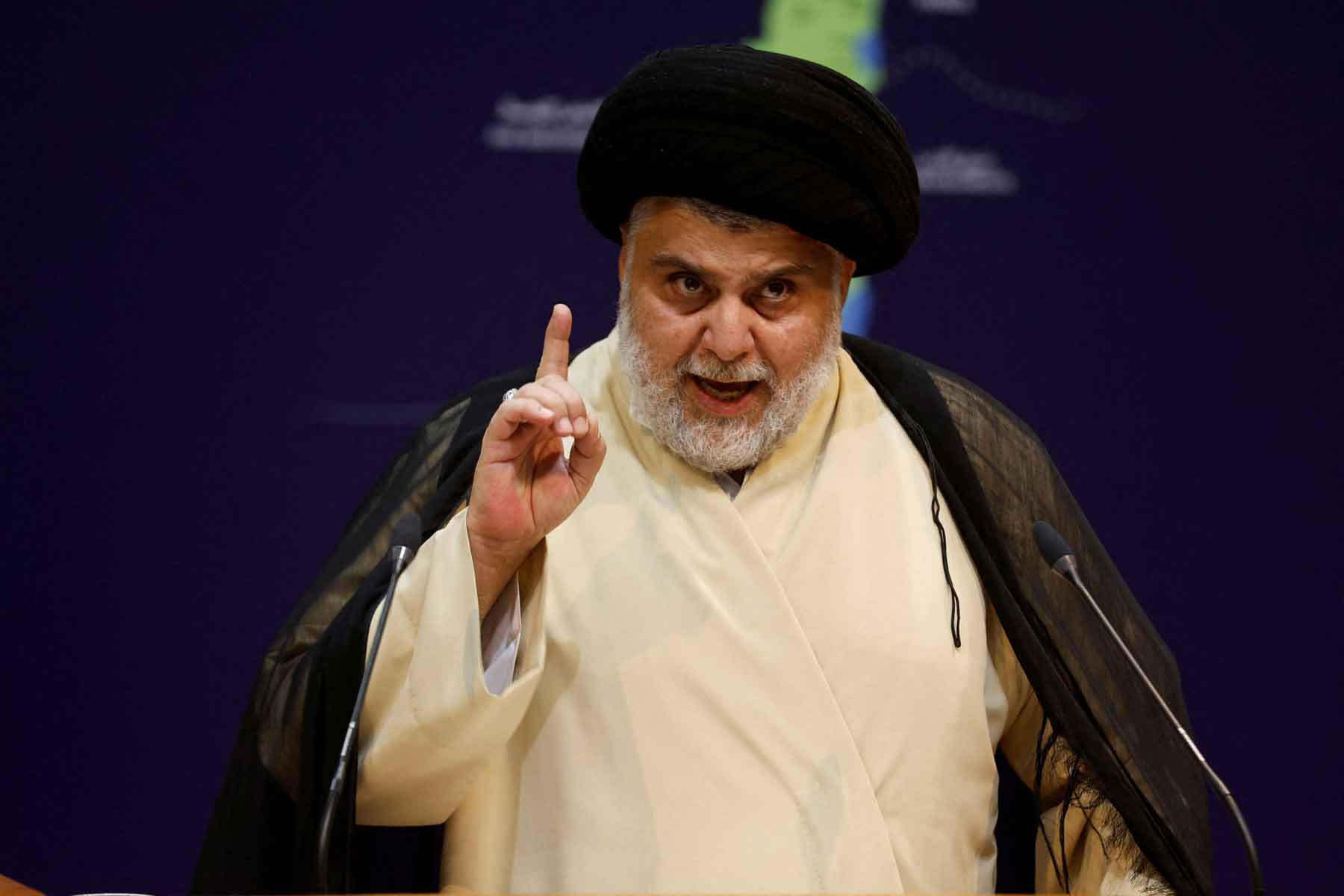
Iraqi Shia cleric Muqtada al-Sadr delivers a speech in Najaf, Iraq.
New calculus on armed groups as Sadr suspends Saraya al-Salam
Founded in 2014, Saraya al-Salam is widely seen as a revival of Sadr’s Mahdi Army, the militia that fought US forces after the 2003 invasion.
Wednesday 17/12/2025

Iraqi Shia cleric Muqtada al-Sadr delivers a speech in Najaf, Iraq.
BAGHDAD -
Muqtada al-Sadr’s decision to suspend the activities of his armed faction, Saraya al-Salam, and close its offices in Basra and Wasit for six months has sparked intense debate across Iraq’s political and security circles, with analysts viewing the move as more than an internal disciplinary measure.
Issued in a rare, uncompromising tone, the directive points to a broader reassessment of the role, limits and political cost of armed groups in a country marked by fragility and heightened tensions. Rather than framing the suspension as a routine organisational step, Sadr positioned it as a corrective measure against repeated violations that risked turning a force he once portrayed as protective into a potential source of instability.
“My dear brother Tahsin al-Humaidawi, I urge you to freeze the activities of the Saraya al-Salam brigades and close their headquarters in Basra and Kut for six months, pending a solution to the repeated violations and defamation of the reputation of Saraya al-Salam fighters,” Sadr said, appointing Humaidawi, the deputy head of Saraya al-Salam, to oversee the full suspension.
The six-month timeframe, coupled with the assertive language, underscored that this was a decisive intervention rather than a symbolic warning. Analysts suggest the order carried a dual purpose: internally, it aims to enforce discipline within Sadrist ranks; externally, it sends a signal to Iraq’s wider political arena, where even minor armed miscalculations can rapidly escalate into national crises.
Sadr, head of the National Shia Movement, formerly the Sadrist Movement, hinted that a “third party” might have sought to tarnish the militia’s image, without specifying who. He stressed that the group’s reputation outweighed the operational importance of its offices, signalling a willingness to sacrifice visibility to preserve political capital.
Founded in 2014, Saraya al-Salam is widely seen as a revival of Sadr’s Mahdi Army, the militia that fought US forces after the 2003 invasion. The faction has long been both a source of leverage and a potential liability for the cleric, who remains one of Iraq’s most influential Shia figures. Observers describe the latest move as among the strictest measures Sadr has taken against his armed wing in years.
What distinguishes the decision, analysts note, is its moral and disciplinary framing. Instead of invoking security threats or political conspiracies, Sadr emphasised ethics, restraint, and internal order, reflecting his long-standing warnings against internal discord. The implicit message: weapons without discipline cease to protect and instead endanger both their holders and the nation.
The statement also avoided blanket blame, explicitly praising fighters described as disciplined and aware, while distinguishing them from others accused of misconduct or of allowing the group’s name to be exploited. The approach appears designed to preserve internal cohesion and prevent backlash among the movement’s popular base.
Politically, the freeze is widely interpreted as preventive. Iraq is navigating a period in which domestic tensions intersect with regional rivalries, making any armed incident potentially explosive. By sidelining Saraya al-Salam, Sadr appears to be insulating his movement from escalation scenarios that could divert it from strategic priorities.
The move coincided with sensitive corrective steps by the Iraqi government following an institutional error in the official gazette, al-Waqa’i al-Iraqiya, published on November 17. The document had listed Lebanon’s Hezbollah and Yemen’s Houthi movement as entities whose funds were frozen without completing legal procedures or securing necessary approvals.
Prime Minister Mohammed Shiaa al-Sudani’s office said an investigative committee was immediately formed, leading to the dismissal or reassignment of several officials and a commitment that those responsible would face full legal accountability. The central bank clarified that the inclusion of the two groups was an unintentional oversight and that instructions were issued to correct the content, emphasising that Iraq’s official political and humanitarian positions remained unchanged.
Observers say the timing of the two developments is telling. As Sadr moves to rein in his armed wing to safeguard credibility, the state simultaneously acts to contain an institutional lapse before it escalates into a political or diplomatic crisis.
Together, the steps point to a broader effort to restore discipline across Iraq’s fragmented political and security landscape. In a period of heightened sensitivity, even limited missteps carry outsized consequences.
Between the suspension of Saraya al-Salam and swift government corrective actions, one message is increasingly clear: tolerance for disorder is shrinking, and accountability is now an essential prerequisite for navigating Iraq’s precarious political moment.