

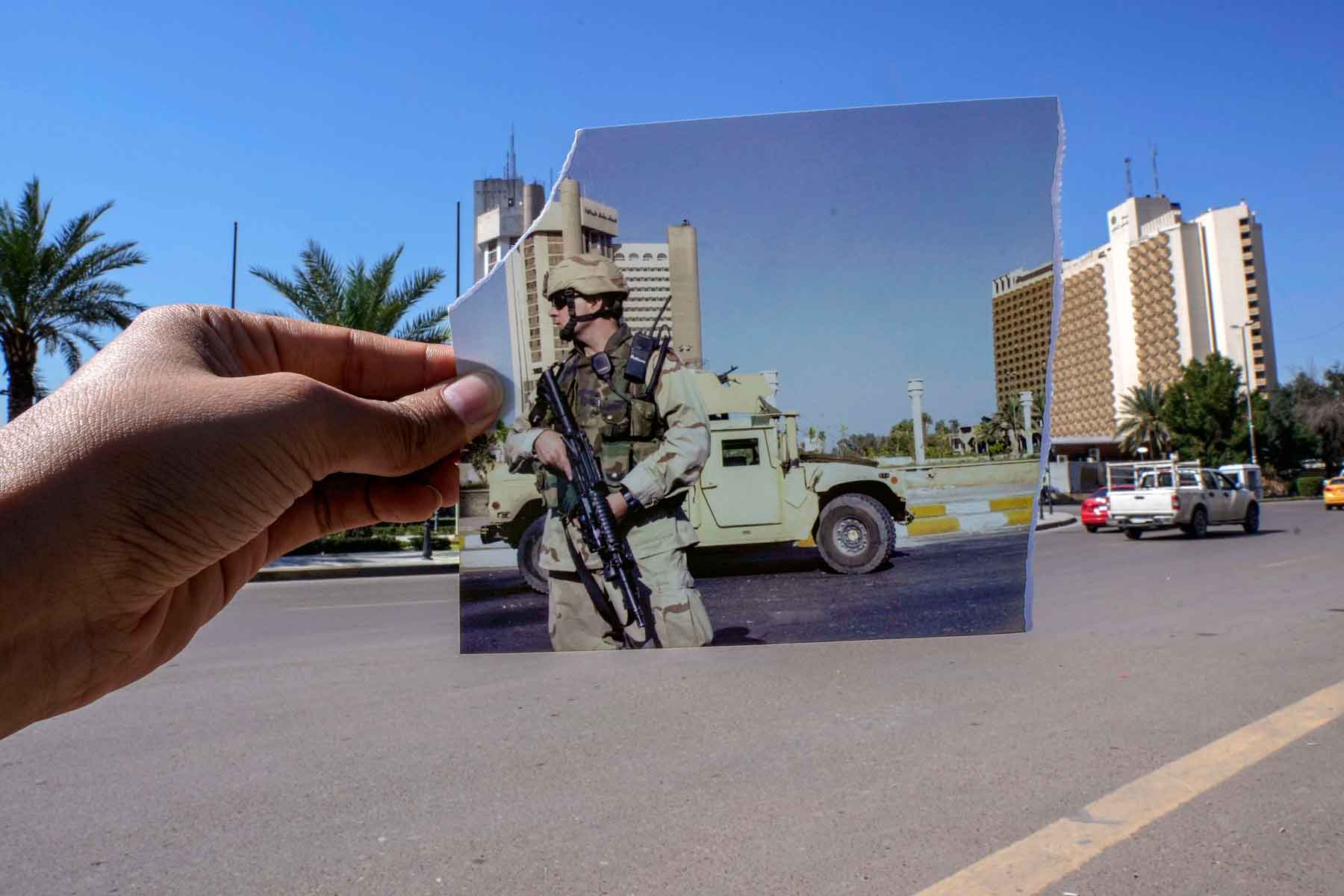
A photograph of a US soldier standing guard in Firdous square in front of the Sheraton (L) and Palestine hotels after they came under attack, July 2, 2004 is inserted into the scene at the same location, March 10, 2023.
Iraq gains political breathing space as US scraps war authorisations
Legally, the move closes a chapter that had remained awkwardly open for more than three decades.
Thursday 18/12/2025
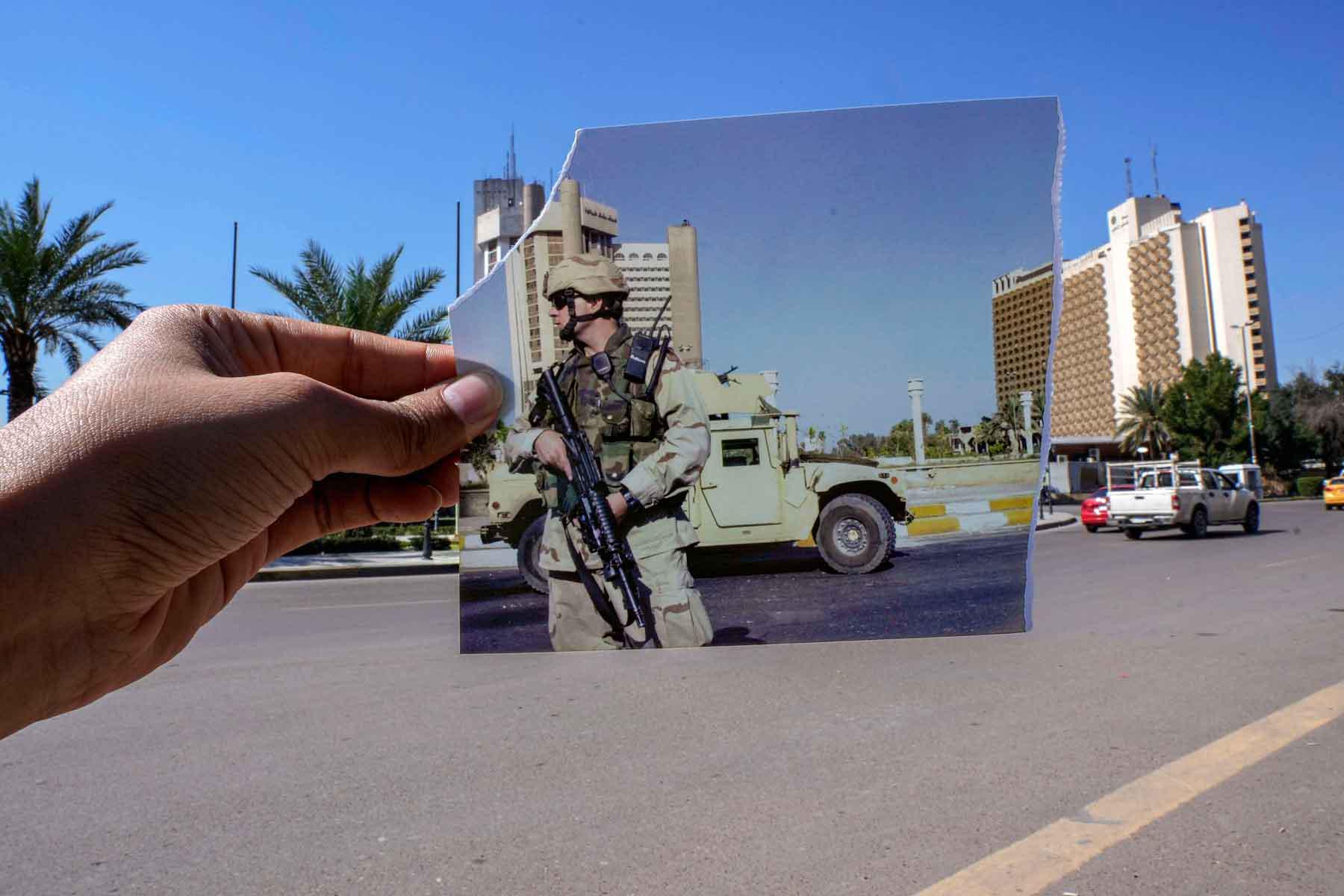
A photograph of a US soldier standing guard in Firdous square in front of the Sheraton (L) and Palestine hotels after they came under attack, July 2, 2004 is inserted into the scene at the same location, March 10, 2023.
BAGHDAD
The US Congress’s decision to repeal the 1991 and 2002 Authorisations for Use of Military Force (AUMF) against Baghdad has struck a chord far beyond Washington, carrying weighty political, legal and emotional implications inside Iraq itself.
While largely symbolic from an American standpoint, the move touches one of the most sensitive fault lines in Iraq’s modern political consciousness: sovereignty, and the long shadow cast by decades of war and foreign intervention.
For Baghdad, the repeal offers a crucial moral and political dividend. Iraqi governments have long faced internal accusations that the country remains legally exposed to external military action, with the continued existence of US war authorisations cited as proof that Iraq was still treated as an open battlefield rather than a fully sovereign state.
By scrapping those legal frameworks, Washington has undercut a powerful domestic narrative. Iraqi officials can now argue with greater confidence that relations with the United States rest on formal agreements and diplomatic understandings, not on dormant war mandates that could, in theory, be reactivated at any moment.
The decision strengthens the hand of the executive in debates over foreign military presence and its legal limits, while weakening political factions that have relied on opposition to US influence as a mobilising tool. Without open-ended war authorisations to point to, anti-American rhetoric becomes harder to sustain, analysts say.
Conversely, parties advocating a more balanced relationship with Washington and the wider international community stand to benefit. The repeal reinforces their argument that Iraq can engage externally on the basis of sovereignty rather than subordination, potentially recalibrating parts of the domestic political debate, even if only gradually.
Legally, the move closes a chapter that had remained awkwardly open for more than three decades. Since 2003, Iraq has sought to rebuild its constitutional order and reassert state authority, yet this effort coexisted uneasily with foreign legislation that explicitly sanctioned the use of force against it.
Ending that contradiction aligns more closely with Iraq’s constitutional narrative and bolsters the sense that the country is, at least in legal terms, edging away from its status as a post-war state.
On the security front, the repeal is unlikely to transform realities overnight. Iraq continues to grapple with lingering threats from jihadist groups and pockets of instability. But analysts say removing the war authorisations reduces the perceived risk of unilateral external escalation, easing both public anxiety and political tension.
That shift carries psychological weight. It reinforces confidence that security challenges can be addressed through Iraqi institutions rather than imposed military action, strengthening trust, however fragile, in the state’s capacity to manage its own affairs.
The economic impact is indirect but potentially significant. Investor sentiment, both domestic and local private-sector confidence, remains tightly bound to perceptions of stability and sovereignty. The continued existence of war mandates had long reinforced a sense of legal uncertainty, discouraging long-term planning and investment.
Their repeal sends a reassuring signal internally, suggesting that Iraq is gradually moving out of the legal grey zone associated with war, a development that could help foster economic confidence and encourage domestic investment.
Perhaps most profound is the symbolic dimension. US-led wars left deep scars in Iraq’s collective memory, and the persistence of their legal justifications was widely viewed as an unresolved wound. For many Iraqis, repealing the authorisations amounts to a tacit acknowledgment that the era of wars has ended, even in the absence of apology or reparations.