

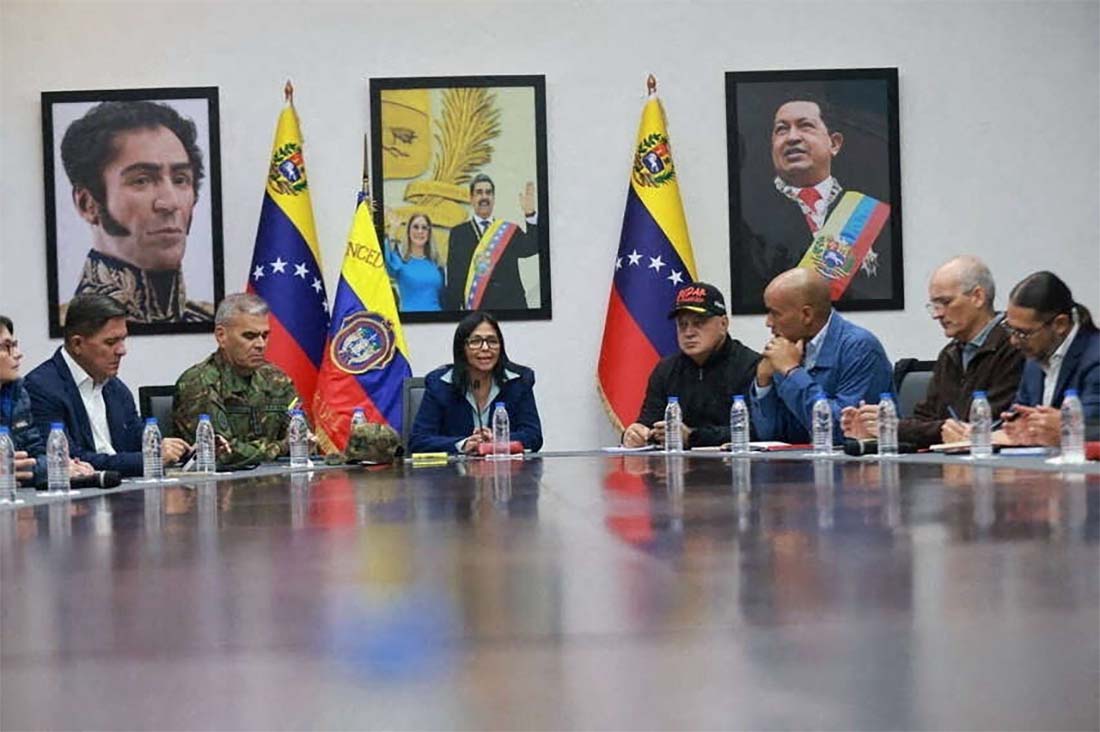
Venezuela's acting president Delcy Rodríguez (C)
Report Qatar helped Venezuela obtain ‘proof of life’ of Maduro
Venezuela's acting president credits Qatari Emir and his government with stepping in during "the darkest hours" to secure the first verifiable confirmation that Maduro and Flores were alive and in US custody.
Monday 12/01/2026
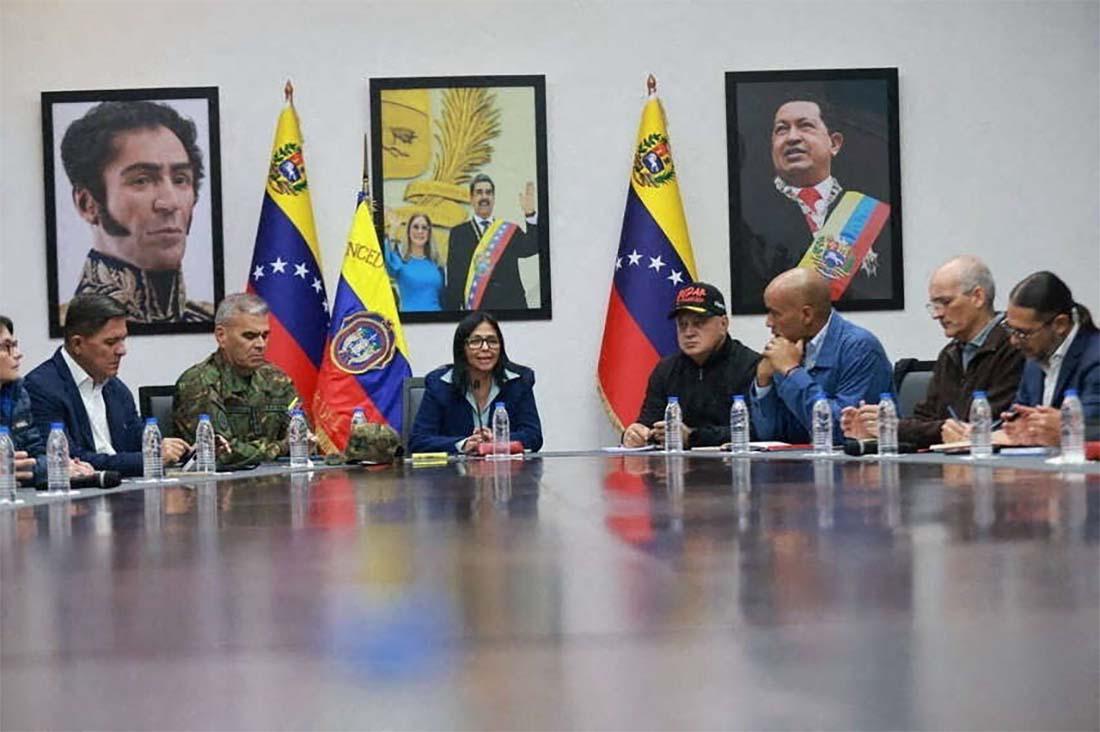
Venezuela's acting president Delcy Rodríguez (C)
CARACAS - Venezuela's acting president, Delcy Rodríguez, publicly thanked the State of Qatar for facilitating the initial "proof of life" confirmation for captured President Nicolás Maduro and his wife, Cilia Flores, following their dramatic abduction by US forces earlier this month.
The statement, delivered during a televised address and reported by state-run Venezolana de Televisión (VTV), highlights Qatar's role as a mediator in the chaotic hours after the US military operation on January 3, which saw elite Delta Force units seize Maduro from his residence in Caracas while airstrikes targeted key military installations.
US President Donald Trump announced the operation on Truth Social, describing it as a "large-scale strike" that resulted in Maduro and Flores being "captured and flown out of the Country." The pair were transported aboard the USS Iwo Jima and later arraigned in a New York federal court on January 5, where they pleaded not guilty to charges including narco-terrorism, drug trafficking, and related conspiracies.
Rodríguez — Maduro's former vice president, sworn in as acting president by Venezuela's Supreme Court — initially demanded "proof of life" from the Trump administration, condemning the raid as a "kidnapping" and violation of international law and head-of-state immunity.
Qatar's mediation role
Rodríguez credited Qatari Emir Sheikh Tamim bin Hamad Al Thani, his government, and prime minister with stepping in during "the darkest hours" to secure the first verifiable confirmation that Maduro and Flores were alive and in US custody.
"I want to emphasise and thank the Emir of Qatar, who, in the darkest hours of the early morning when Venezuela was being attacked, helped — he himself, his government, and his prime minister — to obtain the first proof of life of the president and the first lady," Rodríguez stated. "I want to thank him on behalf of the government and the people of Venezuela."
She said that Qatar established "a channel of communication and dialogue" between Caracas and Washington, and is assisting in a "working agenda that is beneficial to both parties within the framework of respect for international law" and Venezuelan sovereignty.
Qatar's foreign ministry had earlier expressed readiness to contribute to peaceful resolutions following the strikes, which Venezuelan officials claim killed dozens, including civilians and military personnel.
Qatar's involvement aligns with its history of mediating high-profile international disputes, from hostage negotiations to regional conflicts. Doha has maintained ties with the Maduro government, including economic and diplomatic relations, despite US sanctions.
The US operation has drawn widespread condemnation from allies of Venezuela, including Russia and China, which labeled it an act of aggression. Meanwhile, Trump has stated the US will "run" Venezuela temporarily to ensure a "proper transition," focusing on its vast oil reserves.
Rodríguez has balanced defiance — insisting Maduro remains the legitimate president — with pragmatic overtures toward cooperation, including potential economic reforms. Hardline figures like Interior Minister Diosdado Cabello continue to wield influence, urging resistance while navigating US pressure.