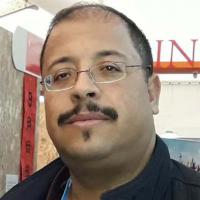
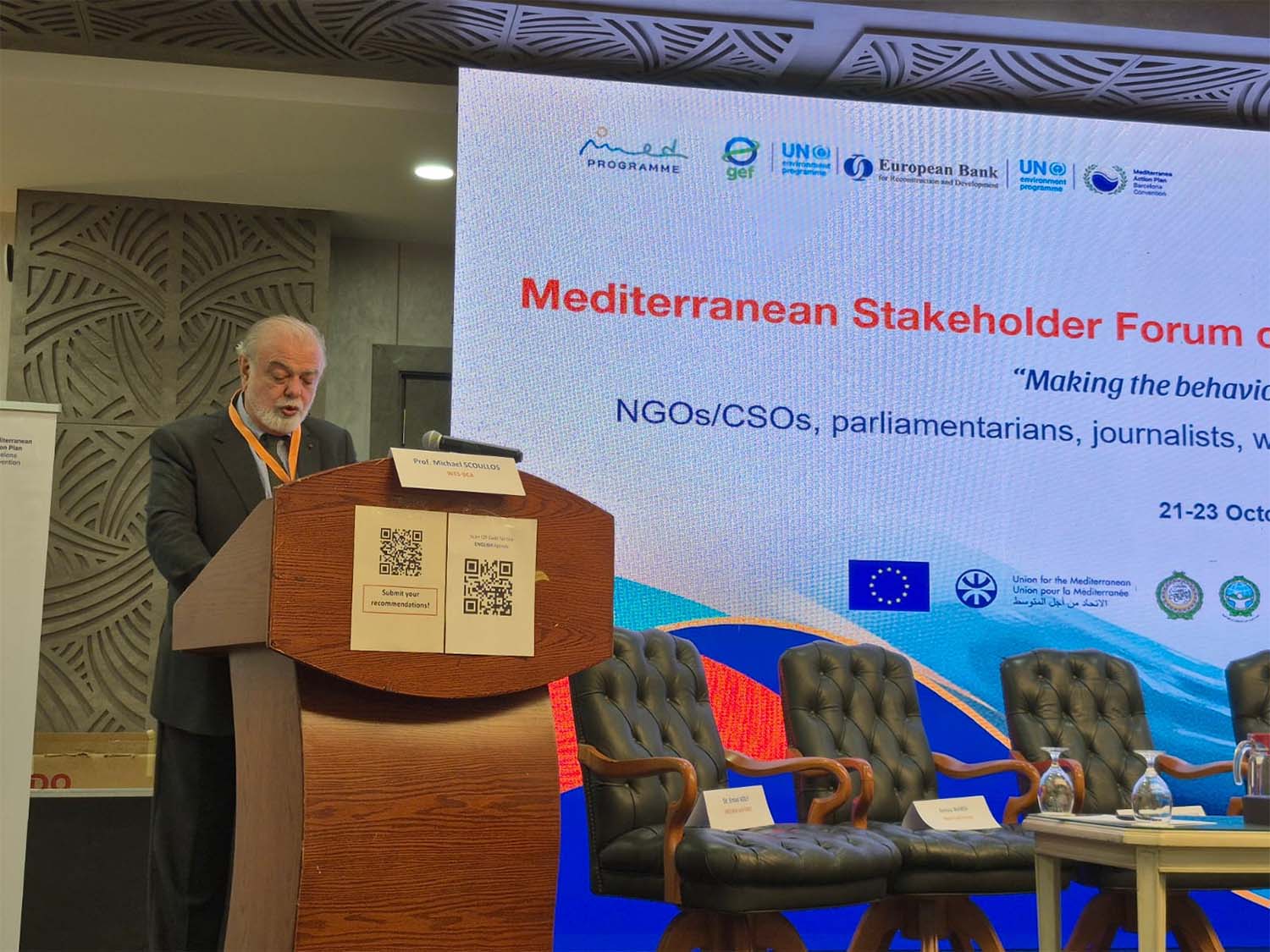
Professor Scoullos said the climate crisis in the Mediterranean region is no longer a purely environmental issue, but one that deeply affects water, food, and social security
Mediterranean forum on environment and climate action in Cairo: From awareness to action
The meeting embodied a new phase of joint regional Mediterranean action, aiming for a deeper understanding of the accelerating environmental and climate challenges and a rethinking of individual, institutional, and national behaviors toward the environment, not as an exhaustible resource but as a foundation of life.
Monday 03/11/2025
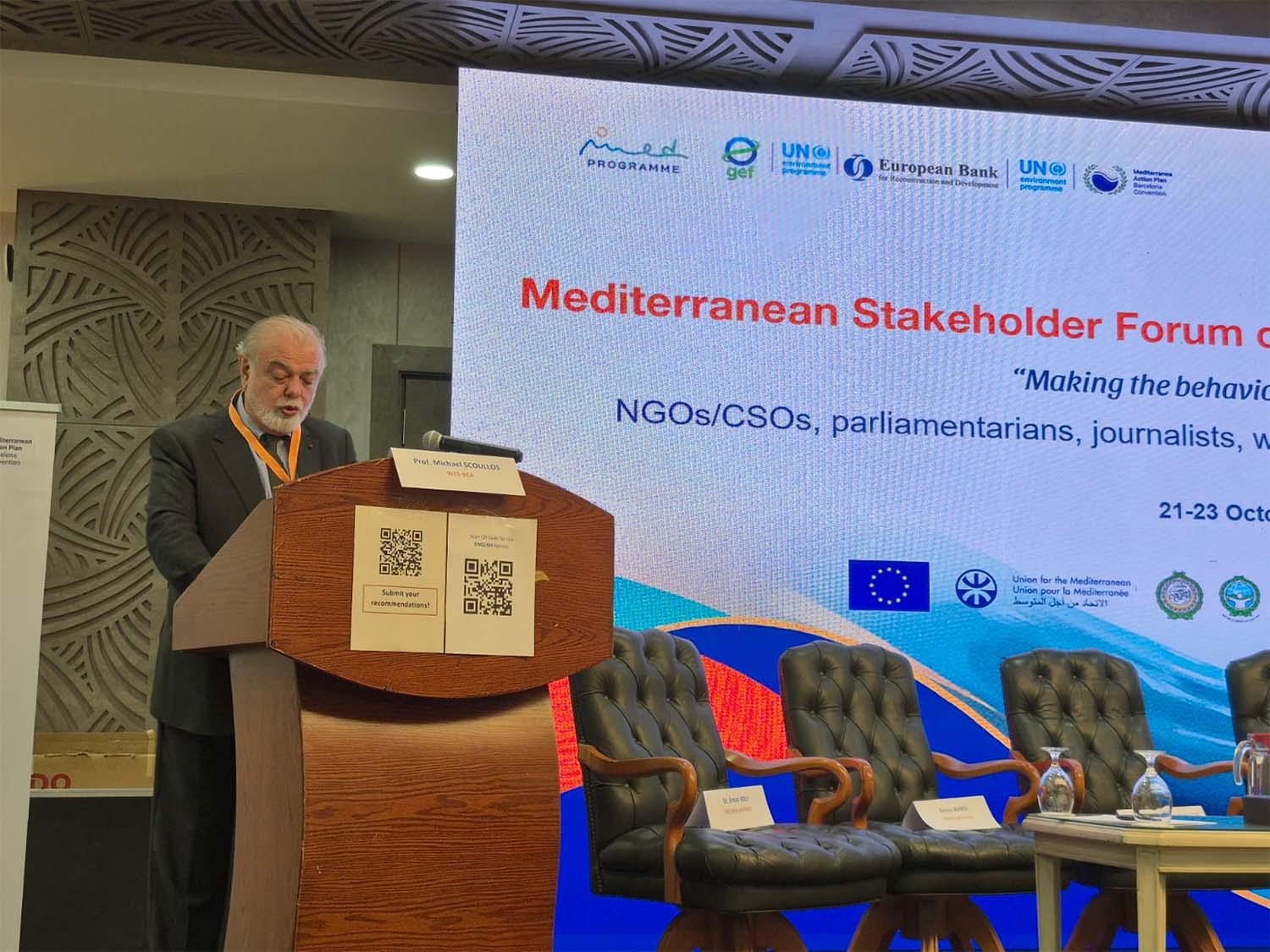
Professor Scoullos said the climate crisis in the Mediterranean region is no longer a purely environmental issue, but one that deeply affects water, food, and social security
CAIRO - At a decisive environmental crossroads in Mediterranean history, where the impacts of climate change intersect with development pressures, urban expansion, and dwindling natural resources, dozens of stakeholders, experts, parliamentarians, journalists, and representatives of women’s and youth organizations from both shores of the Mediterranean gathered in Cairo from October 21 to 23, 2025, for the Mediterranean Stakeholders Forum on Environment and Climate Action, held under the theme: “Making the Behavioural Shift Happen, Driving Behavioural Change.”
The Forum was organized by the Mediterranean Information Office for Environment, Culture and Sustainable Development (MIO-ECSDE), a partner in both the Water and Environment Support (WES-BCA) project in the Southern Mediterranean and the Global Environment Facility (GEF)-funded Mediterranean Program, and was hosted and coordinated by the Arab Network for Environment and Development (RAED), with the support of the European Union and the participation of civil society organizations and the League of Arab States.
The meeting embodied a new phase of joint regional Mediterranean action, aiming for a deeper understanding of the accelerating environmental and climate challenges and a rethinking of individual, institutional, and national behaviors toward the environment, not as an exhaustible resource but as a foundation of life.
By hosting and organizing the Mediterranean Forum on Environment and Climate Action in Cairo, RAED reaffirmed its leading role as a unifying platform for environmental and social actors across both shores of the Mediterranean.
Thanks to the meticulous coordination and clear vision adopted by the network, the event evolved from a mere gathering into a true platform for dialogue and action among civil society organizations, experts, governmental institutions, and others. This experience demonstrated that hosting is itself a strategic and leadership act, reflecting RAED’s capacity to build bridges and align visions around a shared environmental project that seeks to restore the Mediterranean’s status as a space of cooperation and shared living.
Opening Speech by Prof. Michael Scoullos: A Call to Resist Apathy and Revive Hope for a Sustainable Future
In a powerful opening address at the Forum, Professor Michael Scoullos, Coordinator of the EU WES-BCA Project and Chairman of the Mediterranean Information Office for Environment, Culture and Sustainable Development (MIO-ECSDE), stressed that achieving a collective behavioural transformation has become an urgent necessity rather than a choice in light of the accelerating environmental and climate challenges facing the Mediterranean Basin.
Welcoming representatives of nearly one hundred organisations from civil society, parliaments, the media, and women’s and youth groups, Scoullos said: “It is my great pleasure to welcome you on behalf of the Mediterranean Information Office, the EU, and the UNEP Mediterranean Programme. This forum brings together regional actors to face the climate crisis that binds us all.”
He underlined that the climate crisis in the Mediterranean region is no longer a purely environmental issue, but one that deeply affects water, food, and social security. He explained that water scarcity, forest fires, biodiversity loss, and the spread of invasive species are interlinked symptoms of a profound and long-term crisis, one expected to persist for decades even with some progress in mitigation policies.
Scoullos also warned that these environmental transformations intersect with armed conflicts and humanitarian crises, which have eroded public trust in governance and deepened collective frustration.
He remarked: “Fatigue and despair push people toward indifference and short-termism, living only for today and consuming without thinking about environmental consequences.”
Drawing from personal experience, he recounted a telling encounter with a farmer in Greece who told him: “We have no future. I’ll take what I can now, my children have already left, and I don’t care anymore.”
For Scoullos, this reflects a loss of hope, vision, and a sense of responsibility toward future generations.
Turning to the media, he sharply criticized the role of some outlets in fuelling confusion, fear, and alienation: “Instead of serving as a platform for awareness and empowerment, media narratives too often reinforce despair and virtual detachment from reality. We must reorient communication toward hope, integrity, and responsibility.”
Yet, despite this sombre assessment, Scoullos insisted that the Cairo forum was not about surrendering to pessimism, but quite the opposite. He called for transforming challenges into opportunities through enhanced North–South cooperation in the Mediterranean, an area he described as “not a melting pot, but a beautiful mosaic of coexistence. ”Our region’s strength lies in its diversity,” he said. “Through cooperation, we can turn crises into catalysts for change.”
He explained that the forum’s objective was to identify priority areas, coordinate efforts, and share good practices to empower local actors and rebuild citizens’ trust in their capacity to act. “We must restore courage and confidence among people,” he urged, “to overcome fatalism and work actively for their environment and their children’s future.”
Scoullos further highlighted the vital role of civil society organisations, parliamentarians, women, youth, academics, and journalists, describing them as “lighthouses” guiding societies toward sustainability: “Despite limited resources, they are driving real progress in awareness, advocacy, participatory science, and environmental restoration—often filling the gaps left by administrations.”
He concluded his speech with a heartfelt appeal to empower youth and rekindle hope: “We want to show our determination for hope. We don’t want to see our youth wither before they blossom. We want them engaged with us, in the field, away from virtual illusions, learning how to cherish this planet and be part of a movement that resists decay and restores life.”
The Mediterranean and Climate Change: A Region Under Pressure
The forum took place amid a context of rising temperatures and increasing environmental disasters in the Mediterranean basin, one of the world’s most climate-vulnerable regions.
Water scarcity, biodiversity loss, soil degradation, recurrent wildfires, and coastal pollution are cross-border challenges requiring renewed institutional and political coordination.
Despite national and regional efforts, international reports, particularly from the IPCC, confirm that the Mediterranean is experiencing an accelerated rate of droughts, marine storms, and sea-level rise, faster than the global average.
This reality compels decision-makers to design tools that go beyond technical fixes, toward a profound transformation of consumption, production, and social behaviours.
Within this framework, the forum served as a space for advanced dialogue, linking science to policy, knowledge to practice, and civil society to executive institutions.
More than a meeting, it became a laboratory for innovative ideas and policies, promoting the transition from discourse to concrete action.
From Awareness to Action: Behavioural Change as a Driver of Transformation
The forum’s theme, “Stimulating Behavioural Change,” encapsulated the essence of today’s environmental challenge: how to turn ecological knowledge into tangible commitment. Participants stressed the need to embed an environmental culture based on both individual and collective responsibility, noting that even the most ambitious policies remain ineffective without citizen engagement.
Experts emphasized the need to redefine humanity’s relationship with nature, and to liberate environmental discourse from academic confines, turning it into a way of life. Behavioural change, they argued, requires more than awareness; it demands incentives, education, smart legislation, the integration of ecological values into school and media programs, and strengthened local capacities to cope with climate crises.
North–South Asymmetry in the Mediterranean: Toward Climate Justice
A central theme raised during the discussions was the disparity between the northern and southern Mediterranean shores. While northern countries benefit from advanced technologies and substantial green financing, those in the south face structural obstacles: limited financial resources, fragile infrastructure, and mounting social pressures.
These inequalities call for an approach rooted in climate justice and shared responsibility, including the transfer of technology and expertise to the South, enabling it to implement adaptation plans and contribute to emission reduction.
Participants also emphasized the need for innovative financing mechanisms such as regional environmental banks and local climate funds, while encouraging private-sector participation in green economy initiatives.
The environmental battle, they concluded, can only be won through the convergence of visions and actions, not through isolated efforts.
Integrating Water, Energy, Food, and Ecosystems
One of the forum’s central scientific themes was the Water–Energy–Food–Ecosystem (WEFE) Nexus, a strategic approach promoting integrated resource management.
Pressures on water, for instance, affect agricultural production, which itself depends on energy—all of which rely on the sustainability of ecosystems.
This network of interdependencies renders isolated sectoral solutions insufficient.
The forum therefore called for stronger interinstitutional coordination, harmonized environmental data systems, and a systemic approach to crises.
Concrete initiatives were presented, including climate-smart agriculture, sustainable water technologies, clean rural energy, and the valorization of local and traditional knowledge.
A Mediterranean Dialogue Nurturing a New Environmental Conscience
The forum reflected a shared determination to build an interactive bridge between the two Mediterranean shores, where ideas and visions intersect, and where a common environmental consciousness rooted in cooperation, responsibility, and positive behavioural change can flourish.
Discussions highlighted the cooperative momentum between the European Union and Southern Mediterranean countries through programs such as the MedProgramme, aimed at improving environmental governance and reducing marine pollution.
The forum also contributed to preparations for COP24 in Barcelona and UNEA-7 in Nairobi, giving it an international dimension that transcends the Mediterranean context.
Education and Media: Shaping Environmental Awareness
Participants unanimously agreed that behavioural change begins at school and through the media. Environmental knowledge must move from theory to daily practice via participatory education, school initiatives, and ecological citizenship. Journalists and experts underscored the role of media as both a tool for awareness and accountability, calling for the creation of Mediterranean networks of environmental journalism to share experiences and produce human-centered stories connecting citizens to their environment.
As one speaker aptly noted, the media is “the bridge of trust between citizens and environmental policies”, carrying a clear, accessible, and reality-based message.
Environmental Diplomacy: A Catalyst for Regional Cooperation
The concept of environmental diplomacy emerged as a promising new instrument for Mediterranean cooperation.
Given their universal nature, ecological issues offer opportunities to bridge divides and ease geopolitical tensions.
Several speakers called for the integration of environmental dimensions into regional dialogue, as a common language that transcends differences. Regional organizations such as the Union for the Mediterranean (UfM) and UNEP/MAP were praised for strengthening coordination and political commitment toward green diplomacy. The Mediterranean, they argued, could become a global model of climate cooperation if it succeeds in aligning environmental agendas with economic, social, and development priorities.
The Forum: A Bridge Between Science, Policy, and Society
The sessions were marked by multi-stakeholder dialogue, bringing together experts, parliamentarians, government representatives, and civil society actors, embodying participatory environmental governance. Speakers stressed the importance of integrating scientific evidence into policymaking and basing public decisions on precise field research. Discussions on water management, plastic pollution, and waste illustrated the convergence between science and action, with a strong call for inclusive local approaches that engage youth and women. Success stories from Morocco, Tunisia, Lebanon, and Egypt…demonstrated that the ecological transition is possible when knowledge meets political will.
Recommendations and Prospects: Toward Concrete Commitment
The forum concluded with a series of operational recommendations, including:
Integrating ecological behaviour into public policies and development plans.
Supporting scientific research and green technologies, and fostering regional exchange of expertise.
Engaging media, education, and civil society in monitoring environmental strategies.
Developing innovative public–private partnerships to finance green projects.
Expanding environmental diplomacy as a tool for peace and regional cooperation.
These recommendations form a roadmap for institutional and behavioural transformation, placing environmental protection at the heart of sustainable human development.
The participating Moroccan delegation includes members of the media, civil society and the Sustainable Development Sector of the Ministry of Energy Transition, as well as parliamentarians and research students.
Hope in Times of Change
In closing, the “Cairo Message” emerged as a clear call to redefine humanity’s relationship with the environment, anchored in solidarity, awareness, and responsibility.
Once again, the Mediterranean has spoken with one voice, a geographic and civilizational bridge linking North and South, East and West. In a world gripped by accelerating crises, hope lies in true transformation—restoring the balance of life and making human beings part of the solution rather than the problem.
The forum thus marks the beginning of a long path of joint action, shaping the contours of a fairer and more sustainable Mediterranean future for generations to come.