

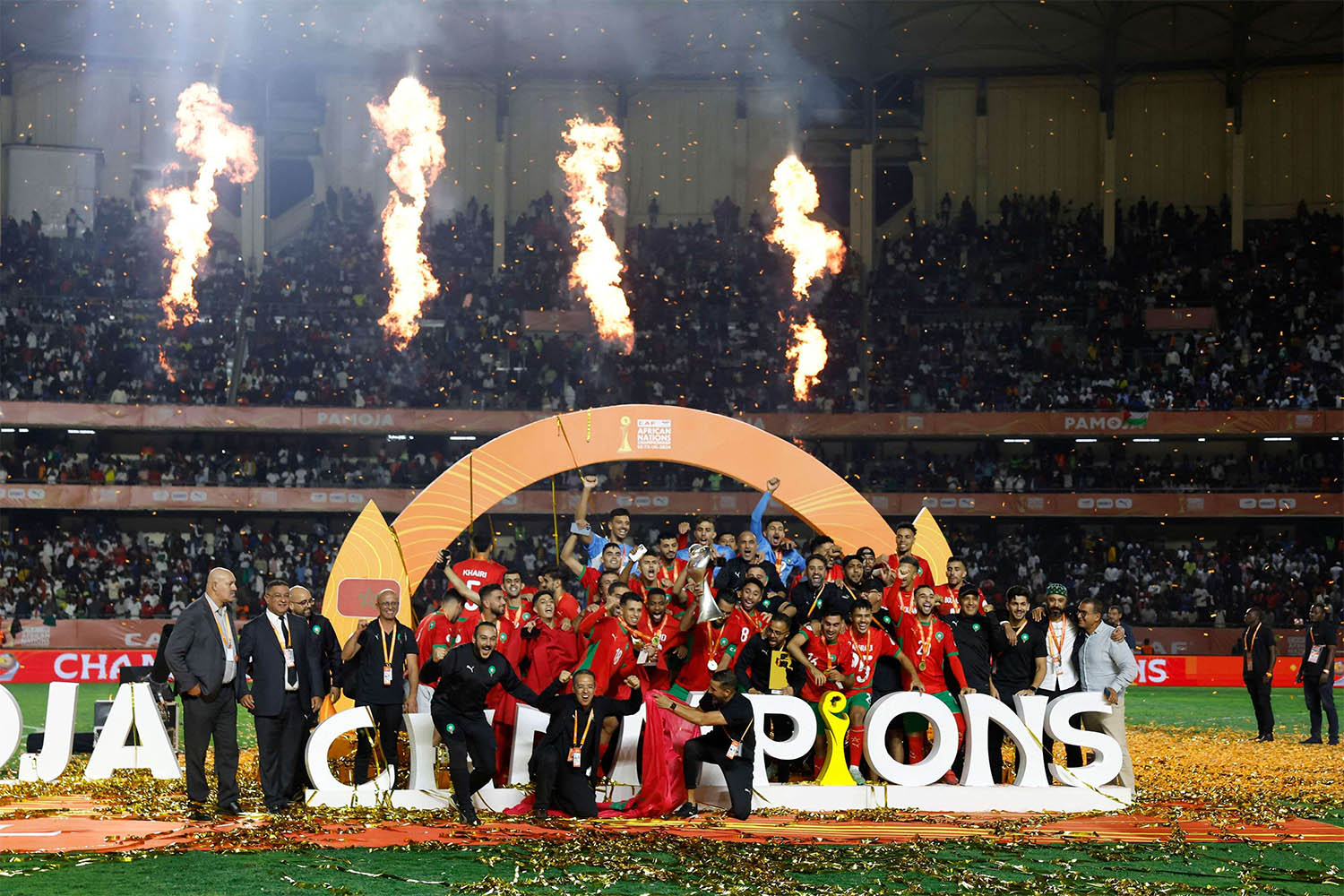
Morocco's players and team celebrate their victory at the end of the African Nations Championship (CHAN) final football match between Madagascar and Morocco
Morocco’s football victories are more than sport — they are diplomacy in motion
Over the past two decades, Morocco has done far more than nurture football talent. It has invested in world-class stadiums, academies, and training programs, turning the Kingdom into one of Africa’s premier sports hubs.
Tuesday 02/09/2025
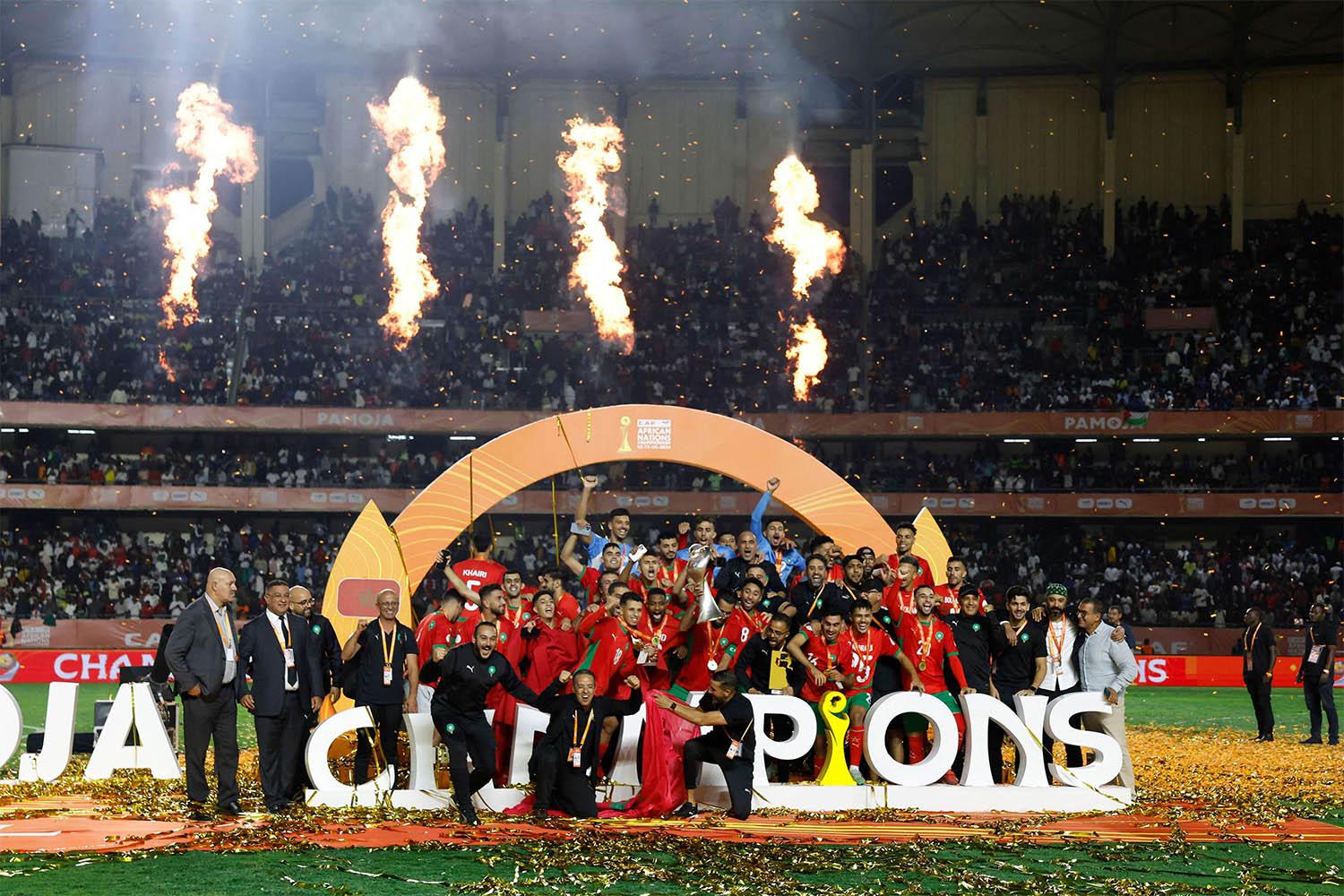
Morocco's players and team celebrate their victory at the end of the African Nations Championship (CHAN) final football match between Madagascar and Morocco
When Morocco’s national team lifted its third African Nations Championship (CHAN) title after a thrilling 3–2 win against Madagascar in Nairobi, the nation erupted in celebration. Streets from Tangier to Lagouira turned into arenas of joy, flags waving, horns blaring — not simply because Morocco had made history as the first nation to win three CHAN titles, but because this victory spoke to something much deeper.
It was a reminder that sport is no longer just a game. It is a powerful form of soft power, capable of shaping national identity, projecting international influence, and building bridges across continents. For policy-makers and strategists, Morocco’s triumph on the football pitch is a case study in how a country can convert sporting success into diplomatic currency.
Over the past two decades, Morocco has done far more than nurture football talent. It has invested in world-class stadiums, academies, and training programs, turning the Kingdom into one of Africa’s premier sports hubs. This is not by chance — it is the result of a deliberate national vision championed by His Majesty King Mohammed VI, who has long understood that sport can be a unifying force internally and a source of influence externally.
That vision is now paying dividends. Morocco’s victories are not just being celebrated at home; they are being noticed abroad. The Kingdom’s successful bid to host the 2025 Africa Cup of Nations and its role as a co-host of the 2030 FIFA World Cup are evidence that Morocco is no longer merely a participant — it is a global stage-setter. These events are international showcases, where every detail — from infrastructure to security, from fan experience to media coverage — becomes part of Morocco’s brand as a reliable, modern, and open country.
For African and international partners, Morocco’s sporting diplomacy offers a template for how to leverage football as a tool of integration. Rabat has positioned itself as a natural bridge between Africa and Europe, not just through trade and politics, but through shared passions. Every tournament it hosts becomes a platform for African youth to connect, compete, and imagine a future beyond borders — a subtle but powerful contribution to continental unity.
Policy-makers should recognize that every goal scored by Morocco’s national team carries symbolic weight. It signals confidence, ambition, and capacity. It reassures investors, attracts tourism, and strengthens Morocco’s voice in multilateral arenas. In a world where image is influence, football victories are not just sporting results — they are strategic assets.
This is why sport must be seen as an integral part of foreign policy. As Morocco prepares to welcome Africa in 2025 and the world in 2030, the stakes go beyond trophies. The Kingdom has an opportunity to consolidate its position as a regional leader, showcase its development model, and turn moments of collective joy into long-term partnerships.
Morocco’s message to the world is clear: its ambition is not only to win matches, but to win hearts, minds, and allies. For a country that has mastered the art of combining tradition with modernity, football is not just a game — it is a diplomatic handshake extended to the globe.
