

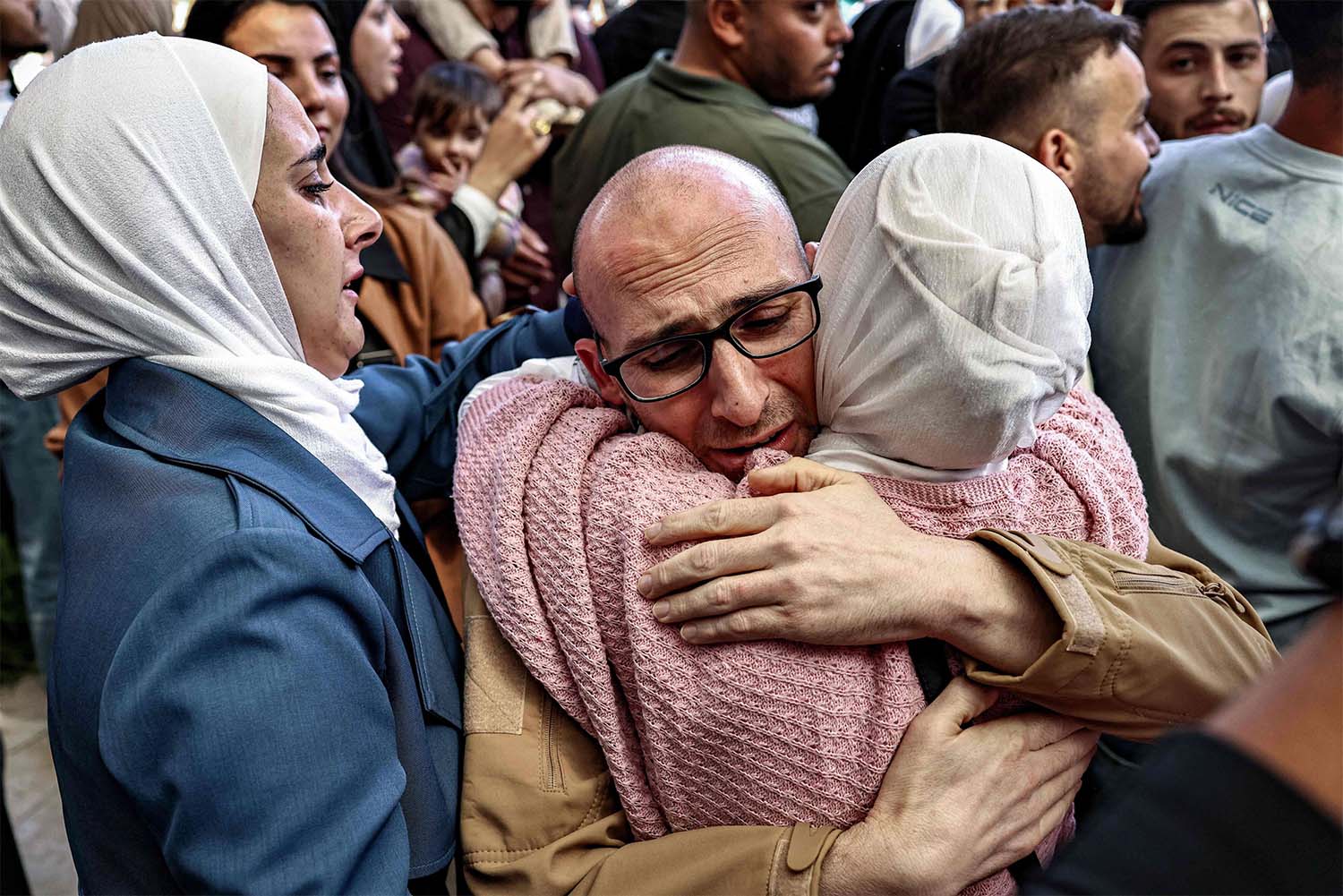
One of the Palestinian prisoners, who was released in a prisoner-hostage swap and ceasefire deal between Israel and Hamas, is embraced by a woman relative upon arrival by bus at Ramallah Cultural Centre in Ramallah
Morocco and the voice of wisdom in times of crisis: From Gaza to Jerusalem — A royal vision for a possible peace
Morocco’s call for full implementation of the ceasefire and its readiness to contribute actively to all agreed-upon stages is a clear signal: the Kingdom does not confine itself to statements, but positions itself as a proactive, credible, and responsible actor in rebuilding stability across the Middle East.
Thursday 16/10/2025
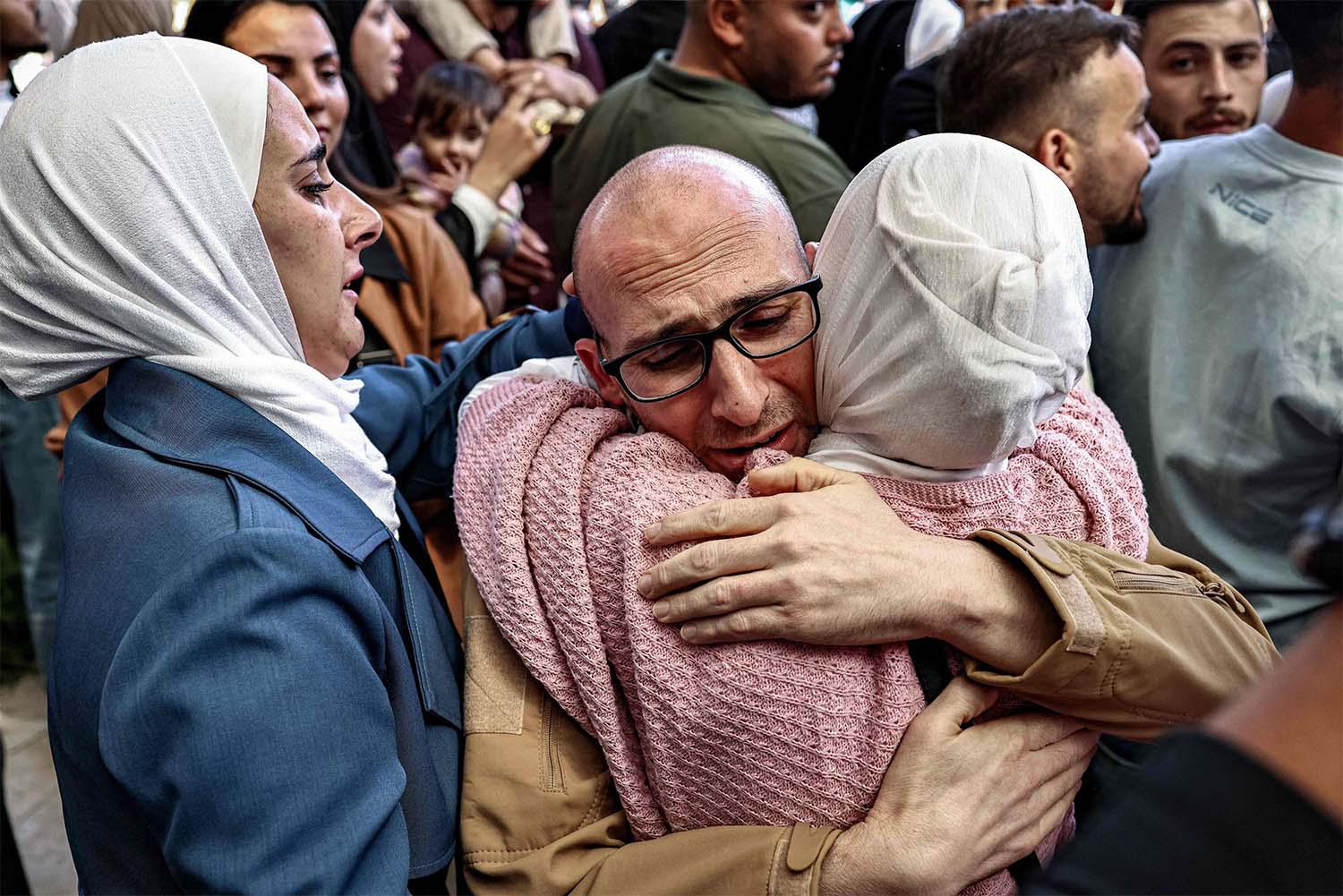
One of the Palestinian prisoners, who was released in a prisoner-hostage swap and ceasefire deal between Israel and Hamas, is embraced by a woman relative upon arrival by bus at Ramallah Cultural Centre in Ramallah
As the winds of violence and devastation sweep across the region, Morocco once again emerges as a steadfast voice of balance and reason — a nation guided by a royal vision deeply rooted in history and imbued with the values of peace, dignity, and human solidarity.
When the Kingdom of Morocco welcomed the announcement of a ceasefire in Gaza, it was far more than a conventional diplomatic gesture. It was the reflection of a strategic doctrine led by King Mohammed VI — a conviction that just and lasting peace cannot be built through rhetoric or force, but through will, wisdom, and mutual respect.
In this spirit, King Mohammed VI, in His capacity as Chairman of the Al-Quds Committee, expressed His gratitude to US President Donald Trump for his personal engagement and tireless efforts that contributed decisively to achieving the ceasefire. The royal acknowledgment was not a mere courtesy; it was a principled recognition that any initiative capable of saving lives and reopening a horizon of hope deserves appreciation and support.
Yet Morocco’s position went far beyond words of gratitude. In the midst of polarization and chaos, Rabat sought to redirect the compass toward the essence of the issue: saving lives, alleviating suffering, and restoring hope. Through a statement by the Ministry of Foreign Affairs, Morocco underscored that the immediate priority must be the protection of civilians, the swift and sufficient delivery of humanitarian aid, the release of hostages and detainees, and the initiation of a genuine reconstruction process. These are not diplomatic platitudes, but concrete steps that restore the human dimension to politics before it becomes a mere game of power.
However, the Moroccan stance also carries a deeper political vision — one that transcends the humanitarian urgency to outline the contours of a durable peace. The Kingdom, under the leadership of King Mohammed VI, sees the ceasefire not as an end in itself, but as the beginning of a longer and more complex process: the pursuit of a comprehensive and just solution based on the two-state principle. That vision calls for the establishment of an independent and sovereign Palestinian state within the June 4, 1967 borders, with East Jerusalem as its capital, living side by side with Israel in security and mutual recognition.
In a regional context marked by volatility and mistrust, Morocco stands out as a soft power of balance, investing its diplomatic credibility and historical legitimacy in building bridges where others erect walls. Rabat’s openness toward Washington’s efforts reflects a mature foreign policy that values realism over posturing and engagement over confrontation. It is an approach that views peace as a shared responsibility, not a zero-sum outcome.
Morocco’s call for full implementation of the ceasefire and its readiness to contribute actively to all agreed-upon stages is a clear signal: the Kingdom does not confine itself to statements, but positions itself as a proactive, credible, and responsible actor in rebuilding stability across the Middle East.
What sets Morocco apart is its ability to reconcile moral clarity with diplomatic pragmatism. In an era dominated by noise and polarization, Rabat reminds the world that diplomacy can still be an act of responsibility before being an instrument of power. From the Moroccan capital, King Mohammed VI renews a timeless truth: there can be no peace without justice, no justice without a Palestinian state, and no regional stability without a shared vision of humanity.
Under the wise and visionary leadership of King Mohammed VI, Morocco continues to offer the world a model of serene and constructive diplomacy — one where the voice of humanity prevails over the rhetoric of division, and where the pursuit of peace remains not a dream, but a deliberate act of will.
In times of crisis, the Kingdom’s voice resonates as a call to conscience: reminding all that the path to peace, though arduous, is still possible — and that from Rabat, the voice of wisdom does not fade; it carries across the world.
