

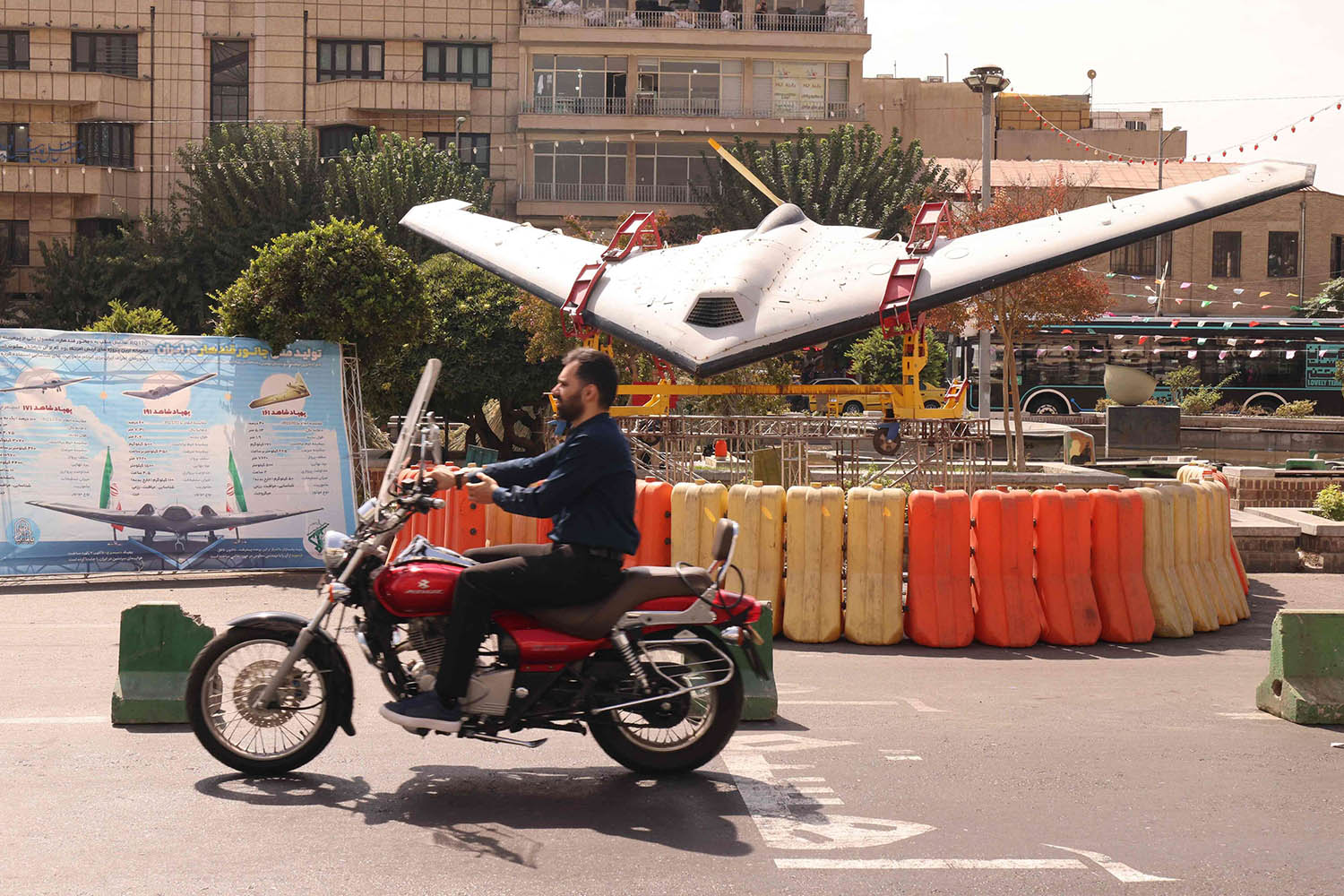
An Iranian man rides his motorcycle past a Shahed drone in Tehrans Bahrestan Square on September 27, 2025, as part of an exhibit to mark the Sacred Defense Week commemorating the 1980-88 Iran-Iraq war
War as a “Divine Blessing”
More than four decades after Khomeini called war a “divine blessing,” his successors still follow the same playbook.
Tuesday 14/10/2025
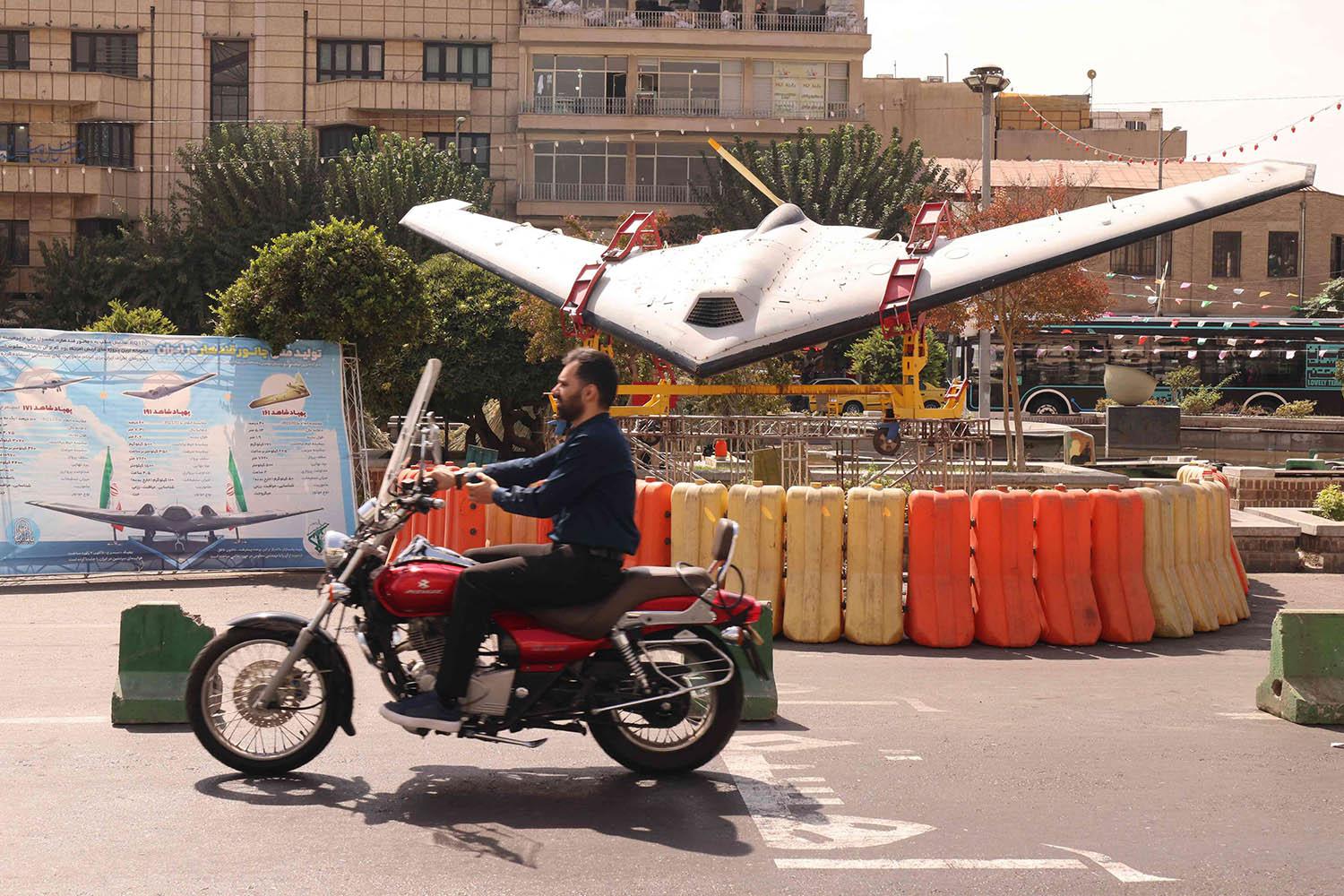
An Iranian man rides his motorcycle past a Shahed drone in Tehrans Bahrestan Square on September 27, 2025, as part of an exhibit to mark the Sacred Defense Week commemorating the 1980-88 Iran-Iraq war
Every late September marks the anniversary of one of the longest and most devastating conflicts of the 20th century: the Iran–Iraq War. Lasting eight years—from September 1980 to August 1988—it consumed millions of lives and resources before ending with no true victor. Officially, the conflict concluded with agreements reaffirming the pre-war borders between the two nations. But the issue had never been about borders. The war was, at its core, a political project driven less by geography than by ideology and the survival of a regime.
Ayatollah Ruhollah Khomeini, the founder and first Supreme Leader of the Islamic Republic, was the true instigator of this war. Only a year after the 1979 anti-monarchic revolution, he had consolidated absolute power. His new regime faced internal unrest, political opposition, and growing disillusionment among the very people who had helped topple the Shah. To preserve his theocracy, Khomeini found in war a convenient instrument of repression and control—a “divine blessing,” as he famously called it. He declared that the war would continue, “until not a single house remains standing in Tehran.”
The price was catastrophic. For Iran alone, the war produced an estimated one million dead, two million wounded or disabled, four million displaced, and damages exceeding one trillion dollars. Khomeini’s so-called “holy defense” became a machine of mass sacrifice that devoured a generation.
The road to war
Reports, of course, hold that Iraq launched the first strike on September 22, 1980, with an air attack on Iran. However, long before that, tensions had been deliberately stoked by Tehran. Immediately after taking power, Khomeini appointed an influential cleric, Mohammad-Ali Doa’i, as ambassador to Baghdad—with clear instructions to promote an “Islamic revolution” in Iraq. Iranian operatives were dispatched to infiltrate opposition groups and stir unrest. In February 1979, just weeks after returning from exile, Khomeini had already called for the creation of a “global Islamic government.” His ambition was nothing less than the export of the revolution beyond Iran’s borders.
By the spring of 1980, senior Iranian officials were openly mounting conflict with Iraq as inevitable and even desirable. Then–Defense Minister Mostafa Chamran declared in April “a line of blood divides us from Saddam Hussein,” adding “no mediation will be accepted until the complete downfall of Saddam.” Khomeini himself addressed Iraqis directly: “Obedience to this tyrant is rebellion against God.”
When war finally erupted, numerous mediators—including Yasser Arafat—tried to negotiator peace. All were rebuffed. Khomeini’s government was determined to prolong the confrontation, portraying it as an existential struggle between “Islam and infidelity.” As Prime Minister Mohammad-Ali Rajai told reporters in September 1980, “This is not a war between two nations; it is a war of belief.”
A war for survival, not victory
To understand why Khomeini clung so ferociously to the conflict, one must look inside Iran itself. The revolution had promised freedom and democracy, but the new regime swiftly replaced one autocracy with another. Competent technocrats and moderate revolutionaries were purged from government. Loyalist mullahs filled the ranks. Disillusionment spread among workers, students, and intellectuals who had hoped for change.
Universities became hotbeds of protest. In the months before the war, Masoud Rajavi, leader of the People’s Mojahedin Organization of Iran (PMOI/MEK)—a key force in overthrowing the Shah—ran for president with the backing of a broad coalition of political groups. His candidacy represented a real democratic threat to Khomeini’s monopoly on power. Years later, former president Akbar Hashemi Rafsanjani admitted: “These opposition groups posed serious dangers to us.”
The war provided Khomeini with a perfect pretext to silence dissent and militarize society. Draft calls swept through every class: workers, students, government employees—even schoolchildren. Teenagers as young as 12 were sent to the front lines, often wearing plastic “keys to paradise” around their necks, told they would ascend directly to heaven if they died. When asked about sending minors into battle, Khomeini dismissed objections: “As long as the fronts need fighters, parental consent is not required” (Jomhouri-e Eslami, Oct. 31, 1982).
The war could have ended in 1982
After nearly two years of fighting, Iranian forces retook the port city of Khorramshahr in May 1982, and Iraqi troops withdrew behind the international border. For most observers, this was the natural moment to end the war. Iraq was ready for peace. The path to negotiation lay wide open.
Yet Khomeini refused. Victory, in his mind, meant not defense but domination. The clerical leadership framed any call for peace as treason. “We shall fight until the last brick of Saddam’s palace collapses,” Iranian officials proclaimed.
That summer, the National Council of Resistance of Iran (NCRI)—a coalition of opposition forces led by Masoud Rajavi—initiated efforts to secure a lasting peace between the two nations. On January 9, 1983, Rajavi met with Iraqi Deputy Prime Minister Tariq Aziz near Paris. The meeting produced a peace declaration based on the 1975 Algiers Accord, calling for mutual recognition of sovereignty, territorial integrity, and good neighborly relations. Copies were sent to the United Nations, the Non-Aligned Movement, and the Organization of Islamic Cooperation. Iraq accepted the proposal as a foundation for negotiations. Tehran ignored it.
The human cost and the silenced dissent
As the war dragged on, public discontent in Iran deepened. Ordinary citizens saw their sons, wealth, and cities consumed by the conflict. Sporadic protests erupted, only to be crushed with violence. According to Le Matin (May 25, 1983), demonstrations against the war in the border city of Dezful led to mass arrests and the execution of thirty protesters.
Despite Khomeini’s rhetoric, Iran never came close to conquering Iraq. The regime’s military strategy relied on “human wave” assaults—mass charges of poorly armed volunteers, many of them teenagers. The results were horrific. In operations such as Valfajr, Iranian casualties were estimated at up to 100,000, half of them school students. Reporting from the Hoveyzeh marshes, Le Matin published photographs of battlefield carnage, noting “tens of thousands of Iranian soldiers were left dead in the swamps.”
Over 50,000 child soldiers perished in this way—sacrificed to sustain a war that had long lost any strategic justification. Yet Khomeini celebrated their deaths as proof of divine favor. In his New Year’s address of March 1985, he declared: “They go to the fronts seeking martyrdom. It has become sweet to their taste. They love to die for God.” (Kayhan, March 25, 1985)
"During the war, more than 50,000 students—many recruited by the Iranian regime through coercion or seducement—were killed."
From the “divine war” to permanent crisis
When Iran finally accepted a ceasefire in 1988, Khomeini compared the decision to “drinking poison.” The regime’s survival, however, depended on it. The military advances of the opposition—particularly the NCRI’s forces—had made continuation impossible. Yet even after peace, the pattern of crisis persisted. The Islamic Republic learned that external conflict could mask internal instability.
Years later, following the US invasion of Iraq in 2003, Tehran found another opportunity: filling the vacuum left by Saddam’s fall. The same regime that once failed to conquer Iraq through war now sought to dominate it through influence and proxy militias—a “hidden occupation” that extended its reach across the Middle East.
This strategy of crisis export continues today. From Syria to Yemen, and most recently in Gaza and Lebanon, Tehran’s fingerprints are visible wherever instability deepens. The regime uses confrontation abroad to suppress revolt at home. As Maryam Rajavi, president-elect of the NCRI, said on the first anniversary of Iran’s 2022 uprising:
“The world has seen a regime that hides its weakness behind wars and terrorism, behind nuclear and missile theatrics. In truth, it is sitting on a powder keg.”
More than four decades after Khomeini called war a “divine blessing,” his successors still follow the same playbook. The Iran–Iraq War was never just a battle between two countries; it was a war between a people seeking freedom and a regime desperate to survive. The price was paid not in territorial loss or gain—but in generations of Iranian lives, lost to a war that served only the ambitions of one man and the endurance of his theocracy.
