
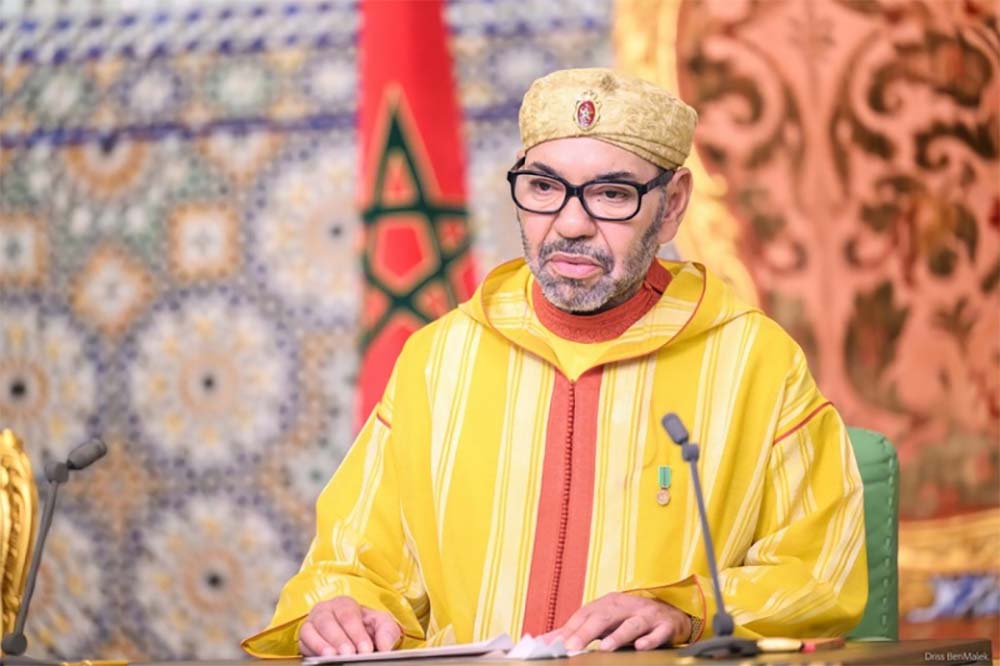
A King whose action speaks louder than words
The modesty of a victorious King
The UN Security Council resolution did not emerge from a vacuum… The King's foresighted vision was, and remains, the fundamental pillar of this dynamic, combining clarity of political vision with the steadfastness of diplomatic action.
Monday 03/11/2025

A King whose action speaks louder than words
In the address he delivered immediately after the issuance of the UN Security Council resolution concerning the Moroccan Sahara, King Mohammed VI delivered the speech of a humble King who considers the victory achieved by his country a victory for Morocco and for stability in the North African region. Hence his call to revive the Maghreb Union, which includes Morocco, Algeria, Tunisia, Libya, and Mauritania.
The Security Council, by a large majority (11 votes), adopted the Moroccan perspective based on expanded autonomy for the Sahara. By virtue of the resolution, autonomy became the "basis" for any negotiations on one hand, and enshrined the Moroccan identity of the Sahara on the other.
The resolution provided an occasion for Mohammed VI to call upon the Sahrawis in the Tindouf camps to return to Morocco and to extend an invitation to "my brother Abdelmadjid Tebboune (the Algerian President) to begin a "fraternal and sincere dialogue between Morocco and Algeria." He simultaneously affirmed that Morocco "remains committed to finding a solution with no victor and no vanquished."
Fifty years after the "Green March," which was launched on November 6, 1975, with the participation of some 350,000 Moroccans raising the Holy Quran, the Security Council recognized Moroccan sovereignty over the Saharan provinces.
At a time when the Moroccan monarch acted as a king who is above all what is related to narrow, petty politics and score-settling, the issuance of the Security Council resolution demonstrated that the Sahara issue was never anything but a fabricated issue; a dispute between Morocco and Algeria, which seeks a gate to the Atlantic Ocean at the expense of Morocco and its sovereignty over its Saharan provinces.
Fifty years after the "Green March," the Security Council recognized Moroccan sovereignty over the Saharan provinces and adopted the expanded autonomy initiative presented by Morocco in 2007. This is the vision of King Mohammed VI, which ultimately led to the new UN resolution, which not only opens the doors to closing the page on the Sahara conflict but could also establish new relations between the countries of the region, free from illusions.
The Security Council resolution did not emerge from a vacuum. The King's foresighted vision was, and remains, the fundamental pillar of this dynamic, combining clarity of political vision with the steadfastness of diplomatic action. This was embodied in the explicit and growing support for the Moroccan identity of the Sahara from more than 120 UN member states.
There is a cumulative process that began with the "Green March," planned by the late King Hassan II. Hassan II also planned for the post-colonial phase of the Sahara at a time when Spain was transitioning from a dictatorship under General Franco to a constitutional monarchy led by King Juan Carlos.
Since recovering its Saharan provinces peacefully, thanks to the "Green March," and then establishing the defensive walls that allowed for their military protection, Morocco has been able to wage all political and military battles. It succeeded to such an extent that King Mohammed VI said in his speech on Throne Day (July 30, 2025): "These positions supporting right and legitimacy inspire us with pride and push us to continue to seek a consensual solution where everyone's honour is preserved, so that there is neither victor nor vanquished."
Among other factors that played a role in revealing the naked truth is that Morocco understood early on what it means to invest in stability, rather than terrorism, across the breadth and length of the Sahel region. It did so far from the vague slogans used by the Algerian regime in the war it wages against Morocco, slogans which include the right to self-determination for peoples. If the Algerian regime were serious about securing a political entity for the Sahrawi people, spread along the strip extending from Mauritania to South Sudan, it would have established such an entity on Algerian territory where Sahrawis reside.
What matters now is to look to the future instead of remaining captive to the past and living under the complex of a Morocco that has managed to achieve huge accomplishments in all fields, including in cementing the Moroccan identity of the Sahara. The pressing question in light of the Security Council resolution is how the Algerian regime will deal with the resolution? Is there room for a positive Algerian engagement with the new Security Council resolution… or is the Algerian regime unable to accept that it has lost its proxy war against Morocco?
In the end, it cannot be ignored that Algeria no longer holds cards to blackmail Europe, including France and Spain, or African countries as was the case in the past. Since its return to the African Union, Morocco has managed to achieve breakthroughs across the entire African continent, which Mohammed VI has toured… all the way to Madagascar.
More importantly, the Algerian regime, thanks to the Sahara file, possesses an opportunity to demonstrate its ability to rehabilitate itself, at least in American eyes. It is no secret that senior Algerian officials are currently betting on better relations with the United States. This has been hinted at in meetings held by senior Algerian officials with foreign visitors. It turns out that this bet is misplaced and that what is required by the US is an Algerian understanding with Morocco, with the Sahara as its gateway. This was evident from the statements by the US envoy to the Middle East, Steve Witkoff, and by Massad Fares Boulos, President Trump’s Africa adviser, including the Sahara file. Boulos's insistence during a television interview on the phrase "Moroccan Sahara" was notable.
The new Security Council resolution is merely a translation of a broader trend towards the expansion of international recognition of Moroccan sovereignty over its Sahara and the growing support for the autonomy initiative. This is matched by a decline in recognitions of the separatist entity, which is only believed in by those who still think that the Soviet Union emerged victorious from the Cold War… that the Berlin Wall is still standing, and that Germany never unified.
Khairallah Khairallah is a London-based Lebanese writer.
This article was originally published in Al-Arab