
Thirst for power is plunging Sudan to the abyss
There is no solution in Sudan unless the two generals quit
There is no way out of the crisis without the exit of the two, for nothing but because neither of them is suitable for building a state with modern democratic institutions.
Wednesday 19/11/2025
Thirst for power is plunging Sudan to the abyss
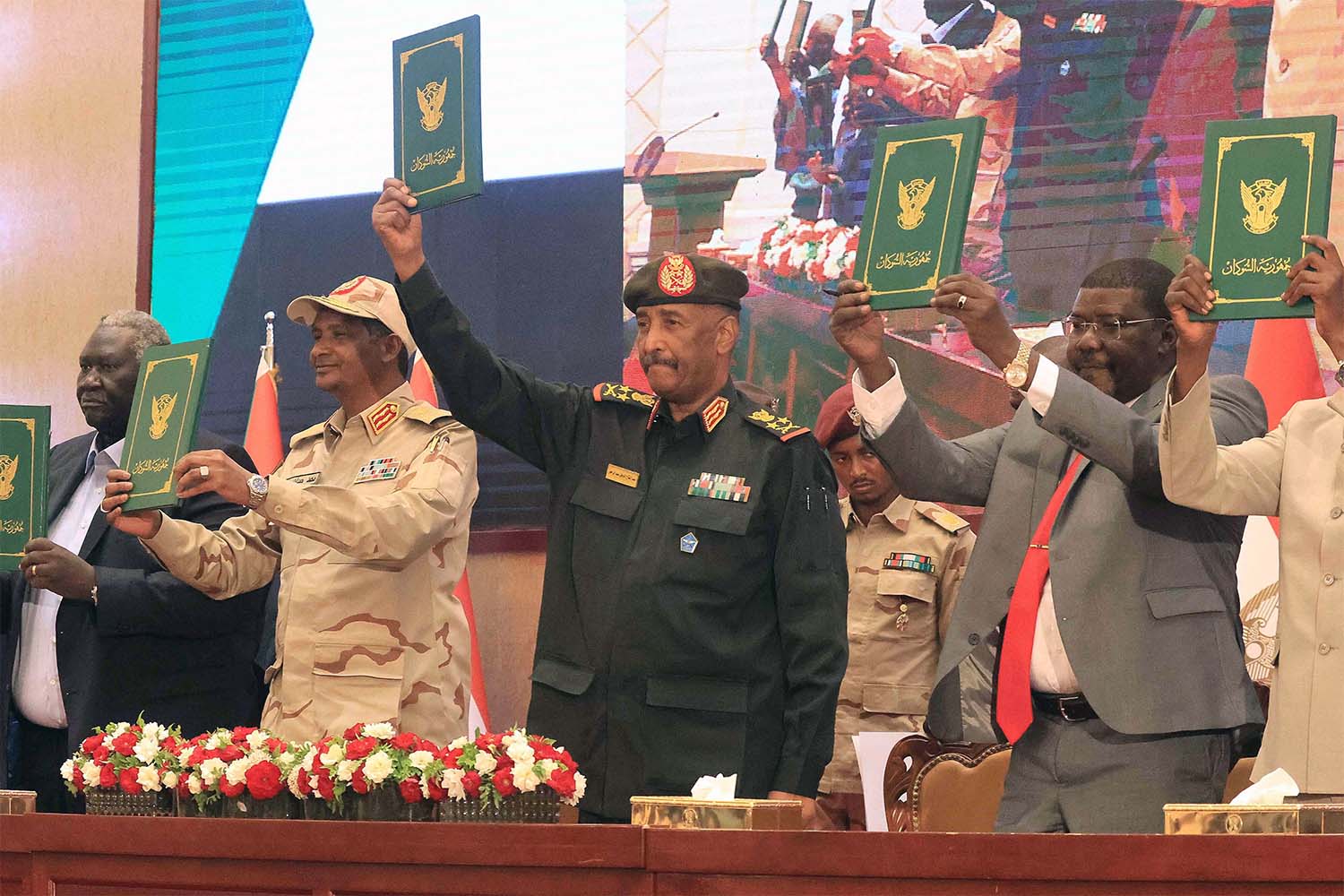
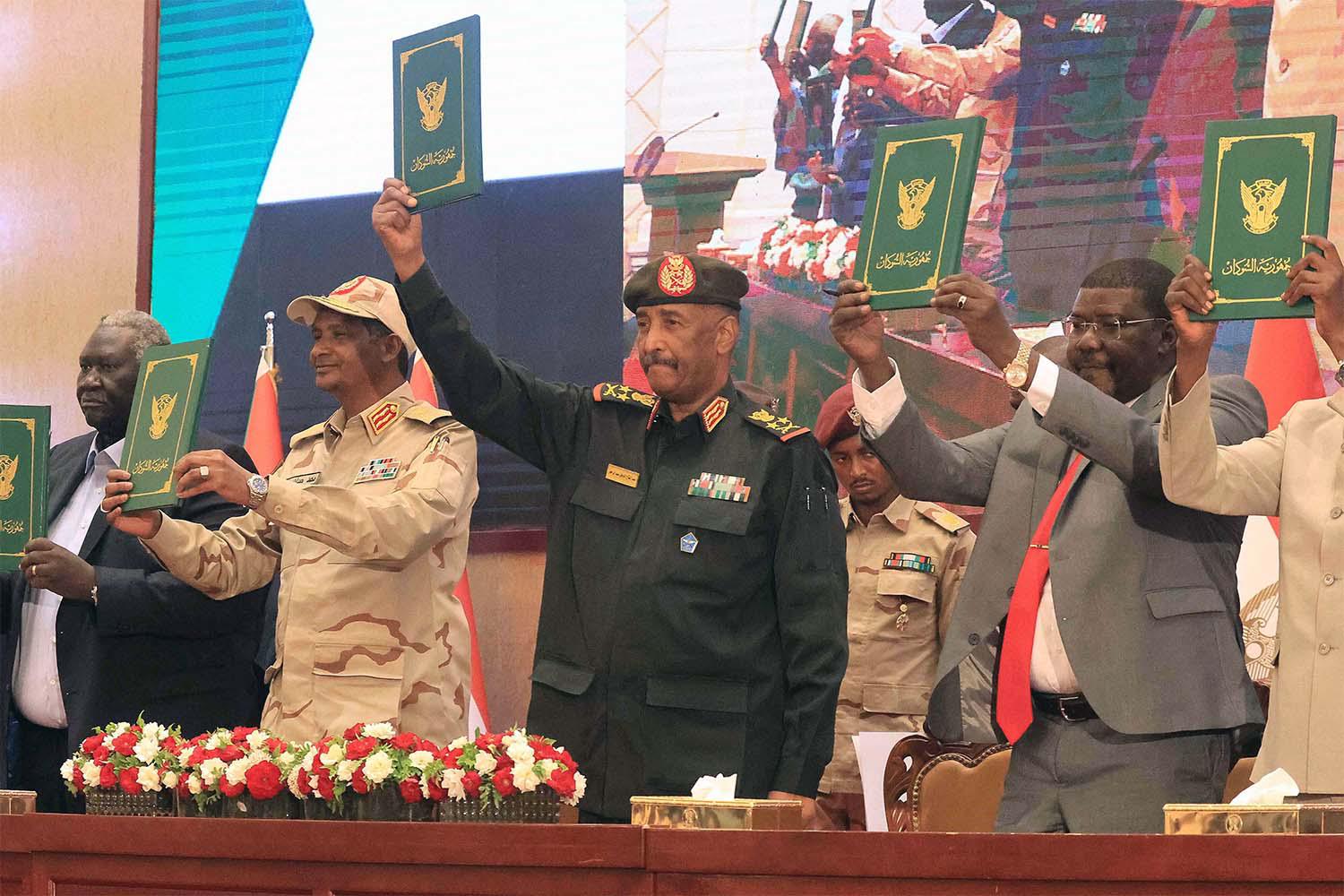
Generals Abdel Fattah al-Burhan and Mohamed Hamdan Dagalo (Hemedti) have taken Sudan into a predicament from which neither can get out. Neither general can grasp the meaning of no military solution in Sudan.
Sudan will only emerge from its crisis through a political path that distances the army from everything related to power and politics. In Sudan's recent history, the military and civilians have taken turns in power. It turned out that the military, from Ibrahim Abboud to Jaafar al-Nimeiri to Omar Hassan al-Bashir, were failures all the time. Former army officer Mohamed Swar al-Dhahab fled power because he knew that army officers were unfit to govern Sudan.
Each of these, with the exception of Swar al-Dhahab, played their part in the elimination of Sudanese state institutions. This included, of course, the acrobatics of Omar Hassan al-Bashir, a graduate of the Muslim Brotherhood school, who was prepared for anything, including dividing the country, in order to retain power.
Civilians remain the least expensive solution for Sudan. Finally, the resolution of the UN Human Rights Council in Geneva agreed with the need to seek a political solution. The Council, in support of the UAE's position, called for the formation of a transitional government that paves the way for the return of civilian political life to Sudan as an alternative to the two conflicting generals who must be removed from the Sudanese scene. Al-Burhan was quick to reject the council's decision, stressing his insistence on continuing the war on the grounds that victory over his opponent was imminent. He believes this despite his recent defeats.
All Burhan can do is pursue a war for which there is no political horizon. It relies on logic based more on stubbornness than on reality. How long has stubbornness been politics? General al-Burhan does not realize that this war will only lead to more devastation and destruction for a country that could have been the food basket of the Arab world, given its natural resources. With the current status quo continuing, it is no longer unlikely that Burhan and Hemedti will take Sudan to fragmentation...
The proof did not grasp that blaming external parties was nothing but an escape from reality. It is a fact that at the core of the current crisis is a power struggle between two generals who have each rode their heads. There is no way out of the crisis without the exit of the two, for nothing but because neither of them is suitable for building a state with modern democratic institutions.
In their own way, each aspires to repeat the experience of the officer Omar Hassan al-Bashir, who ruled Sudan between 1989 and 2019, relying mainly on the Muslim Brotherhood organization on the one hand and opportunism, in its worst kind, on the other.
Bashir knew how to exploit the Islamic theorist Dr. Hassan al-Turabi to the fullest extent and soon threw him in prison. He would have been nearly executed twice had it not been for the intervention of Ali Abdullah Saleh, the late Yemeni president who was assassinated by the Houthis in 2017. Ali Abdullah Saleh told me this during one of the sessions when I asked him about Bashir and the nature and secret of the relationship he had with him.
Not only did he avoid his execution, based on the advice of Ali Abdullah Saleh, who told him that "it is not in his interest and in the interest of him to remain in power." Bashir did not hesitate to go for the partition of Sudan. He chose partition and secession of the south when South Sudan's independence seemed to be a guarantee of the continuation of his regime. Osama bin Laden was expelled from Sudan when pressure intensified. He also handed Carlos over to France when the need arose.
It's just that the Sudanese people revolted against Bashir in 2019. This was an opportunity for al-Burhan and Hemedti to work to get rid of the man who ruled Sudan for thirty years. His only concern is to stay in power at all costs. This mentality controls the ideology of the Muslim Brotherhood throughout the Arab region. So it was not surprising that Bashir at a certain point used Iran to stabilize his regime. The Muslim Brotherhood has a rut to power, not a rut after it. This is evidenced only by Hamas's insistence on ruling Gaza, on the ruins of Gaza.
There is no difference between Bashir and both Burhan and Hemedti. He took advantage of the popular revolution, in which Sudan's women and youth participated, in order to remove the man in preparation for his trial. But the top commanders of the Sudanese army had a different agenda. They wanted to recreate Bashir's experience, but without him.
Yes, there have been horrific massacres in El Fasher perpetrated by the Rapid Support Forces. This came in response to other massacres committed by Burhan's forces during military operations aimed at expelling Hemedti's forces from all of Khartoum. From this point of view, there is no legitimacy for Hemedti and no legitimacy of any kind for al-Burhan, who from the first day of Bashir's fall refused to accept Sudan's return to civilian rule supervised by specialists who know the world from outside the Muslim Brotherhood's angle and their miserable ideology.
There is a need for a different approach to the Sudanese crisis away from settling scores with this or that Arab party, especially with the United Arab Emirates, which has done nothing but good for the Sudanese. This is evidenced by figures related to the aid through which it sought to alleviate the suffering of these people in all regions of Sudan.
The beginning of the crisis is clear in Sudan. There is no hope for either general. This is what a country like the United States is supposed to recognize. In the end, there is nothing worse than "Hemedti" other than the proof, and no worse than the proof other than "Hemedti"!
Khairallah Khairallah is a London-based Lebanese writer.
This article was originally published in Al-Arab
The views expressed are solely those of the author and may or may not reflect those of Middle East Online.