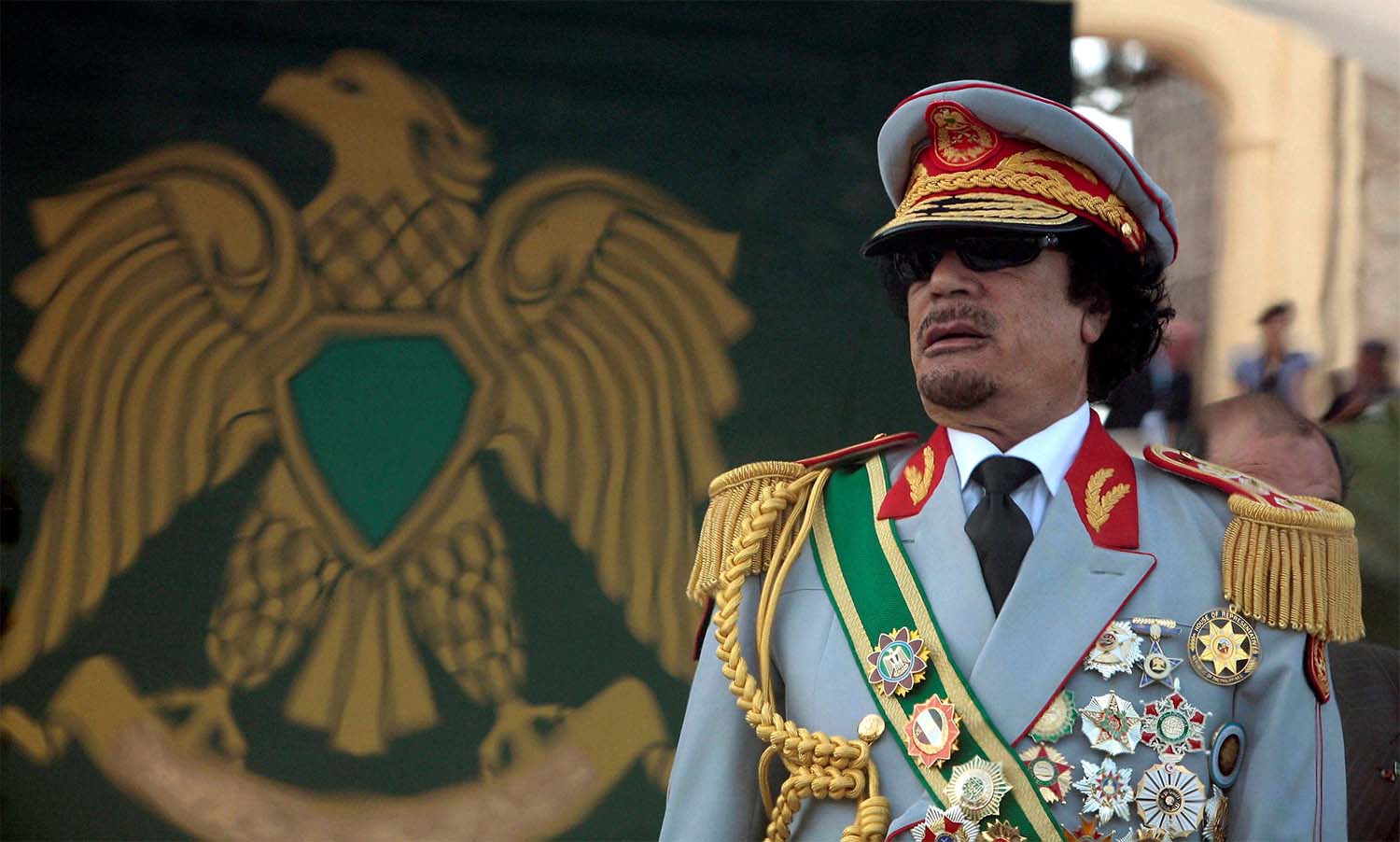
Late leader Muammar Gaddafi attends a celebration of the 40th anniversary of his coming to power at the Green Square in Tripoli September 1, 2009
Libyan Memories (3/3)
Colonel Gaddafi's heart softened at the roughness I experienced from Qaddaf al-Dam; he asked his cousin and his bodyguards to let me finish my question. His answer was very brief; he simply said, while raising his head upward: "This is an April Fool’s joke."
Thursday 05/02/2026
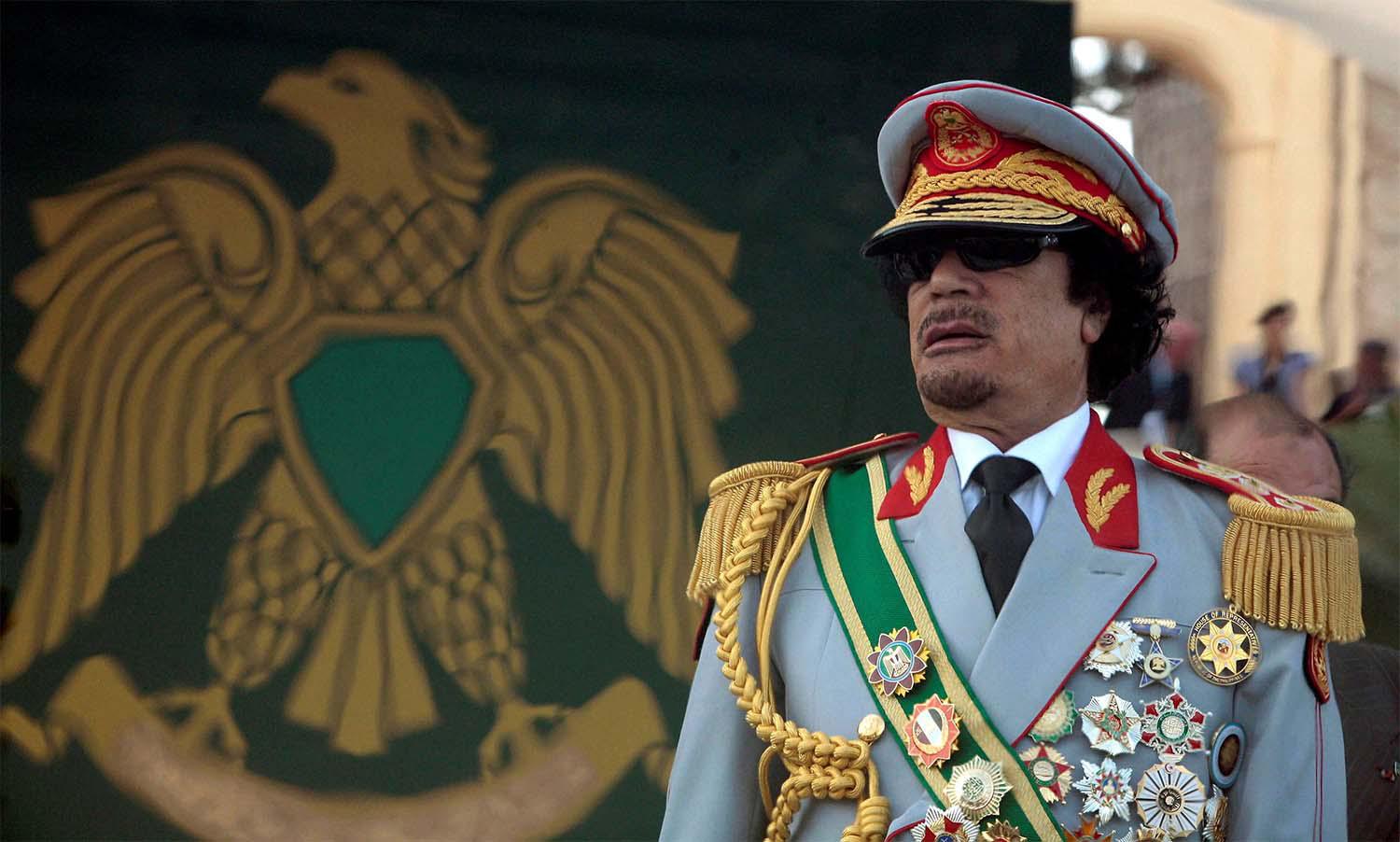
Late leader Muammar Gaddafi attends a celebration of the 40th anniversary of his coming to power at the Green Square in Tripoli September 1, 2009
I did not have the opportunity to meet senior Libyan officials during my first visit to Tripoli in 1991, let alone meet the leader of the "Great Al-Fateh Revolution," Colonel Muammar Gaddafi. I returned to my country empty-handed, having only gathered observations of the Libyan street. However, in the profession of journalism—filled as it is with surprises and paradoxes—everything remains possible. What proved impossible in Tripoli was later realized in Cairo, and at an even higher level.
In the middle of the day on April 3, 2000, I found myself face-to-face with the "King of Kings of Africa" at the headquarters of the first Afro-European Summit, hosted by the Egyptian capital. Despite the tightened security arrangements, I found myself near an open meeting hall where discussions were taking place between the Moroccan Monarch, King Mohammed VI, and Colonel Gaddafi. I was delighted to witness this historic meeting, an opportunity not always afforded to journalists.
After the meeting concluded and King Mohammed VI left the hall, I headed toward Colonel Gaddafi, full of hope to secure a statement from him. I asked him about the truth behind the news circulating at the time regarding Libyan-Israeli contacts. Before I could finish my question, Ahmed Qaddaf al-Dam, the Colonel’s cousin, violently pushed me back, preventing me from approaching the "Leader." I was so confused that I wondered whether Qaddaf al-Dam was a coordinator for Libyan-Egyptian relations or the Colonel's personal bodyguard. However, Colonel Gaddafi's heart softened at the roughness I experienced from Qaddaf al-Dam; he asked his cousin and his bodyguards to let me finish my question. His answer was very brief; he simply said, while raising his head upward: "This is an April Fool’s joke."
I was overwhelmed with joy at having snatched a statement from the Colonel, even though it did not exceed five words. That statement headlined the front page of the Asharq Al-Awsat newspaper the following day.
In the early 1980s, during one of the sessions of the Assilah International Cultural Festival, I met the Tunisian journalist Safi Saïd, who was then the Rabat correspondent for the Paris-based magazine Kull al-Arab. I was addicted to reading it, along with other Arabic magazines published abroad, such as Al-Watan Al-Arabi, Al-Majalla, and Al-Mustaqbal.
Safi's journalistic coverage and interviews fascinated me greatly, as did his wonderful book about the "Great Mujahid" Habib Bourguiba: Bourguiba: A Semi-Forbidden Biography.
A few months after we met, Safi intended to travel to the Rock of Gibraltar to conduct a journalistic investigation and interview its Chief Minister at the time, Peter Caruana, and the opposition leader, Joe Bossano. Safi wrote a magnificent report with a beautiful and provocative title: "Gibraltar: Everyone is fighting over it, and for the Arabs, only the name remains!"
On his way to Tangier from Rabat, Safi stopped in Assilah and kindly invited me to accompany him for an evening there; we stayed at the Almohad (Al-Muwahhidun) Hotel. The next day, Safi took a speedboat to Gibraltar, while I returned to Asilah. About two weeks after this meeting, my father came to me one morning to tell me that a policeman had come early asking for me. Since I was still asleep, he requested that I report to the police station when I woke up.
There, an intelligence officer received me politely and kindly, and began asking me about my relationship with Safi: How did I meet him? Did he talk to me about internal political matters? Did he give me books or magazines? I answered those questions briefly, saying that Safi was a friend I met in Assilah, that he was an accredited journalist in Morocco, that our conversation touched on ordinary matters, and that he had not given me any book or magazine.
My last answer was far from the truth, because Safi had gifted me a copy of "The Green Book" during our discussion about Libya and Gaddafi—especially since he had conducted an interview with the Colonel a few months prior. He told me how the magazine’s editorial board had censored a large part of that interview. Regarding The Green Book, he said: "I won't tell you if the book is good or bad; read it before you pass judgment on it." I did not want to inform the intelligence officer about The Green Book, believing that it might lead me into great complications.
My stay at the police station lasted less than 15 minutes. After leaving, it became clear to me that the reason for my summons was that security had noticed a student from Assilah accompanied by a foreign journalist in a hotel in Tangier. That same evening, I called Safi and told him what had happened.
He said to me: "If you want to become a journalist, you must get used to going to police stations." This made me feel a sense of pride and a wave of childish joy; my conviction grew that my appointment with journalism was inevitable.
Hatim Betioui is a London-based journalist and Secretary General of the Assilah Forum Foundation.
The views and opinions expressed in this article are those of the author and do not necessarily reflect the position of Middle East Online